
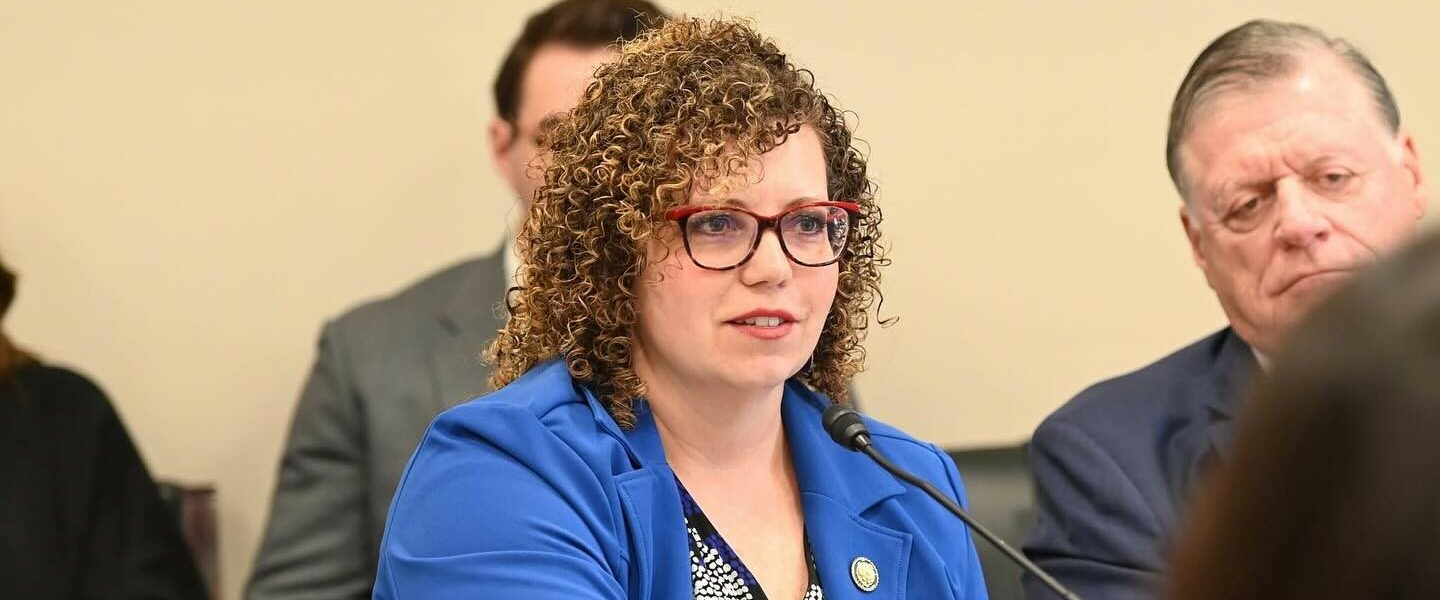
SVI Radio Interview: U.S. Rep. Celeste Maloy (R-Utah)

United States Congresswoman Celeste Maloy called into SVI Radio’s Weekday Wake-up for a discussion on public lands access and management in western states including Wyoming and Utah.
Rep. Maloy serves in Utah’s 2nd Congressional District covering western, central and southern Utah. She serves on the House Committee on Appropriations and the House Committee on Natural Resources.
(0:00) It is the weekday wake up on SVI radio. (0:03) And today our guest interview is U.S. (0:05) Congresswoman Celeste Malloy. (0:07) Celeste is a Republican serving in Utah’s second congressional district, which (0:10) covers Western Central, Southern Utah.
(0:13) Uh, representative Malloy serves on the house committee and appropriations of the (0:16) house committee on natural resources. (0:18) And in full disclosure, she’s also my cousin, first cousin. (0:22) So cousins representative Malloy, good morning.
(0:25) How are you today? (0:27) Good morning. (0:28) Thanks for inviting me on your show. (0:30) We’ve been cousins our whole lives, but you never wanted to interview me until I (0:33) got elected to Congress.
(0:34) You know, that’s fair. (0:35) I guess that’s fair. (0:37) And to be, and to make it even worse, it wasn’t until we had a lot of (0:40) encouragement from your aunt and uncle, my mom and dad to, to really make this (0:44) happen too.
(0:45) So yeah, here we go. (0:46) But actually a number of what (0:47) The lengths I have to go to get attention from my family members. (0:52) That’s right.
(0:53) Well, a number of reasons I wanted to have you on the show today, uh, with (0:57) everything happening in DC and just, you know, a couple of things that we could (1:00) talk about today, of course. (1:02) Um, but a lot of public land stuff, right. (1:05) And, and I I’d like to have you give our listeners, since there may not be as (1:10) familiar with you and who you are since you serve in Southern Utah, uh, give us (1:14) your background with public lands, because you’ve been dealing with public land (1:17) access and fighting for public land access rights for a long time before you (1:21) took office.
(1:22) I have, um, I have an agriculture degree from Southern Utah (1:26) University. (1:28) I started off my career working with farmers and ranchers, but I was (1:32) working with them from the USDA side. (1:35) I was with the natural resources conservation service and I helped design (1:40) conservation plans for private land owners, but in South central Utah, where (1:46) I’ve spent my life, they, they don’t have a lot of private land.
(1:51) And so most of the ag producers in this area are dealing with federal land. (1:56) And because of what I was doing, I just naturally was also (2:00) involved in federal land policy. (2:03) And so both of us from Western states, we know that federal land policy doesn’t (2:07) always make sense for ranchers or even hunters, campers, hikers, it’s supposed (2:14) to be managed for multiple use, but sometimes it feels like the (2:17) users are getting pushed off.
(2:20) And so after about a decade of doing conservation plans, I got (2:26) frustrated with policy and decided to go to law school. (2:28) I didn’t really know how to change policy, but I thought a (2:31) law degree would probably help. (2:34) And after law school, I ended up in Southern Utah in St. (2:38) George as a deputy county attorney, working on land issues and land (2:42) access in some of the most landlocked towns in the West where, you know, (2:49) St. (2:49) George has been one of the fastest growing towns in America off and (2:52) on for the last 20 years, but they’re surrounded by federal land.
(2:57) And so every decision they’re making requires federal processes (3:01) and dealing with federal agencies. (3:03) And that’s what I did for them. (3:06) And because I was working federal issues, I started meeting (3:11) federal elected officials.
(3:12) I’d never met a Congressman until then. (3:14) I met Chris Stewart, who was my Congressman at the time and the (3:18) rest of the Utah delegation. (3:22) And through that work, I got to know them really well.
(3:25) Chris Stewart offered me a job a few years later. (3:28) I worked for him for four years and then his wife had a stroke and was (3:33) having some severe health problems. (3:34) And he resigned to take care of his wife, encouraged me to run, which is the (3:39) craziest thing I’ve ever done in my life.
(3:41) I ran for Congress. (3:42) I won in a special election a year and a half ago. (3:46) And now then I had to run for reelection.
(3:48) I’m in my first term. (3:49) So I’ve been in Congress for about a year and a half. (3:52) So regardless, I guess, to summarize all that, you’ve really kind of seen and done (3:57) it all when it comes to public land and multiple use and working with all the (4:01) different agencies involved in.
(4:03) Yeah, I’ve done it from the local level, the state level, the county level, the (4:08) federal level, and it’s not working well at any of those levels. (4:13) So, so let me ask you this then. (4:15) Here in Western Wyoming, it’s very similar as you described to Central Utah.
(4:18) A lot of BLM, a lot of Forest Service, a very, of course, outdoor recreation is big (4:23) here, just as it is in Southern Utah. (4:25) Energy production, extremely huge, as you know, across Wyoming and Utah. (4:30) So from a congressional standpoint, what do you see is the biggest issue when it (4:35) comes to public land management in the United States? (4:40) The biggest issue is access.
(4:44) And that wraps in a lot of other issues like permitting and red tape and (4:49) bureaucracy, and even just the ideological tug and pull between different (4:55) groups, but everything with public land has to do with access. (5:00) It’s, can you access for drilling? (5:02) Do you have access for recreation? (5:04) Do you have access for grazing? (5:07) And there are groups who would like to see some groups have more access (5:11) and other groups have less access. (5:13) And then there are politicians that are all along that spectrum as well.
(5:18) And in order to get anything done at the federal level, you have to have a lot of (5:21) politicians buy into the same idea, which if you follow politics is getting tougher (5:26) and tougher to do. (5:27) And especially on issues that really only affect about 11 states in the West. (5:32) And the biggest impacts are felt in about half of those states.
(5:37) U.S. (5:37) Representative Celeste Malloy out of Southern Utah joining me today here on the (5:41) Weekday Wake-Up. (5:42) So when you talk about access, one of the things that comes up, and it’s something (5:47) I’ve discussed at length with our own Representative Harriet Hageman at times. (5:51) And from your state in Utah, Senator Mike Lee, with the big, beautiful bill, had a (5:56) proposal to sell off public lands.
(5:58) And boy, was there a discussion on that, right? (6:01) And so from your take on it, kind of what do you think happened there? (6:06) What was the original proposal? (6:07) Did it get skewed at all? (6:10) What’s your overall thoughts? (6:12) Oh, it absolutely got skewed. (6:14) So to give you a little background on this, I probably started it on the House side. (6:20) Mark Amadei from Nevada and I introduced an amendment that targeted specific lands in (6:27) Nevada and in my district in Utah for sale.
(6:30) I had about 10,000 acres, all of it nominated by local elected officials that was (6:37) needed for infrastructure in my district. (6:40) So expanding the airport in St. (6:42) George, some roads, some trails, some water infrastructure projects. (6:47) And because of how the process went with reconciliation, which is the one big, (6:52) beautiful bill, in the Natural Resources Committee markup for the one big, beautiful (6:58) bill, it went for about 17 hours.
(7:01) We ended up offering the amendment at like one o’clock in the morning and (7:04) immediately Democrats lost their minds. (7:07) This is a midnight amendment. (7:09) We didn’t have time to get ready for it.
(7:11) Why are you doing it sneaky in the middle of the night? (7:13) And we hadn’t had time to do a lot of prep work to let everybody know what was (7:17) coming. But I went to work, I met with all the conservation groups, I explained (7:21) what I was doing. But the narrative that immediately took off is they’re selling (7:26) off these gems, you know, the national parks, pristine hunting lands, blue ribbon (7:32) fisheries, and none of that was ever true.
(7:35) Um, but I think groups that want to see less access knew that in a second Trump (7:43) administration, somebody was going to try to do something with public land and they (7:48) were ready. They had money, they were organized, they had messaging, and they (7:52) were pretty effective. (7:53) I worked really hard to tamp it down, to show my track record of legislation that (8:00) protects access, protects land.
(8:03) Um, but then when the bill went to the Senate side, Oh, sorry. (8:08) First, our language got stripped out. (8:10) It didn’t ever make it into the final house version.
(8:13) When it made it to the Senate side, Senator Lee, who is the chair of energy and (8:17) natural resources on the Senate side, offered an amendment that was a little less (8:23) precise than ours. (8:24) It called for selling off one half of a percent. (8:28) So 0.5% of federal land adjacent to cities nominated by local governments for specific (8:40) purposes.
(8:41) But the immediate narrative was they’re trying to sell off national parks, blue (8:47) ribbon fisheries, pristine hunting grounds. (8:49) And that narrative caught on really well. (8:51) And even really conservative people in really red Utah started calling my office (8:57) really angry about selling off public land.
(9:02) So Celeste is, uh, sorry, Congresswoman Malloy. (9:07) I got to get used to that being my cousin, right? (9:08) Uh, you can call me by my name. (9:12) Well, so I appreciate the background on that.
(9:14) We could, we could of course talk, uh, much, much more in length about many more (9:17) other items. (9:18) And, uh, so, so with that in mind, what do you think is the answer to retaining open (9:25) access and multiple use for the public lands across places like Wyoming and Utah, (9:31) while at the same time being able to find uses for those types of parcels that you (9:35) described? (9:37) I think we’re going to have to do a lot of the work before there’s any legislation. (9:42) We’ve got to bring people along before we introduce anything in Congress, which is (9:47) normally my style anyway.
(9:49) Um, you know, some of the hunting groups that were upset about our amendments would (9:54) actually be shocked to know that the maps they were sharing came from the wilderness (9:58) society, the wilderness society, not big fans of hunting. (10:01) So if we do the legwork ahead of time, build coalitions, make sure people understand (10:07) what we’re actually doing. (10:08) I think we can move the needle on some of these access issues, but we have to have (10:13) people read in and bought in far enough in advance that they don’t believe everything (10:18) they see on social media.
(10:20) That’s a U.S. (10:21) Congresswoman Celeste Malloy out of Utah’s second congressional district. (10:25) Celeste, I know we had a whole bunch of items we could have talked about today, so (10:29) maybe we’ll have to schedule, darn it, we’ll have to schedule another time, I guess, (10:33) to have you on the show to give your take on some things. (10:35) Yeah, I will come back and tell you all how great Harriet Hageman is because we (10:39) served together on natural resources when I’ve traveled with her.
(10:42) U.S. (10:42) Congresswoman Celeste Malloy this morning on the weekday wake up. (10:45) Celeste, thank you for your time. (10:46) Let’s do it again.
(10:49) Seriously, I will do it again. (10:50) All right. (10:50) This is fun.
(10:51) You bet. (10:51) It’s the weekday wake up on SBI radio.
1 COMMENTS
Comments are closed.