SVI Radio Interview: Rep. Scott Heiner (R-Green River) – Legislative Report

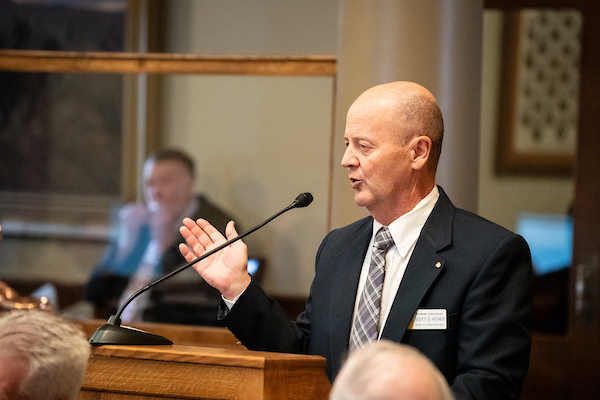
Representative Scott Heiner (R-Green River) from House District 18 in southern Lincoln County called into the Weekday Wake-Up on Monday, March 2 with a legislative report from Cheyenne. Rep. Heiner discussed the current status of the budget, school recalibration and highlighted a few other pieces of legislation.
(0:01) 743 is our time this morning on SWIFT 98 and the SPUR. A quick legislative report (0:06) this morning from Representative Scott Heiner, House District 18, which does (0:10) cover southern Lincoln County. Good morning, Representative Heiner.
It’s, man, (0:14) been a sprint since day one of the session, it seems like, this year and (0:19) coming down to what, a week and a half left, correct? Yes, Duke, this is (0:24) our short session. We only have 20 days that we’ll be in session and we’re (0:28) finished up with the third week, so we got one more week to go and then we have (0:34) a couple of days off and coming back next Wednesday, a week from this (0:37) Wednesday, just for veto overrides, if there are any. Yeah.
So it’s been pretty (0:43) pretty busy. The budget has taken up a majority of that time, but we should be (0:49) signing the budget today. Both chambers, we’ve agreed upon a budget and so we’re (0:55) off to the races here.
Well, I’m glad you brought that up. I wanted to start right (0:59) there. Of course, you were part of the Joint Conference Committee, which (1:02) met last week, and it looks like you may be finalizing that today.
Give us some of (1:06) the highlights in the budget as it stands now, after the Joint Conference (1:10) Committee meetings. Okay, so the budget, we run mirror bills, one in each (1:16) chamber, one in the Senate, and one in the House, and then we come together and work (1:20) out our differences. So once it went through each chamber, we had about a (1:24) $170 million difference between the Senate and the House budgets.
And then (1:28) Joint Conference Committee is appointed to work out those differences. It’s five (1:33) members from each each chamber, and we were able to work out those differences. (1:38) And so ultimately, we have now we have a budget.
We’re going to vote on it this (1:43) morning, and it’s about $140 million below what the governor requested. Of (1:49) course, the Senate came in a little higher than what the governor wanted. Had (1:53) asked, they actually added more money to it.
But ultimately, we resolved those (1:59) differences and came in a little bit below what the governor requested. So (2:04) universe, some of the key points, University of Wyoming funding has all (2:07) been restored. But there’s a caveat there, that in order to get this, all (2:12) this money, they have to identify some efficiencies, they’re going to do a (2:16) little bit of efficiency in cost savings study, and come up with identify (2:23) $5 million of savings.
And that’s in courses that are have low enrollment, (2:29) like two or three people that are enrolled in a course, you know, it’s not (2:33) very popular. And hopefully, we can teach those out and then not renew them. (2:39) Also, administration, they’ve got you when you compare our university to some (2:43) other universities, we have more administration load.
And so let them find (2:48) ways to reduce some of the costs and all the funding will be restored to them. (2:54) Public Media has been funded as at historic levels, all state employees will (3:01) be given raises to bring them up to the 2024 market rate for for their salary. (3:08) And the Wyoming Business Council has been funded for one year while we do a (3:12) deep dive into their organization and see if we can come up with a way that (3:16) they can be more effective.
And everyone has agreed that there’s there needs to (3:21) be a kind of a change of focus there. Even the governor has said that, you (3:26) know, it’s it needs to be refocused and so that it actually helps our economy (3:32) grow a lot better than what it has in the past. So I think those are the four (3:37) points that people have been really concerned about.
And we have been able to (3:40) address those. And this is a good budget. It’s, it’s one that I think will (3:44) pass both chambers today and the governor.
Hopefully we’ll we’ll sign it (3:49) and we’ll go forward. (3:51) All right. That’s Representative Scott Heider this morning on the weekday (3:54) wake up representative, what other pieces of legislation would you like to (3:57) highlight today? (3:59) So one of the other couple of the other things that are going through our (4:02) parental rights bill, and K through 12 literacy bill as well as a bill to (4:07) remove sexually explicit books from our school libraries, not remove but move (4:12) them to an adult section rather than in the child section.
So when when this (4:17) bill came through the the bringer of the bill, the prime sponsor started (4:21) reading some of these books that are in our grade school libraries. And that (4:26) person got called for point of point of order because it was too graphic for (4:31) the floor here at the house. So you know, it gives us an idea of what is (4:37) actually there, and how how we need to protect our children, let them be kids, (4:41) let them play in the dirt, don’t, don’t introduce them too soon to some of this (4:46) explicitly sexual graphic material that is out there.
The other thing, Duke, I (4:52) wanted to highlight is, is direct distribution increases we we ever since (4:58) we got rid of the sales tax on food 20 years ago, we’ve been making that up to (5:04) the counties and towns and municipalities. But we increased that by (5:10) about 50% this year over what the governor recommendation was, and changed (5:15) it to be more stable. And that is a way for backfill for the property tax relief (5:21) that was passed last year, we, we, you know, we tried to get backfill for (5:25) special districts and towns last year.
And we were shut down when the Senate (5:30) killed that bill. So this year, we got that done. That $42 million extra will be (5:36) going to the towns and communities and special districts to make up for the (5:41) lower property tax that our citizens are paying.
So that was our intent all (5:46) along. And we got it done this year to help those, especially the special (5:50) districts that got hit the hardest. (5:53) Representative Scott Heiner, House District 18 this morning on the weekday (5:55) wake up representative really appreciate up the appreciate the update your time (6:00) anything else you want to mention? (6:01) It’s been a it’s been a long three, four weeks, but hopefully we’ve done (6:06) things that’s going to actually help the state.
I know that a lot of people (6:09) have been concerned about some of the things we’ve been doing here (6:13) recalibration, I think we’ve come to a consensus on recalibration that (6:18) everybody is most everyone is agreeing upon. The process of making laws is a (6:25) long process. And when you see the first piece, as it goes into this meat (6:29) grinder, it gets changed, gets changed a lot.
So because of the public input (6:35) and and all the input from the various organizations, that bill has changed (6:40) dramatically. And hopefully it will be recognized as something that’s going to (6:45) improve our our education system throughout the state. It right now it (6:51) adds $125 million a year to education.
(6:55) Representative, thank you so much. I appreciate the update. We’ll be in touch.
(6:59) All right. Thank you so much. (7:00) You bet.
It’s all part of the weekday wake up this morning on SVI radio.