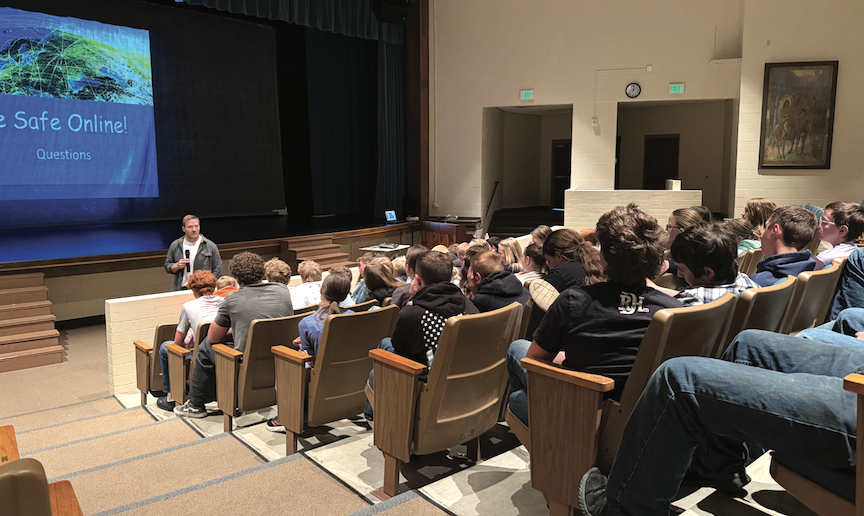
• Richards talks digital footprint and online safety
Dustin Richards, a special agent for the Teton County Sheriff’s Office shared insights about digital citizenship, digital footprints, online predators and held a question and answer session with 7th-12th graders at Cokeville High School Monday March, 23 2026.
Richards has been with the Teton County Sheriff’s Office since 2016 and was working with the Internet Crimes Against Child (ICAC) for five years but recently became a special agent for the state of Wyoming in January of this year.
“You don’t know how something you do online will affect someone,” Richards said as he spoke to students about digital citizenship/leadership. He had the audience think about how they use technology, how they treat others online, how they use the “like/share” buttons, the snaps they send and the stories they post. During this part of the presentation, he briefly shared a story about a young girl that committed suicide due to social media interactions and encouraged the students to only be positive.
When one is online a digital footprint is left, like walking on a muddy path. Richards informed students that everything they do can/will create a “footprint”: social media, texting, uploads of videos or photos, comments, web searches, visiting websites and purchasing items. He also talked about being careful what one posts and when posts are made; it can give a predator easy access to where one is, what they plan to do or if a home is left unattended.
Richards shared that one might think they know who is going to be seeing what they are doing/posting but shocked some by sharing a list of who could be looking at your stuff, even if it might be in future. He started with the more obvious, parents, teachers, coaches and family. He then shared a story about college students getting rejected and kicked out of school because of posts they had made or simply shared; potential colleges are watching. Potential employers are also able to access profiles to see what kind of person they are looking to hire. Strangers and online predators are aware of what one is doing online.
“Secure your three P’s: passwords, personal information and privacy,” Richards explained as he displayed a slide with the three P’s and additionally information about each one. He also included that when one does these things it also protects their name, their identity and their reputation.
Sextortion was explained to the students; financial sextortion is a scam. People will do anything for money, and most will still carry out the threats made even if they receive money. Richards explained if it does happen; stop responding, take screenshots, don’t send money, don’t send more images, report and block the user and tell someone,
In July 2017 W.S. 6-4-305 “Dissemination of Possession of a nude image of a minor by a minor” was effective. Richards broke the law down more for students to understand. He shared that distributing a nude image of oneself or another minor, possessing a nude image of another minor, distributing or threatening to share a nude image of a minor and capturing a nude image of another minor without knowledge of the depicted minor are all violations of the law.
If one is caught and charged with breaking this law, charges vary is severity first to third degree.
After explaining the law, Richards went on to a much more serious topic: online predators. He explained that online predators as the following: tricky, flirty, flattering, will ask one to keep secrets, use videos/photos of oneself against victims, they will ask questions about adult subjects and sex.
He warned that, “People are not always who they say they are.” You never know.” He proceeded to talk about some of his cases where he was undercover online interacting with predators.
“Phones are todays playgrounds for predators,” refereeing to how predators use to stalk and kidnap children from parks and playgrounds. He also mentioned how there are more predators in Wyoming than people think and how they are closer than one would think. He shared that he has 12 active cases right now and there are 10 agents in Wyoming, some cases are in Lincoln County. He shared a video based on a real incident showing a girl chatting with a guy online and how he wanted pictures and videos and then after she sent them, he started threatening to her that he would share the files with her family and others if she didn’t pay him or send more.
After much discussion about predators Richards shared what one can do if they are approached by an online predator: do not engage in the conversation, block the individual, don’t meet offline, don’t send money or more images, tell a trusted adult or use online National Center for Missing and Exploited Children tipline (cybertipline.org).
In his conclusion he reminded the audience that “what you upload, send or webcam to a person on the internet could potentially be there forever.” He encouraged the students to remember “as a rule of thumb: if you wouldn’t send it to your parents, don’t send it to anyone else.”
After his conclusion, he opened a question-and-answer session. Many questions were asked by students and staff. One question was about what happens at the end of a case when a predator is caught; Richards explained that the law will have to take care of the predator, but the agency will help the victims get the help they need and help them to realize they are not victims anymore.
The assembly was originally scheduled for just over an hour but ended up being just over a hour and a half due to the interaction of the students/staff with Richards. Upon being released from the assembly there was still talk of what Richards covered in the halls and in classes, according to CHS staff.