Fighting the Willow Creek Fire requires team training and experience

SVI PHOTO/ DAN DOCKSTADER
Daily organizational meetings were key to the increased containment percentages on the 4,066 acre Willow Creek Fire south of Star Valley in the past two weeks.
Management of the fire came under the direction of a trained fire fighting team, known as Nevada Team 2. They come from their home communities throughout the nation where they have extensively trained in the offseason and then fulfill their assignments as a team in summer months.
Past assignments have included various locations in the western states, Florida, Canada and Mexico. This time it was the Willow Creek Fire south of Star Valley in the Bridger-Teton National Forest.
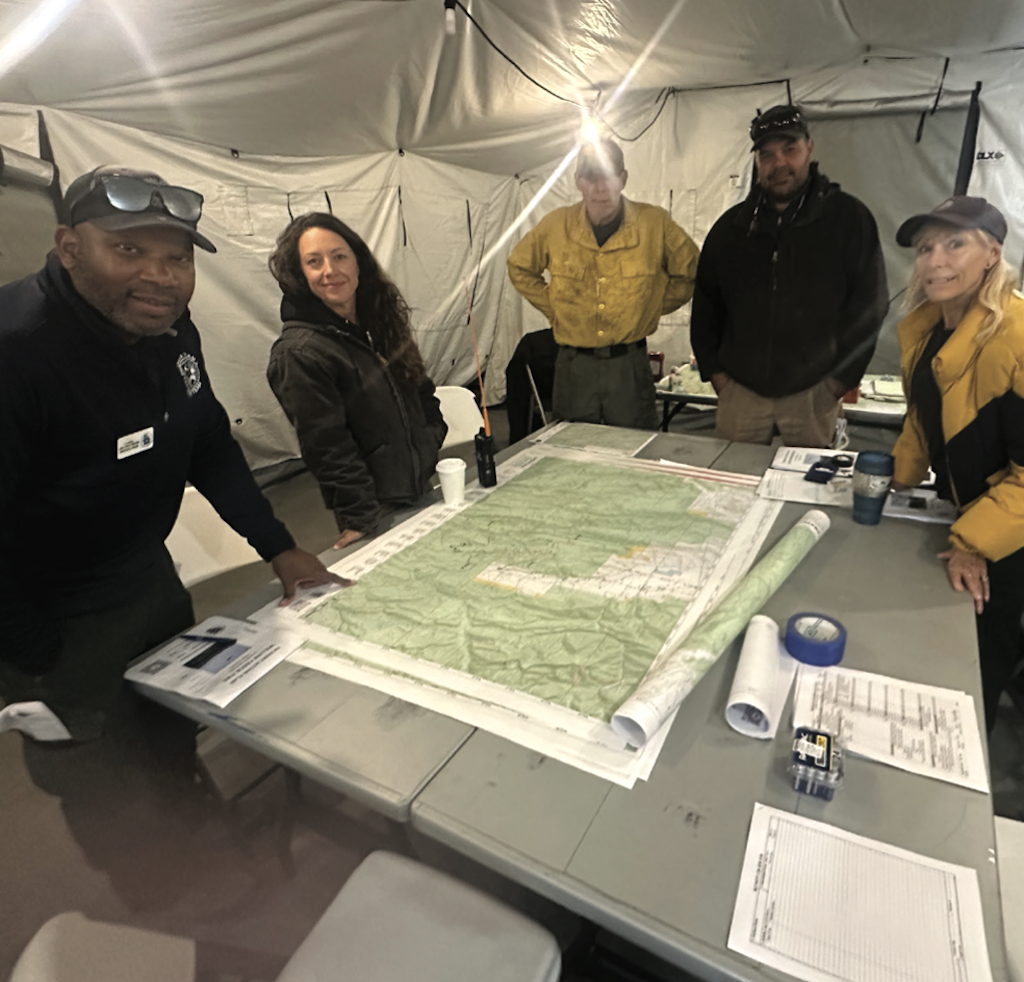
Incident Commander Brian Kitchen oversees a management team that includes Jay Berte with operations, Cy McCullough and Jamie Streinik covering the field operations and Beth Young, information officer.
In the early stages of the fire, they were overseeing the work of over 400 firefighters who had assembled at the scene.
“They come from the Bureau of Land Management and Forest Service,” Sreinik said of the firefighters. “All of them come from their home units and have day jobs.”
She added, “We also have contractors and contract companies that have firefighters.” They all come together as a team.
That team was initially assisted by a local team from the Bridger-Teton Forest, the Afton Fire Department, and the Lincoln County Sheriff’s Office.
When the team arrives they coordinate the attack under the incident commander.
“We get directions from the IC,” McClullogh explained. “We look at the fire behavior, the topography, where we can put crews and the resources that are threatened and we come up with a plan. Sometimes we agree, sometimes we disagree, but we always come up with a good plan. “
That plan includes the logistics of a detailed camp. The camp for Willow Creek was based at the parking area commonly used for ATV and snowmobile recreational parking just above the intersection of the Smiths Fork Road and U.S. Highway 89. The main logistics center, with headquarter tents, computers, radios, maps, food and bathrooms, was located at the parking site with firefighters camped in groups of individual sites throughout the Smith’s Fork area.
“We have all of the pieces that support the operation,” Streinik said of the team maintaining the main base camp. “They literally support the firefighters.”
She continued, “They help us with the plans and there are the logistics that help support us with all the supplies, and the finances so everyone gets paid. They help make sure the operations can happen, so we can get the fire put out.”
The planning and execution continues on a daily basis for the fire fighting team.
The team goes through extensive training in the winter months to prepare for main summer fighting events.
For the main, events, firefighters are divided further into small groups with specific assignments from Incident Command center.
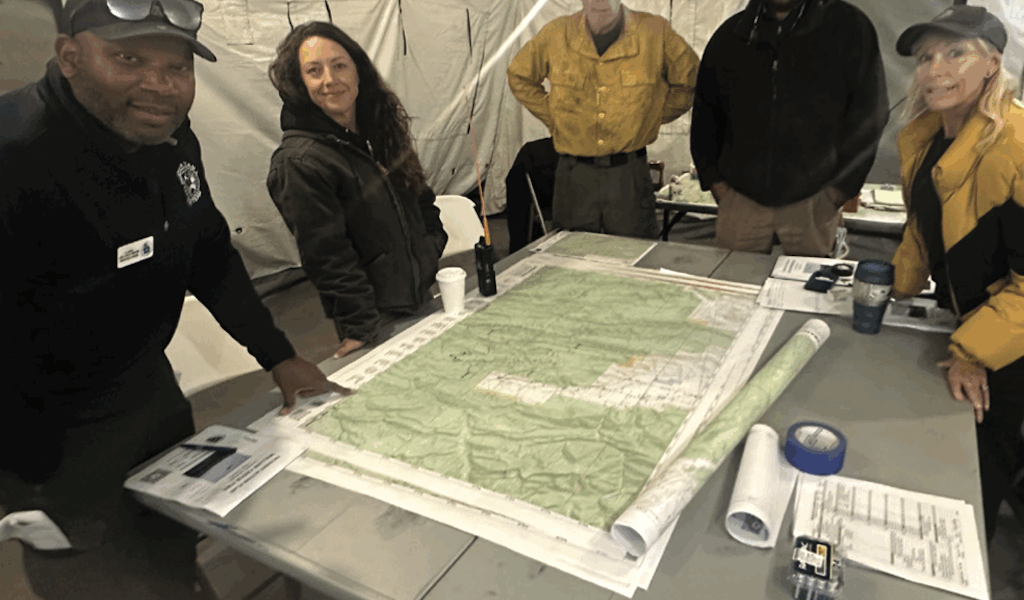
“We have divisions. They are responsible for [an area],” McCullough said, pointing to a map and saying, “from here to there; we support these divisions.”
Young added, “There are a lot of moving pieces.”
The Incident Commander credited the work of local forest managers in the early stages of the fire and the information they provided for the incoming team.
“The agency administrators, the district rangers, they brief me on what their objective is, what are the dangers, what habitat and species,” he said. “They brief me on what they are looking for. I talk to the team, about logistics, finances, safety. We present a plan and as a team; we create the plan.”
Each day the plan is updated with objectives for the day. “A plan comes out every day. Each day is different,” Kitchen explained.
Throughout the fire, the divisions work through the management team gathering the information and prepare it for submission to the commander.
“I have people that report back to me and I report back to Brian,” Bedard noted. “It has a command structure.”
The Incident Command team on the Willow Creek Fire had individual experience ranging from 25 to 47 years.
Firefighting teams are ranked, ranging from one to five, according to the demands of the fire. For example a Type 5 team would respond to the smallest fire, such as a lighting caused fire with one or two trees. “Then if you have more acres and resources, it becomes a Type 4 Fire,” Bertek explained. “We are a Type 3 incident management team.”
For this team their training and travels have covered the western U.S., Florida, Mexico and Canada.
And now, their latest firefighting responsibility brought them to the Willow Creek Fire south of Star Valley.