Wyomingites’ reactions mixed regarding uncertainty in Venezuela

By Noah Zahn
Wyoming Tribune Eagle
Via- Wyoming News Exchange
CHEYENNE — Last weekend, the global political landscape was upended when U.S. special forces launched an operation in Caracas, Venezuela, seizing President Nicolás Maduro and his wife, Cilia Flores, from a military base.
Even in Cheyenne, a town of 65,000 people that’s 3,100 miles from Caracas, the impacts of this are felt heavily by those from and with ties to Venezuela.
While President Donald Trump touted the mission as an impressive victory to curb narco- terrorism, there was a human cost, with Venezuelan Interior Minister Diosdado Cabello reporting that 100 people were killed during the raid. As Maduro now awaits trial in New York City on narco-terrorism conspiracy and weapons charges, the Trump administration has signaled its intention to “run the country” and take control of its massive oil reserves.
On Tuesday, a small but vocal group gathered at the Wyoming State Capitol. Initially held to mark the fifth anniversary of the Jan. 6, 2021, attack on the U.S. Capitol, the demonstration also became a forum for criticizing the military action in Venezuela as unconstitutional and dangerous.
The reaction among locals with intimate ties to Venezuela, however, remains deeply divided, showcasing a complex web of personal history, political ideology and uncertainty.
“Un mal necesario”
Maira Marcum is a Venezuelan native who grew up in the Andean region of the country and later worked in the tourism industry. She now lives in Cheyenne. She provided a historical account of a time of democracy before Hugo Chavez took power in 1999, saying people were happy and felt they could pursue their goals through hard work, though not everything was perfect.
That changed, she said, when the “regime” took power, leading to the destruction of the education and health systems.
“I saw with my own eyes, people grabbing food from the garbage because they didn’t have anything else to eat,” she said.
Her reaction to Maduro’s arrest was one of relief mixed with fear and uncertainty. While seeing him taken away is important, she noted that the military and the same regime’s other leaders, like Vice President Delcy Rodríguez, who was sworn as interim leader of the country, remain in power.
“Right now, normal people have to be quiet. They cannot say anything,” she said, fearing that opposition members will be jailed or persecuted. In recent calls with friends and family in Venezuela, she said they confirmed that is the case there.
She also described the shock of Rodríguez being sworn in: “It’s exactly the same. I’m afraid that might be worse in a way.”
Marcum said the U.S. intervention is a “mal necesario” (a necessary evil), noting that after 27 years of peaceful protest and what she believes to be rigged elections, the Venezuelan people were defenseless against a militarized government.
“We don’t have guns … we are defenseless from the whole military,” she said.
However, she remains worried about the future — specifically whether the U.S. will make a deal with Rodríguez that leaves the old regime in place.
“I will say this in name of all the Venezuelans: I hope Delcy Rodríguez and the rest of the regime are out of the country as soon as possible and we can bring the people that we elect as Venezuelans and start a democracy and start working hard to rebuild our country again,” she said.
She said she has hope for her country, though it is difficult to feel optimistic under current circumstances, expressing a cautious hope for a “little light at the end of the tunnel.”
Marcum also raised a significant local concern regarding the Temporary Protected Status for Venezuelans in the U.S. She pleaded for the U.S. to consider the safety of those who might be deported back to a country where “the repression is worse.”
“Protect those people, at least until our country gets some stability,” she urged, noting that many have spent years building honest lives, working hard and paying taxes in the United States.
The missionary
For Charlie Hardy, who is originally from Cheyenne, the current U.S. intervention is a repetition of a continuous effort to illegally overthrow a government he says is legitimate. While some exiles remember the pre-Chavez era of the 1980s as a flourishing democracy, Hardy’s 26 years in the country as a missionary (eight of which were spent living in a shack in a poor neighborhood outside of Caracas) tell a story of extreme decay and state-sponsored violence.
He recalled a life without running water or sewers. He said residents were forced to put “a piece of newspaper on the floor, (defecate) on it, fold up with your hands and throw it down the mountainside.”
Hardy describes the 1980s as a time of inflation and brutal repression. During the 1989 Caracazo riots, he witnessed what he called a “human slaughterhouse,” seeing soldiers throw bodies down mountainsides and encountering naked corpses of young people piled on the floors of hospital morgues. He said he slept in a cemetery to protect the bodies of the dead from being destroyed by the government.
To Hardy, this history is essential context for his defense of the current administration, leading him to dismiss the narrative of Maduro as a “thug.”
He explicitly outlined four main concerns that define his opposition to the recent raid.
First, he stated that the U.S. has been trying to overthrow the Venezuelan government since Chavez took power in 1999. Second, he argued that he does not consider Maduro or Chavez to be dictators, as they were elected in conformity with constitutional laws.
Third, he asserted that the U.S. intervention “had nothing to do with drugs,” pointing out that the U.S. has ignored larger drug producers like Colombia. Finally, he argued that the massive migration out of the country is not due to government ineptitude, but because of American sanctions that have hurt people and hurt the economy.
Hardy warned that “Venezuela is not Iraq” and expressed grief over the people he said were killed “in cold blood” during the weekend operation. He remains skeptical of the U.S. recognizing opposition figures, like 2025 Nobel peace prize winner María Corina Machado, and believes the true motivation for the seizure is the control of gold and oil.
Hardy has spent his recent years in Cheyenne teaching, protesting and writing. In 2014, he ran for the U.S. Senate as a Democrat after attempting to run in the previous election as an Independent. Despite his losses in those elections, he remains committed to his view that the United States does not need to continue to fund foreign interventions in places like Venezuela or Israel with American taxpayer dollars.
“Our foreign policy, it’s very clear. It is making subjects around the world,” he said.
The teacher
Dan Marcum, a teacher at Cheyenne’s South High School with 40 years of experience, lived in Venezuela for 17 years across three separate stints. That’s where he met his wife, Maira, and the couple now live in Dan’s hometown of Cheyenne.
He taught at international schools in Caracas and Valencia, which is about two hours west of Caracas. Marcum arrived in the country in 1994, prior to the rise of Chavez.
While he acknowledged that “nobody’s really going to shed a lot of tears for Maduro,” he is not personally comfortable with the U.S. taking such unilateral action to arrest a foreign leader and try to seize control of the country.
Marcum described Venezuela as a society where the political system is broken and said he is concerned about the future of the country.
“There’s a lot of bad people with guns, and there’s a lot of good people that don’t have any way to defend themselves,” he said. “… So people are easily cowed into just trying to go about their daily lives and making the best of it. I’m not necessarily optimistic that anything good is going to come from this, other than some economic gain for potentially the United States and maybe some other players.”
He noted that while gas prices might drop in the U.S. as a market reaction, it won’t necessarily help the average Venezuelan who has become “accustomed to living without.”
In his Cheyenne classroom, students have approached him to ask how he feels. Marcum tries to be delicate about the situation, but he admits he is discouraged by the direction of U.S. society.
“We’ve kind of lost our empathy for people,” he said, pointing to the public’s willingness to see boats blown out of the water with no real due process.
“Things here are amazingly good, and enough Americans don’t really appreciate it,” he added.
Marcum recalls the beauty of the South American nation, but laments how it has spiraled into chaos.
“It’s an amazingly beautiful country … and to see what’s happened just breaks my heart,” he said.
The oil professional
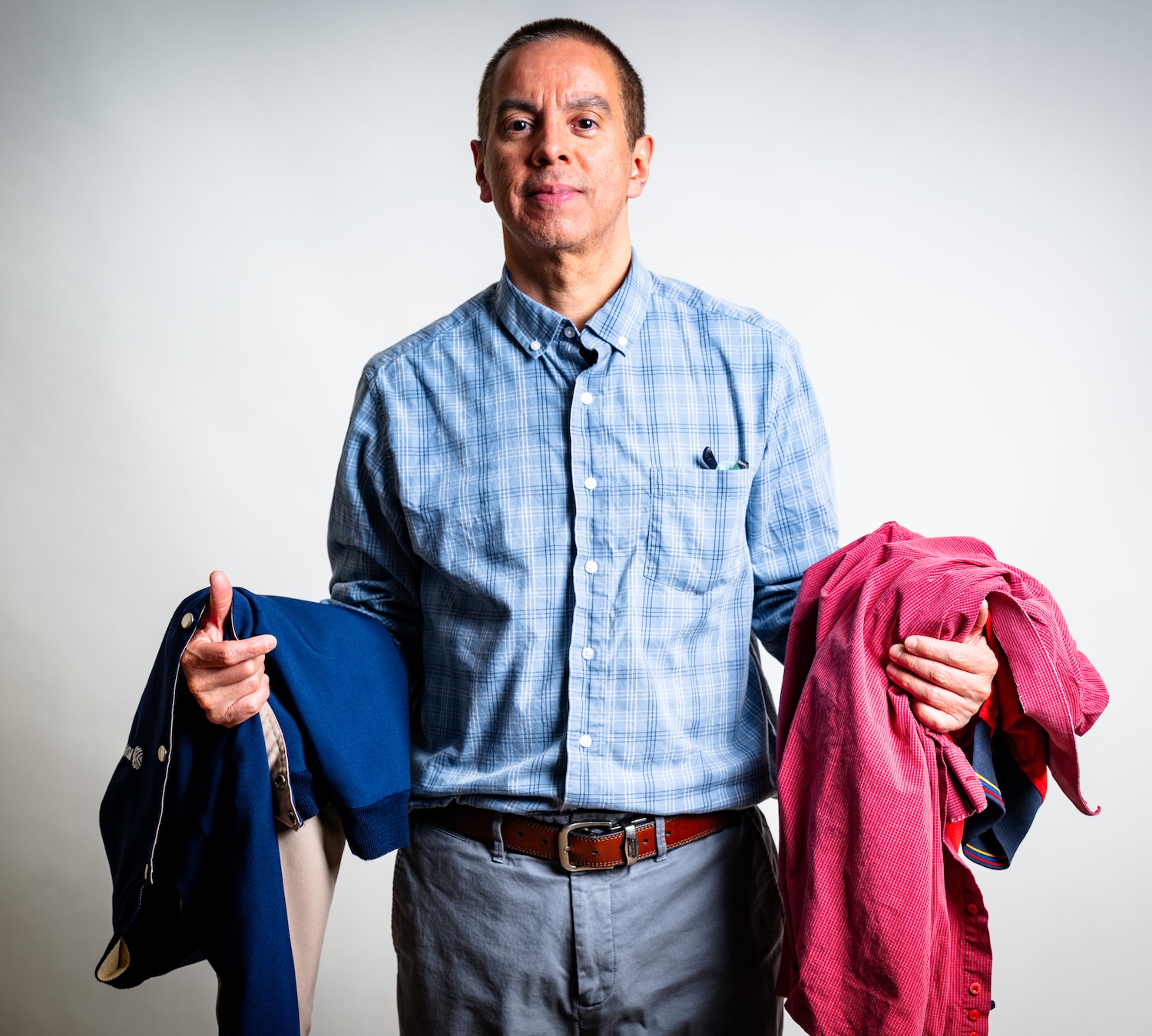
Alex Carrillo is a Caracas native and former Venezuelan oil industry professional who now works at Cheyenne’s South High School. Of those interviewed for this story, he was the most outspoken supporter of the U.S. operation.
Having worked in data management for Venezuela’s national oil company, PDVSA, and various international firms like Schlumberger, Carrillo saw firsthand the corruption and “monopoly” that he said destroyed the nation’s infrastructure.
He described the rebranding of the oil industry as a political game that squandered billions of dollars. Carrillo still has his official jackets from working for PDVSA, noting that in the 2000s all employees were required to switch from wearing blue jackets to red, which he said was a symbol of revolution and blood.
Carrillo has no sympathy for either the Maduro regime or the current political opposition, whom he labels as “traitors” and “self-corrupted.” This includes people like Machado, along with Maduro challengers like Juan Guaidó and Edmundo González.
He said the elections are rigged, and officials would watch voters’ eye movements to see if they looked at the government or opposition section of the ballot. He believes the U.S. had a “moral obligation” to intervene.
“I will not criticize Donald Trump for what he’s doing. Never will,” Carrillo said, adding that he wants to personally thank Secretary of State Marco Rubio for his role in the Maduro capture. He supports the idea of the U.S. administering the country for as long as it takes, even 20 years, if necessary, to ensure that a responsible administrator eventually takes over.
His support for Trump’s methods extends beyond Venezuela; he believes the U.S. should pursue similar actions in Cuba and Mexico to rid them of socialist influences, adding that he believes the U.S. has a duty to bring peace throughout the Americas.
“This will be the greatest day of the Western Hemisphere,” he said, referring to if the United States conducted similar operations in countries like Cuba and Mexico. “We need to get rid of that parasite.”
Carrillo dismissed Hardy’s claims that life was better under Chavez, calling that a bait that many people fell for. He recalled taking showers once a week in muddy water before leaving Maracaibo, Venezuela, in 2016.
“Don’t give [the money] back to opposition leaders … keep that money here for however many years,” he said, fearing that any funds returned now would only fuel further corruption.
The capture of Maduro has wide ripple effects and a long geopolitical shadow of uncertainty for the future. While some see a light at the end of the tunnel, others fear the U.S. has merely installed a more convenient dictatorship that prioritizes oil over the genuine freedom of the Venezuelan people.
The above story may be used ONLY by members of the Wyoming News Exchange or with the express consent of the newspaper of its origin.