
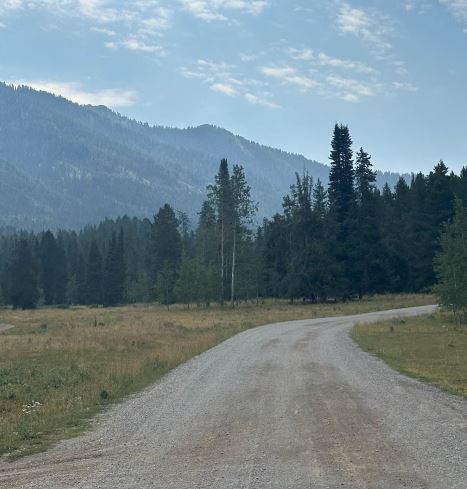
SVI Radio Interview: Brett Story, Greys River Collaborative

SVI Media’s Dan Dockstader spoke with Brett Story who provided an update on the projects being worked on by the Greys River Collaborative.
(0:00) SBI meeting with Brett Storey, his latest community endeavor is (0:04) at chairing the Graves River Collaborative. Brett, thanks for being with us. (0:08) Let’s start with just an explanation of what the Graves River Collaborative is (0:12) for those who may not be familiar.
Sure, it was put together several years (0:17) ago by a number of community members (0:21) that wanted to participate with Forest Service. Forest Service was a big (0:26) advocate of it, the county big advocate of it, so they (0:29) formed and centered really around supporting (0:33) the Forest Service in projects. When I came on, I moved here (0:37) five years ago, I volunteered my time to do it, (0:41) joined it, a couple years really kind of sort that I think they (0:47) were trying to sort out how they could really be a participant (0:50) with the Forest Service.
As you know, Forest Service has a lot (0:54) of rules on how to participate. I’ve spent the (0:58) last two decades of my career supporting the (1:01) Forest Service and other forests, and so I had that capability, (1:06) got organized with the district ranger and the leadership (1:10) and the staff and kind of talked about what could we do, what can we do. (1:16) They prepared like nine or ten projects that they felt like (1:21) the collaborative could assist with, and that’s where we are now.
They gave us (1:25) that about a year and a half ago, those (1:28) projects. We’ve been working with them on all (1:32) sorts of projects. Most of them are timber sale, forest restoration, (1:37) community wildfire protection, but one of them (1:41) is a master plan for Grover Park, and I think we’ll talk about that a little (1:45) later, but a variety of things that combine (1:50) what the forest is about, which is certainly (1:52) protection of species, recreation.
And it allows for local involvement in (1:59) the forest. Exactly, exactly, and I think this forest (2:02) is still warming to the idea and really starting to figure out how (2:08) they can make them work, particularly now (2:09) since they have a reduction in force due to the new administration’s (2:14) goals. It’s funny, they have higher goals to (2:18) produce more timber, which requires people to figure out how to do it, right, (2:22) and to set up the sales and to manage those sales.
(2:25) And I think that’s where the collaborative can play a role in (2:29) both the sales themselves. We have organizations that are aligned that (2:33) could take on some of that, but we also have (2:35) people like myself who have experience with that, and we could be kind of a (2:40) third arm, if you will, to the local forest service here. (2:44) Right, you mentioned Grover Park.
Let’s transition to that. That’s kind of next (2:47) on the work of the Graves River Collaborative. What’s envisioned there? (2:51) We’ve already had a little bit of work done.
(2:53) Yes. What’s the long-term approach? Sure, well, the long-term approach is (2:57) to develop a master plan for Grover Park, but it’s really to develop a master (3:03) plan for anywhere in the Bridge of Teton, up and (3:07) down the county. We have lots of areas that could utilize (3:10) this same thing.
We’re focused on Grover Park, one, because (3:14) it gets a lot of use now, and there’s a lot of people with a lot (3:18) of good ideas of how it could be used better. (3:21) Therefore, we’re looking to put together… I actually, (3:25) right here, I have a grant that I helped write (3:29) that will hopefully go to the National Forest Foundation for funding, (3:33) which will allow us to bring in a professional. Because really, a master (3:36) plan, while a lot of us have done it, you really (3:39) need a professional to organize it.
But the idea is this. (3:43) Develop a master plan that reaches out to local residents, (3:47) particularly those that have been here for a long time, those that live (3:51) near it, people who come in, as you know, people (3:55) come all four seasons to Grover Park and this beautiful valley. (3:58) So it’s going to be an outreach effort, and then it’s going to be a (4:02) combination of what makes sense, what can we (4:04) economically put in there, what makes sense with the (4:08) Forest Service regulations, and how they manage recreation.
(4:14) It’s one of those things, be careful what you wish for, because (4:17) we could suddenly have thousands of people come all the time to there, and (4:21) then it would get overused and potentially damaging. So we’re (4:24) looking to build that balance. Once that balance is put together, (4:29) the next step for it would be, it would have to go through (4:32) NEPA or the National Environmental Protection Act.
It’s not a long process (4:37) for this type of thing, but nevertheless it has to check and balance everything (4:40) that goes on in the forest. And that’s where the details of, let’s (4:45) say someone wanted a horse trail or a (4:51) bicycle trail. While that works well on paper, you got to figure out how does it (4:57) work with the topography, how does it work with (4:59) the other recreational things that are going to go on there, how does it work (5:03) with traffic, because as you know there’s some (5:05) traffic through there.
All of that would be planned in that (5:09) environmental report, and then it would come up with a (5:12) conclusion of what’s feasible and what’s not. (5:15) Part of that has to be economics as well. You know, right now there’s not a ton of (5:19) money, and we’re going to be looking for all sorts of grants (5:22) through the county, the state, the federal government, and private areas to (5:27) try to do this.
But the idea is this, that once we have that plan, then we would (5:32) begin implementation. The first pieces of the implementation (5:35) would probably be to prepare the forest. In other words, (5:38) like we’re doing now with a small roadside treatment to get it cleaned up, (5:42) there’s much larger areas within there that would coincide with what the (5:47) recreational opportunities are.
Like for example, building a trail. You (5:51) may have to take some trees out, you may have to take (5:53) some boulders out, and things like that. And so that work would be done (5:58) first to get the forest prepared for it, and then (6:02) each project would come in, you know, if there were, (6:05) for example, someone has already suggested, which I think is a great idea, (6:09) horse camping, because you know a lot of people come to this area for many events (6:13) and they need a place to do that.
And that might be an ideal place. I (6:17) don’t know, I don’t know the topography, but (6:20) then corrals would be built, that sort of thing, you know. (6:23) And so it would be a staged thing.
I’m guessing that’s what I just (6:28) talked about, probably takes five years from start to finish. It’s not something (6:34) that’s going to be done right away, but in the end (6:36) we could have a very wonderful master-planned (6:40) area for recreation. And then that master plan (6:44) and the ideas that came from it can be taken, (6:47) Kemmers probably looking for something similar, (6:51) you know, each of the areas could do something like that.
(6:54) And the other piece is, if you have a master plan, (6:58) as our district ranger Justin says, it’s a golden ticket for (7:02) funding opportunities, because it showed that you’re (7:05) really thoughtfully planning out what to do, you’ve listened to the public, (7:10) and you’re taking an economic approach to build something that’s (7:14) going to last a long time. So that’s the big plans for it. (7:19) A lot of little steps to take before we get there.
(7:21) Let’s close out with a summary statement on the Grays River Collaborative. (7:26) Thoughts? I think it needs to grow into itself, and by that I mean (7:35) a lot of people want to be on the collaborative, and they have an (7:38) idea about the forest. It takes a while to get used to the (7:44) Forest Service.
They’ve been around since 1905. (7:46) Many of their rules are still from 1905. I’ve been able to navigate it, so you (7:52) have to have patience, and I think the collaborative (7:55) will grow as they understand how the Forest Service works, (7:59) how funding works, how different processes work.
(8:03) But I think we have a lot of good people who really want to participate, and they (8:08) want to make the forest not only a safer (8:11) place, but a place that has broader (8:15) aspects to it that can be accomplished by (8:19) the local residents, and our tourism capacity for this city can only grow (8:25) with the forest. And so I think it’s one of those things (8:29) that will take time. I consider myself still (8:33) relatively active and young.
I’m 65, but I see the use of this forest over (8:39) the rest of my life as being an increasing thing that I want to do, (8:43) and I want to help other people do. And I think members of the collaborative share (8:46) that thought, and I think talking to the Forest (8:50) Service, now that they understand there’s help that can help (8:54) them, and they need it, they are warming to (8:57) that idea. And I think that’s when it really will take off, is when (9:01) everybody trusts everybody, and we can start getting things accomplished (9:04) together, independent of one being a federal and (9:08) one being a local.
I mean, that stuff, those barriers (9:11) should always break down to what’s right for the community, and that’s (9:14) really what the collaborative is there for. (9:17) Thank you. Brett Storey, Graves River Collaborative.
Dan Dockstader, SBI Media.
1 COMMENTS
Comments are closed.