Wyoming lawmakers clash over where to stash $250M in surplus revenue

• Members of the Joint Appropriations Committee split Wednesday over whether to put the quarter of a billion dollars into temporary or permanent savings accounts.
By Maggie Mullen, WyoFile.com
Amid ongoing budget fights over spending, Wyoming lawmakers clashed Wednesday on the proper way to stash a quarter of a billion dollars in savings.
While Wyoming Freedom Caucus lawmakers called for placing $250 million of excess revenue into temporary savings to retain the ability to spend it at a later date, others supported Gov. Mark Gordon’s recommendation to put that amount into permanent savings, where it would remain inaccessible but would generate spendable investment income in perpetuity.
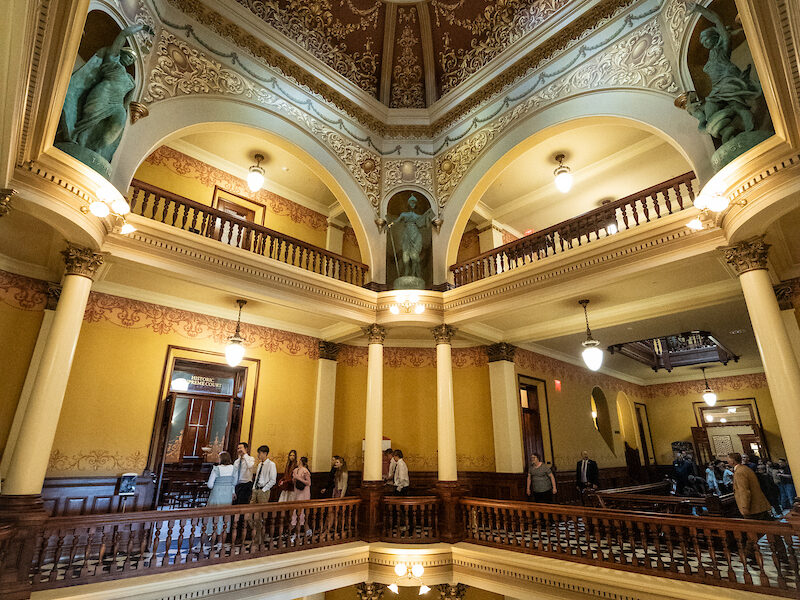
Tensions have run high this week in Cheyenne as the primary budgeting arm of the Wyoming Legislature has been meeting at the Capitol to write a draft budget bill ahead of next month’s legislative session. Debate has largely centered on cuts, including unprecedented measures to dismantle the Wyoming Business Council and halt state dollars from funding Wyoming Public Media. Lawmakers also voted to axe $40 million from the University of Wyoming’s block grant and to strip tens of millions from the state’s health department.
The driver of such cuts? Not a financial deficit, but a desire by a newly empowered group of Republicans, known as the Wyoming Freedom Caucus, to reshape state government.
“We’re going to do everything we can to limit the growth of government, so it does not outpace your paychecks,” Joint Appropriations Committee Co-Chairman John Bear, R-Gillette, said at a Freedom Caucus press conference in November.
The caucus has criticized previous legislatures for stowing revenue in permanent savings. Those past decisions recently led to a record $1.86 billion in investment earnings, surpassing state revenues from the mineral industry.
Even so, Gordon urged lawmakers to “significantly increase our savings, which are invested so as to bring additional revenue to the state,” he wrote in a Jan. 7 letter to the Joint Appropriations Committee.
“As you know, these earnings from our savings continue to help defray the costs taxpayers would otherwise have to pay to receive the services the legislature has required under the law,” Gordon wrote. “Consequently, setting aside savings from current surpluses facilitated during President Trump’s administration better sets the state up to mitigate against harder times.”
Gordon proposed lawmakers evenly split $250,000,000 into two permanent savings accounts — the Wyoming Permanent Mineral Trust Fund and the Common School Permanent Land Fund. Both savings accounts earn investment income, the former of which provides “significant stability for the operations of our state government and statutorily mandated services to our citizens,” Gordon wrote.
“This income is now one of the top three sources of revenue for the state and, at times, has been the number one revenue generator. This keeps taxes low and provides a quality of life for residents,” Gordon wrote. “Thanks to the wisdom of these former legislators and governors, Wyoming has not been faced with the prospect of being broke in 25 years. That specter was not unfamiliar before that.”
Bear sought an alternative. He brought a motion Wednesday to place those dollars in the state’s “rainy day” fund, officially titled the Legislative Stabilization Reserve Account, or LSRA.
The fund is consistently ranked as the nation’s largest state reserve as a share of its operating cost. And while it also earns investment income, unlike permanent savings, lawmakers can dip into the account principal — not just the investment income it generates — to cover expenses.
“There are many arguments to be made that the Legislature is far too liberal about spending this money down the road, and it should be protected by putting it in a constitutionally protected account, which is what the governor has recommended,” Bear said. “But as I look at the long-term forecast with the potential of being in deficit spending on education, I think it’s important that the Legislature have funds available in the next two years, especially in the next four years, to be able to meet those needs in education funding, where this money being tied up in permanent savings would not be available to this body.”
Sen. Ogden Driskill, R-Devils Tower, spoke against Bear’s motion and pointed back to 2020 when the state was facing a $400 million budget shortfall.
“We’re sitting on one of the biggest sovereign wealth funds in the nation, and our budget’s balanced with yet another year of excess money,” Driskill said. “We’re not arguing like I did back when we cut $400 million [that] we didn’t have.”
In response, Bear pointed to the committee’s attempt to spend less money and a forthcoming ballot initiative to cut residential property taxes — which fund local governments and education — by 50%. The reduction would be in addition to the 25% exemption lawmakers already put on the books.
“What I’m proposing would help to keep local governments, which I’ve heard my colleagues across the aisle say is just draconian, what we’re doing to local governments, that they can’t afford these 2% to 5% cuts,” Bear said. “Well, there’s gonna be bigger cuts if people vote to relieve themselves from some tax burden.”
Bear’s comments piqued the interest of Jackson Democratic Sen. Mike Gierau.
“We just got the tell right there. If you ever play cards, you always look for the tell. And there it was,” Gierau said. “Because we’re going to cut taxes and we’re going to need that money for spending.”
The income that Wyoming’s investments generate “staves off the pain of the bust that we had time and time again,” Gierau said, speaking against Bear’s motion.
“This is one of the most consequential decisions that we’ll make in this budget. Say you want to save, but you don’t want to save for the future. You want to hold this money out because you may want to spend it on something else,” Gierau said. “Well, I tell you what, when people in my party say that, they get called all kinds of names.”
Rep. Jeremy Haroldson, R-Wheatland, asked the committee to understand that both options are savings and to find a compromise.
“Ultimately, I think maybe we need to wake up to the fact that we can maybe achieve both ways and not just draw lines in the sand on this one,” Haroldson said. “Frankly, I’m frustrated.”
Before Bear’s motion passed, he told the committee that approximately $500 million is already statutorily earmarked for permanent savings.
The committee will meet again Thursday to complete crafting the draft budget ahead of the session that begins Feb. 9. Once the budget bill reaches the House and Senate floors during the session, it’s subject to debate and amendments from the full Legislature.
WyoFile is an independent nonprofit news organization focused on Wyoming people, places and policy.
The above story may be used ONLY by members of the Wyoming News Exchange or with the express consent of the newspaper of its origin.