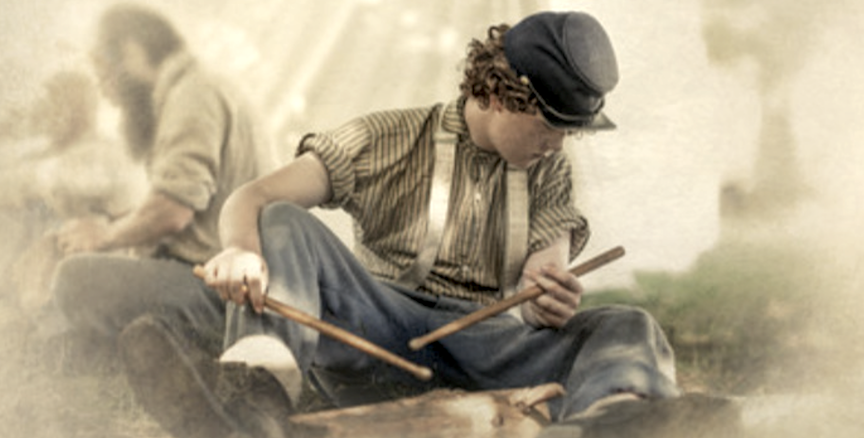
Visual artists are storytellers, preserving moments in time that draw emotion and build connection with the observer. Star Valley native, Wayne Heim, has used his artistic creativity to bring history and the American West to life in the minds and hearts of those who view his works of painterly photography.
Painterly photography is an artistic style that adapts the detail of a photograph by producing the visual qualities traditionally found in oil or watercolor painting, such as softer light, blended color palettes and selective focus. Prioritizing mood, atmosphere, and emotion, the artist employs specific techniques in the shooting and editing processes that produce a work of fine art.
A 1986 graduate of Star Valley High School, Wayne is the son of Walter and Kathy Heim, who joined Etna’s population of 50 when Wayne was a youth. Following high school graduation, he attended Montana State University and the Cleveland Institute of Art where he completed a Bachelor of Arts as a student of Fine Art and Medical Illustration, with significant coursework in photography. He and Chris, his wife of 34 years, also began their family that has grown to four children.
In his career as a medical illustrator, Wayne has traveled the world and created “highly realistic 3D illustrations and animations of medical procedures and devices…that teach surgeons, market medical products, and explain procedures to patients,” helping people “understand something they couldn’t see before,” he explained in an interview with SVI Media.
Artistically and professionally, everything changed for Wayne 18 years ago as he attended a WWII reenactment with his son. Firmly believing that there is “always a story to find,” Wayne has consistently carried a camera with him – everywhere. Capturing that event with his camera was a pivotal moment in his artistic expression.
“I was hooked immediately — not by the spectacle, but by the storytelling potential,” said Wayne. “Unlike a landscape, a reenactment puts human beings inside a charged historical moment. The question became: could you take a photograph and not just show what an event looks like, but what it might have felt like to be there? The raw emotion, the tension, the weight of what’s coming.”
From this experience, he branched into Civil War reenactments and then attended a Wild West event. “That was the moment the thread from Star Valley connected back to everything I’d been building.” Today, his focus is the 1850-1890 Western Frontier with pieces that have been displayed in the Cheyenne Frontier Days Old West Museum Show and the Great Western Show in Montana. A small collection of his pieces is currently on display in Buffalo, Wyoming and his work has been featured in “Art of the West” magazine.
While Wayne maintains his medical illustration practice, he has chosen to dedicate significant energy to his photography work, “that tries to keep the history alive so the icons of the West have the foundation they deserve,” shaping the light and the story to reflect “emotional truth,” guiding the “viewer’s eye through an image, to make them focus on exactly what matters.”
“Each image I create is what I think of as an interrupted moment of a bigger story,” he explained. He hopes to draw people into the story in such a way that they forget that they are viewing a photograph and instead find themselves feeling the power and weight of the moment.
“I tell stories of struggle, loss, and sacrifice, stories of frontier women in positions of power, of Native Americans not as victims but as full human beings navigating an impossible moment, of the moral tension and human cost of the journey West,” Wayne said. “My goal is that through these images, people gain a deeper understanding of what the pioneers endured, what they sacrificed, what they left behind – and kept going anyway. And maybe, through that discovery, find something in themselves. If these people could face what they faced and keep on keeping on, so can we.”
At a recent show of his Western work, Wayne accompanied a young woman though the exhibit, “sharing the stories, the context, the hidden details I embed in each piece.” As they stood before a photo titled “Cough and Covenant,” that depicts a frontier doctor administering medication to an older man, this young woman experienced what Wayne hopes every viewer will. “As you look closer, you notice something alarming about the patient. Small blisters. Smallpox. The covenant to protect and serve, the oath every doctor carries, is almost certainly going to mean the death of this good [doctor]. When I finished telling her the full story, she began to cry. She was completely inside the moment. Whether it was the story itself, or something from her own life that the image unlocked – her own experiences with loss and sacrifice – she was no longer standing in a gallery. She was there. That’s the whole reason I do this.”
Wayne plans to continue his pursuit of bringing the Old West to life through photographic images, writing, galleries and institutions that are seeking art that evokes emotional connection in uncommon ways. “These are important stories. The West deserves more than heroic spectacle on the walls. It deserves the full human truth of what it actually was and, in many ways, still is.”
Though Wayne left Star Valley, “the Valley, Wyoming, and the West never quite left me.” His work as an artist has become “deeply rooted” in the world of his childhood home and the “history of the West, the struggles, the sacrifices, the spirit of the people who built it.”
To learn more about Wayne and his work, please visit http://www.k4studios.com.