Wyoming hopes $100M will be enough for Colorado River compromise

By Marit Gookin
The Ranger
Via- Wyoming News Exchange
RIVERTON — Litigation, State Engineer Brandon Gebhart testified before the Select Water Committee, would be bad for all seven Colorado River Basin states. While talk of potential litigation has swirled and some states have fervently vowed to protect their own rights and interests, Gebhart emphasized that best-case scenario remains a workable compromise – without the involvement of the courts or Congress.
Wyoming has a new tool that it’s hoping to use as part of that path toward compromise. Now, it’s hoping that $100 million in federal funds can help bolster that tool.
Passed during the 2026 legislative session, Senate Enrolled Act 62 essentially allows Wyoming water users within the Colorado River Basin to apply for a conservation project under which they would use less water without losing their appropriation rights.
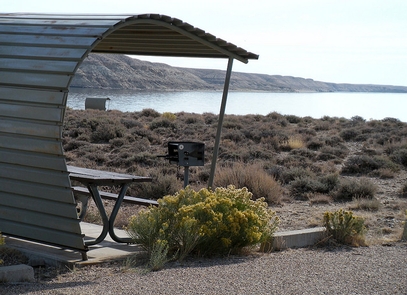
Conserved water could be stored in Fontenelle Reservoir.
“Our hope is that the funding will work in conjunction with our voluntary conservation program, and some sort of successor agreement to our previous provisional credit [memorandum of understanding] between the upper division states and [the Bureau of] Reclamation,” Gebhart explained.
The Upper Basin states are also trying to put together plans that could be launched if Congress decides to allocate funding to both divisions.
The new conservation program comes at a moment of crisis for much of the West. The winter’s severe snow drought left the region grappling with water shortage concerns at the exact moment that the Upper and Lower Basins have failed to reach a compromise on how to manage the Colorado River going forward.
“Some parts of our state are seeing unprecedented and historic low hydrology this year,” Gebhart told the committee. “Over 83% of the state is in severe or extreme drought … some of the drainages in our state continue to be on pace to be the lowest on record.”
The state is split into four water divisions; in Division III, which includes most of Fremont County, Gebhart said that 10 streams were under regulation as of August 6.
“Some of the priority dates that they’re regulating back to are in the late 1880s, which is pretty senior water rights,” he added.
Wyoming’s not alone; the drought is regionwide, and so are its potential consequences.
Colorado’s snowpack was at historic lows this past winter; Lake Mead sits at less than 30% full, and Lake Powell just hit its lowest water elevation on record since it began to fill. At the beginning of the 2027 water year (which will start on October 1), the 10-year aggregate flow is on track to be 81.5 million acre-feet, Gebhart reported.
“The Lower Basin believes that it’s entitled to about 82.5 million acre-feet under the 1922 Colorado River Compact,” he explained. “So we will be dipping below what they believe they’re entitled to.”
Sen. Gary Crum, R-Laramie, asked if there had been any discussion about limiting the amount of water being taken from the Colorado River system and over to the Front Range, which is on the other side of the Continental Divide – meaning that water does not return to the Colorado River.
Gebhart responded that there hadn’t been significant discussion of a moratorium on the practice.
Across all seven states and Mexico, people rely on the Colorado River system for drinking water, agriculture, industry, and more.
On average, the Lower Basin uses about twice as much water as the Upper Basin; the complex legal history of the Colorado River means that the federal government has different authorities over the two divisions. Lower Basin states have faced dry-year water cuts for years, but as things currently stand Upper Basin states can’t be required to make water use cuts in the same way.
In negotiations, Lower Basin states have argued strongly that Upper Basin states should have to face the same kind of mandatory cuts they do. The Upper Basin has offered voluntary cuts, which Lower Basin states have thus far rejected as insufficient.
“The [voluntary conservation] program provides a tool for Wyoming to be part of a compromise to address the historic drought that has plagued the Colorado River Basin for the past 25 years. Compromise with our sister states avoids uncertain, harmful outcomes from litigation or Congressional intervention – and also in a way that can benefit Wyoming water users,” Gebhart commented. “And then secondly, if we are required to make mandatory reductions, it helps preserve our senior irrigation uses which … mandatory reduction would put all of our junior water use at risk,” largely impacting municipal drinking water and industrial water use.
Although there has been limited interest while the program is still figuring out practicalities such as rules and applications, Gebhart also expressed optimism for Wyomingites’ willingness to participate in the program.
“I think everybody in the basin understands just how dire it is right now, and I think there is some willingness to be part of the solution,” he said.
The above story may be used ONLY by members of the Wyoming News Exchange or with the express consent of the newspaper of its origin.