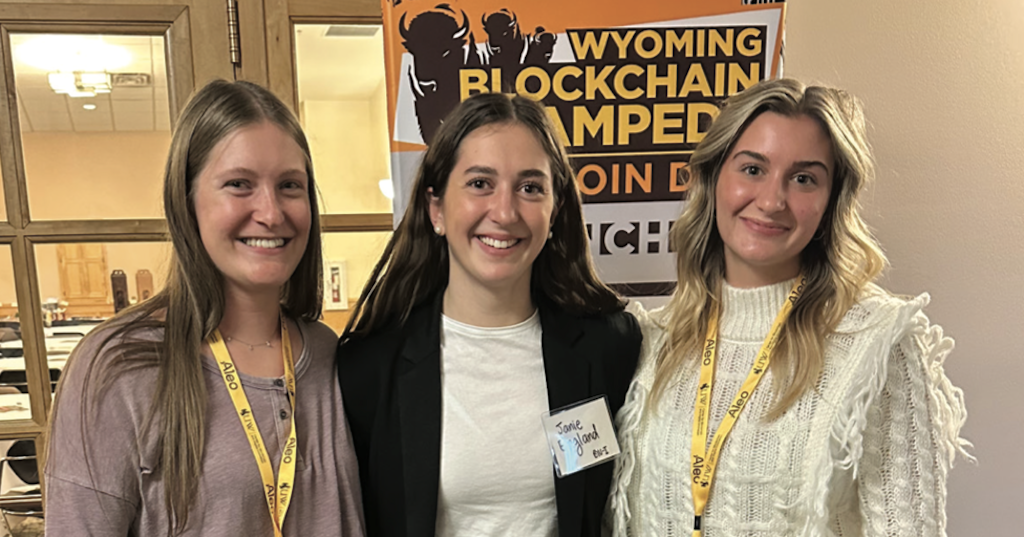
Janie England speaks at Wyoming Blockchain Stampede

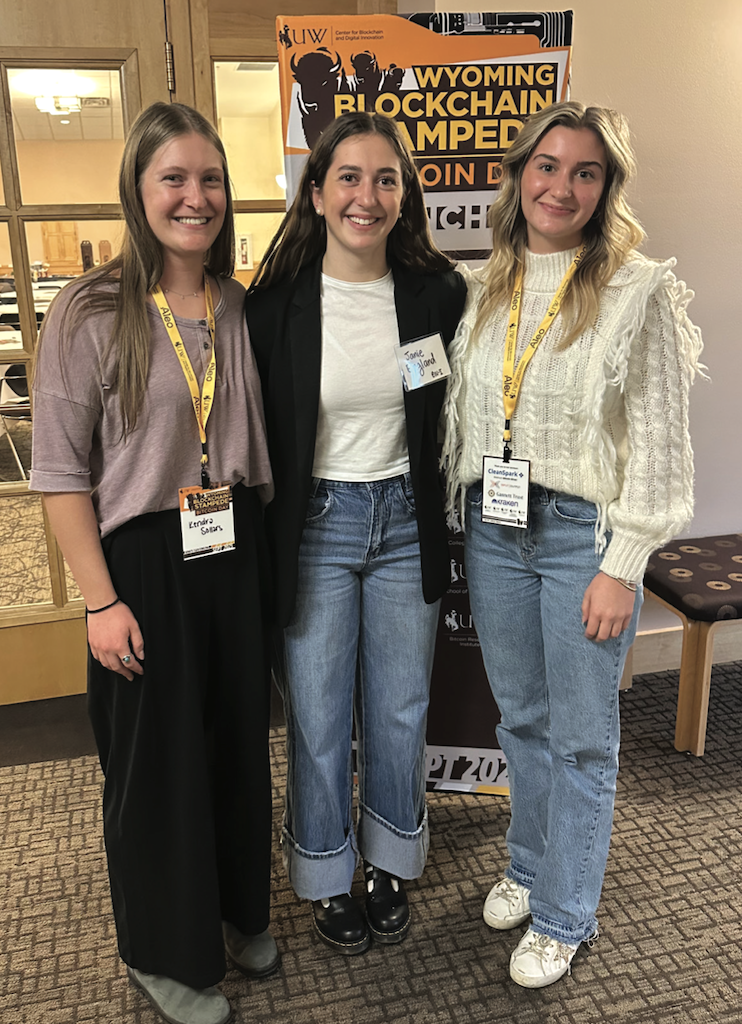
At the recent Wyoming Blockchain Stampede, a leading gathering of blockchain and digital innovation thought leaders, Janie England, a former SVHS student, now a junior studying Organizational Leadership Communications at BYU-Idaho, spoke on a panel about students on Bitcoin in Universities.
She was joined by Bradley Rettler, Director of the Bitcoin Research Institute, Professor of Philosophy at the University of Wyoming, and author of several Bitcoin publications. Another panelist was Dr. Michael J. Kelly, a professor in the Department of Judaic Studies at Binghamton University with an extensive background in Bitcoin.
The panel focused on students and Bitcoin, exploring “how professors can educate students and how Bitcoin can be involved in universities.” The event was organized by the University of Wyoming’s Center for Blockchain & Digital Innovation (UWCBDI), and many companies attended. The University of Wyoming shares the event’s focus: “The Stampede featured state and national experts in innovative technologies; Bitcoin mining; economic development; startups, fintech; artificial intelligence; education; digital literacy’ and digital asset regulation and law.” Tuesday’s sessions centered entirely on Bitcoin.
In the summer of 2024, England interned with Senator Cynthia Lummis and her team as they introduced the Strategic Bitcoin Reserve Act, resulting in a virtual internship with the Bitcoin Policy Institute. During her internship, she wrote a white paper titled Bitcoin Reserve Strategies: Lessons from Bhutan, Ukraine, El Salvador, and the United States, which she presented at the National Press Club in Washington, D.C.
“My paper set out to explore how different countries might use Bitcoin as part of their national financial strategies. It compared Bhutan, Ukraine, El Salvador, and the United States to see why they adopted Bitcoin, how they use it, and what goals they are trying to achieve. The research aimed to identify patterns in these approaches and developed two models to help explain them: a “tiered model” showing whether countries use Bitcoin out of necessity, for development, or as a long-term hedge; and a “public vs. private adoption model” that compares government involvement with everyday citizens’ use. Overall, the research was looking for lessons that other countries could apply when considering whether to build their own Bitcoin reserves.”
Following the D.C. presentation, a member of the University of Wyoming Blockchain Club invited her to speak on their panel for the Wyoming Blockchain Stampede event.
When asked about her future plans, England said, “I’m really just saying ‘yes’ to every opportunity I get.” She added that she hopes to rejoin work on Bitcoin policy with Senator Lummis.