
SVI Radio Interview: Dan Ordyna, Star Valley Health EMS udpate

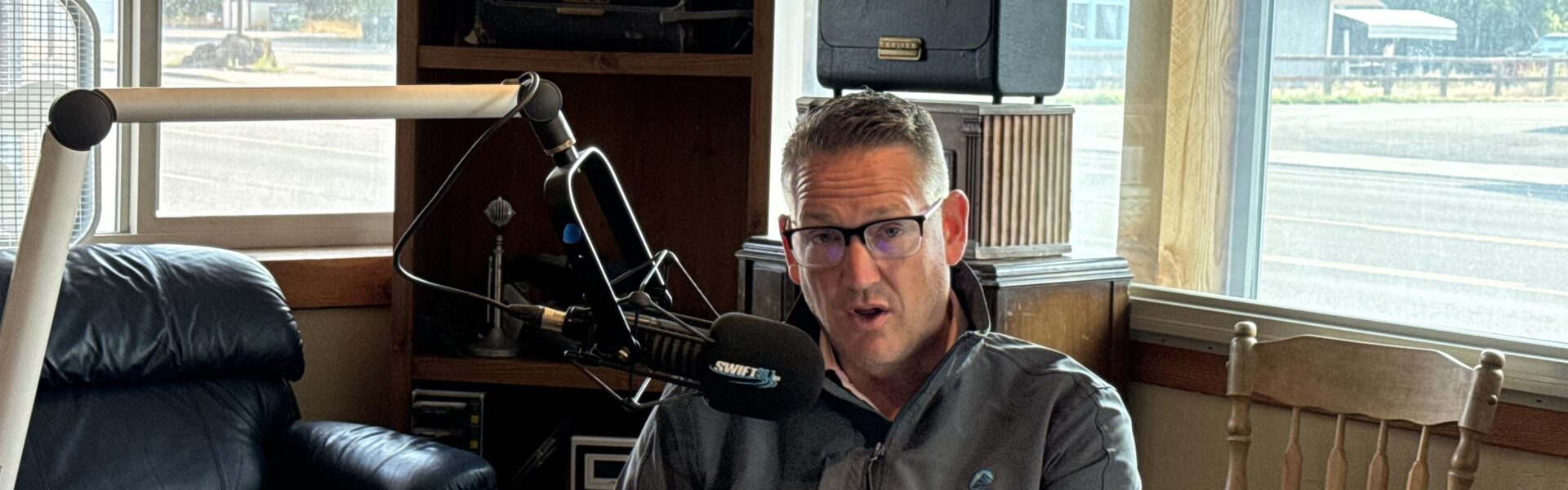
Star Valley Health CEO Dan Ordyna stepped into the SVI Radio studio on Tuesday, August 11 to provide an update on the future of EMS in Star Valley, specifically funding both short and long-term.
(0:00) Joining me live in studio right now is Dan Ordina. (0:03) Dan is the CEO of Star Valley Health (0:05) and the ongoing discussion of EMS funding (0:08) in Star Valley, with Star Valley Health. (0:10) Dan here to give us the latest details there.
(0:12) Dan, thanks so much for your time today. (0:14) Appreciate it. (0:14) Oh, thank you, Duke.
(0:15) Good morning to you. (0:16) Happy to have you here. (0:17) So let’s talk EMS.
(0:19) Of course, this has been a topic of discussion (0:23) for years and years and years. (0:24) It’s nothing new. (0:25) But recently, Star Valley Health was part of this (0:29) working group that was organized.
(0:31) And we’ve talked about the petition to the commissioners (0:34) that’s already been discussed. (0:35) But let’s start with the working group. (0:37) Who’s on that? (0:37) How did that come to be? (0:38) That’s something we haven’t talked much about.
(0:40) Yeah, so last year, about September of 2025, (0:46) I pulled together representatives from each of the towns (0:53) and the county. (0:55) And so we’ve had the mayors of each of the towns. (1:01) We’ve had council members from each of the towns.
(1:04) We’ve had representatives from the county. (1:07) And we’ve been meeting regularly since last year. (1:12) And certainly, the intent was to figure out (1:18) what to do with EMS long-term (1:21) and create some type of sustainability model.
(1:24) And the collaboration’s been fantastic. (1:27) There’s been a lot of back and forth and good questions (1:32) and good discussion in those meetings. (1:34) And we’ve really helped each other understand (1:41) the pressure points surrounding EMS (1:44) and the funding issues that everybody is facing right now (1:51) in trying to balance budgets (1:54) and to keep things moving forward.
(1:59) And so by sitting down and talking through the issues, (2:04) I think that’s the most productive way. (2:07) The whole reason why we started it is I knew that, (2:12) back in 2025, I knew that the contracts that we had (2:16) with Alpine and with Star Valley Ranch and Thane, (2:25) those EMS contracts are going to expire (2:27) at the end of this year, in November of 2026. (2:31) And so we wanted to be very proactive (2:35) in trying to figure out where we go.
(2:40) And that’s how the whole, (2:43) that’s how the entire idea (2:46) about forming an EMS district came about. (2:52) Obviously, the county commissioners felt otherwise. (2:57) And so now we’re back at the table (3:00) trying to figure out the correct model (3:02) of what to do with EMS going forward.
(3:06) Well, after the potential for the EMS district (3:09) was voted down by the commission, (3:11) the working group got together (3:13) and you were pretty blunt in that working group meeting, (3:16) basically saying, I don’t know (3:18) if this is going to continue at all past November. (3:20) So maybe give us some of those numbers (3:22) and what the reality of the situation is. (3:25) Yeah, so the situation’s been extraordinarily fluid.
(3:29) And from the hospital’s position, (3:34) we got involved with EMS back in 2021 (3:37) because we felt like EMS (3:40) was really starting to fail in the Valley. (3:44) And the volunteer model was deteriorating, (3:48) service calls, people were just waiting a long time. (3:53) And so the quality of care (3:55) was just going in the wrong direction.
(3:58) And so we raised our hand (4:01) because we felt like we were a funding source (4:05) to keep this essential service alive. (4:10) And we’re glad we did because we’ve spent millions of dollars (4:16) in training and hiring and upgrading equipment (4:19) and putting in place a delivery model (4:25) that we believe is second to none in the state of Wyoming. (4:30) Not a lot of towns and counties have what we have.
(4:35) We just don’t want to see that go backwards. (4:38) But the problem is, is that the hospital is, (4:43) EMS is not a hospital service. (4:46) It’s something that we feel is connected to the hospital (4:52) in many regards, but most organizations out there, (5:01) they don’t, you know, they’re trying to figure out (5:05) what to do with EMS because many states (5:09) don’t deem it an essential service.
(5:11) So right now, we think that we can still continue (5:17) to have this collaborative model with the towns (5:20) and counties because of the Rural Health Transformation (5:23) funds that have become available to us (5:27) through the big beautiful bill that was passed in 2025. (5:32) But that’s only gonna be for another year. (5:34) And so it’s gonna be touch and go from year to year (5:39) about how to fund EMS.
(5:41) But we believe that the 1.3 to $2 million operating loss (5:46) that the hospital is absorbing every single year, (5:50) we’re gonna be able to fill that gap, (5:55) that financial gap with the Rural Health Transformation (5:59) funds that could be available. (6:02) We’ve applied for them, and now we’re kind of (6:06) in the wait and see mode of, (6:08) to see if those funds are available. (6:10) Okay, so that’s kind of the short term solution (6:14) as of right now.
(6:16) You and other members of the working group and hospital (6:19) have traveled around and met with municipalities (6:21) and continued the conversation with county on that level. (6:26) What have those conversations been like? (6:28) Well, I think they’ve been very positive. (6:30) Certainly, everybody has concerns.
(6:33) I think that there is agreement amongst everybody (6:36) that we need EMS in this valley. (6:38) I mean, it’s 2,000 square miles. (6:42) It’s a readiness model.
(6:44) It’s 24-7. (6:47) We’ll never have enough staffing to cover every situation, (6:51) but having EMS in the valley (6:54) with the amount of recreation that takes place, (6:58) the number of visitors that come to our valley (7:04) in the summertime, it’s just, we just have to have it, (7:11) and especially for our own residents. (7:15) We’re experiencing an aging population, (7:17) and that’s not going to change in the next 10 years, (7:22) and so I think you have to look 10 years out (7:25) and say, okay, what are the EMS services (7:27) that we’re going to need going forward? (7:31) And so, really, I am trying to make sure (7:36) that it is collaborative and that we’re not, (7:41) we’re trying to address the issues (7:43) and to make sure that the facts are available to everybody.
(7:47) There’s a lot of misinformation about EMS, (7:51) and I think that by us being transparent (7:56) with the information that we’ve put together (7:58) during this working group, (8:00) I think it’s going to help educate the community (8:02) as to what’s really going on with EMS (8:06) and how Star Valley Health is managing. (8:08) In fact, what I’d love to do is just give a pitch. (8:13) We have posted all the information (8:16) that we have collected into a community report (8:19) and have put that on our website at starvalleyhealth.org. (8:23) If people can take the time to just go to that, (8:27) they can see the detailed financial breakdown (8:30) of the EMS program, (8:31) explanation of the hospital district mill levy, (8:34) staffing models, qualifications, and operational structure.
(8:38) They can see the pay ranges and the market data, (8:42) sample scheduling. (8:44) We’ve got education, growth, (8:47) and professional development initiatives there. (8:50) We got call volume and response information, (8:55) and we have average emergency response by town, (8:59) and then obviously the administrative allocations (9:02) and the cost sharing.
(9:03) So we want to be transparent to everybody in the community (9:09) and let them know, hey, this is our reality, (9:12) and these are the things that are really impacting EMS (9:17) in the Valley, and just, again, (9:20) try to get the facts in front of people. (9:22) Dan Ordina, CEO of Star Valley Health, (9:23) discussing EMS this morning. (9:25) So Dan, what are some of the long-term solutions (9:28) and options being discussed right now? (9:30) Well, the long-term solutions, obviously, (9:32) is we would like to revisit the whole EMS district.
(9:36) Star Valley Health doesn’t have to run this. (9:39) In fact, some people say, well, (9:43) the hospital has mismanaged EMS. (9:45) I obviously beg to differ, (9:47) because we think that we have taken EMS (9:49) to a whole nother level, (9:52) and again, there’s no pride in authorship here.
(9:55) If there are a group of concerned community members (10:01) that feel like they can run EMS better, go right ahead. (10:06) We want the community to be able to own (10:13) and feel like they can dictate the direction (10:19) and the future of EMS, and so that was the whole point (10:21) of trying to put together an EMS district (10:23) with a governing board and a separate budget (10:28) from the hospital. (10:30) The hospital will always somehow be involved with EMS.
(10:34) I don’t know how you’re gonna separate that. (10:36) Just because we have two emergency rooms in the valley, (10:40) we coordinate care with trauma programs, (10:43) the EMS personnel are intertwined with (10:48) and talking to our folks, (10:52) and so we’re just looking for partnership. (10:56) We’re shouldering this burden alone right now (10:59) as a hospital district, (11:01) and everybody knows that rural hospitals, (11:04) independent rural hospitals (11:05) are under significant financial pressure and stress, (11:09) and so my job as a CEO of this wonderful community asset (11:15) is to ensure the long-term viability (11:18) of both EMS and the hospital, (11:21) and that’s a delicate dance, (11:26) and so we need good ideas.
(11:30) We need reasonable minds at the table (11:34) to come up with these long-term solutions, (11:36) but to answer your question directly, (11:40) I truly believe that the EMS district (11:42) is a great long-term solution. (11:45) So do you go through the petition process (11:49) as was suggested by some of the commissioners (11:52) to go collect signatures? (11:54) Do you revisit this in a coming year (11:59) and see if the vote goes differently? (12:01) I mean, what do you do? (12:02) Well, there’s obviously, (12:04) I think the county commissioners (12:05) would like a county-wide EMS district, (12:10) and certainly their proposal is to go (12:15) and get the 60% landowner vote. (12:19) That would be a tall task.
(12:23) There was a reason why there was legislation created. (12:28) We were just trying to follow the legislation (12:30) that specifically allows for an EMS district (12:33) to become created just through a simple vote (12:37) by the commissioners, (12:41) and this is something we felt, (12:43) hey, this is a very reasonable option, (12:46) but I think there was differences of opinion (12:49) about how the EMS district should be created, (12:52) and so right now we don’t have that available to us, (12:56) but it would take a lot of grassroots effort (12:59) to get that petition signed (13:02) and for us to be able to move forward, (13:04) but if the community members want EMS, (13:08) I think that ultimately they just have to say, (13:12) how much am I willing to pay for this? (13:14) That’s what it comes down to, is who’s gonna pay for it? (13:18) And I think that it’s disingenuous of folks to say, (13:23) well, the hospital should just pay for everything. (13:27) I don’t think that’s right.
(13:29) We’re already subsidizing a nursing home, (13:32) and that’s a great asset for the community. (13:35) We subsidize OB services, (13:37) and we’ll put all this information on the website (13:39) so that people can understand, (13:41) hey, the hospital is here for the community, (13:45) but we need partners to help us with this lift (13:49) because these are services that are just badly needed (13:53) and it’s very difficult to try to do everything (13:59) with just one organization. (14:01) Dan Orndine, CEO of Star Valley Health.
(14:03) Dan, appreciate your time. (14:03) Anything else you’d like to mention while we have it? (14:05) Just want to thank all the leaders (14:07) and the community members (14:08) that have been involved in this process. (14:10) We really appreciate the input (14:13) and the different perspectives.
(14:16) It’s great to have that healthy tension (14:21) and to discuss issues (14:23) so that we get to the right result for our community. (14:26) That’s all part of the weekday wake up this morning. (14:28) Dan Orndine, Star Valley Health CEO on SVI Radio.


2 COMMENTS
Comments are closed.