Still Missing: More than 50 years later, two of four girls abducted from Rawlins in 1974 have yet to be found

By Joshua Wood
Saratoga Sun
Via- Wyoming News Exchange
SARATOGA — “Four girls disappeared over the course of six weeks. For those of you who lived here during that time, that must have been completely unnerving.”
On July 17, investigative journalist Jen Kocher led a panel at Carbon County Museum on the disappearance and murders of four girls in 1974. The case, which has become known as the Rawlins Rodeo Murders, began on July 4 with the disappearances of Carlene Brown and Christine Gross and included the August 4 disappearance of Deborah Meyer and of Jayleen Banker later that month.
Joining Kocher on the panel were former investigator Janet Franson, County Coroner Brittany Nyman, County Sheriff Alex Bakken and Rawlins Police Chief Mike Ward.
A Different Time
Just over 52 years to the day that both Brown and Gross disappeared, Kocher and Ward started the panel by highlighting the differences in the country—and Rawlins— between 1974 and 2026. Ward began by saying that the 70s could be described as “a different time” where a lot of people in the country felt safe — but also a time when serial killers were very active.
“I remember a number of years when I was a major crimes detective on the East Coast, two of the older detectives I worked with were friends of mine and two guys I liked to hang out with and they worked on cold cases,” said Ward. “I remember them telling me that, in the 70s, there were serial killers all up and down the East Coast of the United States and they were active for periods of time. It was a time when criminals could move around undetected, untraceable.”
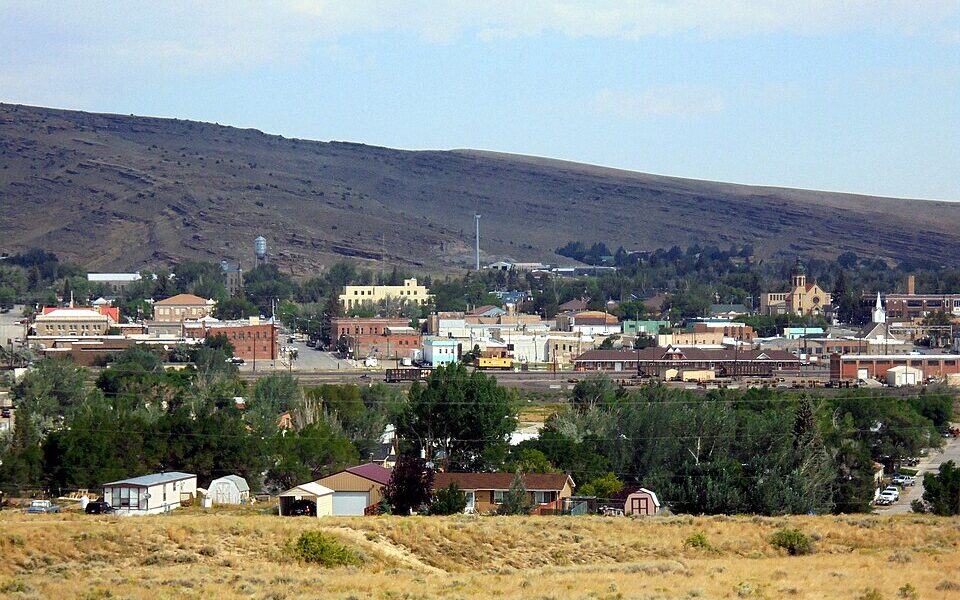
According to Kocher, the 1970s was a time of major growth for Rawlins. A boom in the energy industry—coal, oil, uranium—caused the population to balloon from 8,000 to 11,000 people.
Ken Klouda, president of the Carbon County Museum Board, told attendees how his friend Dave Rader had described the city when arriving by train in 1974.
“He said he got off the train down at the depot, walked out the front door and looked down fourth street and said it looked like Las Vegas [with] all the neon on fourth street and front street,” said Klouda. “Folks were relocating to Rawlins from all over the nation. The community grew to the point where sometimes we lost our feeling of who our neighbors were.”
Brown and Gross
It was in this time of rapid growth when the four girls went missing; the remains of two of them were later found. Carlene Brown and Christine Gross, both 19 years old, disappeared from the Little Britches Rodeo at the Carbon County Fairgrounds. According to Kocher, reporting from the time was unclear as to where a car belonging to either of them was found. One report said a car was found at the fairgrounds, another report said one or two cars were found 200 miles away in Worland.
“When I got into law enforcement, we had things such as a CAD system, we had a Spillman records system. We had digitized files [and] computer records. Now, if we need to pull facts from a case relatively recently, it’s really not that hard to find where we found a car in a specific case,” said Bakken. “Back in 1974, the record keeping system was very different and then the record retention system from ’74 to 2026 – a lot happens in that period of time.”
Gross’ remains were found nine years later near Sinclair; they showed she died of blunt force trauma to the head. Again, said Kocher, the accuracy of where the remains were found is unclear.
“In one place you read it, it was south of Sinclair. In another spot you read it, it was two miles north of Sinclair [and] one mile west,” said Nyman. “If you map out either location, I would be more confident with the northern location.”
While Gross’ remains were found, Brown is still considered missing.
According to the panel, while it could be likely her remains have been found since then, an issue with trying to connect any located remains to Brown is the fact she was adopted. Further complicating this is that all of Brown’s adopted family has since died, and what was thought a recent break in the case with the discovery of a birth certificate revealed it was one created after Brown’s adoption.
Brion Domman, who was also adopted, connected with Brown and her brother over that fact.
“I grew up in La Paloma, which is where the Browns’ kids were, so we all grew up together. Carlene and Rick would occasionally work in the dry cleaners. They really did not like working in there because it was hot, dirty work,” said Domman. “I was there when she disappeared and we had lots of people coming into the store and the phone was ringing off the hook. We would answer the phone and then we would give it [the message] to Carl. I wish we could have kept all that information.”
While Brown and Gross have often been linked together due to disappearing at the same time, no Rawlins residents knew Gross’ connection to the area. Neither Domman, nor former teachers like Larry Moore or classmates like Tink Day, remembered Gross as having any connection to Rawlins or the Browns.
At the time that Gross’ remains were found, Undersheriff Jeff Faycosh was quoted in the Rawlins Daily Times as saying there was a suspect, but no arrests were made.
Meyers & Banker
Exactly one month after Brown and Gross disappeared, 15-year-old Deborah Meyers also disappeared. Meyers was visiting her aunt, Marlene Crawford, from Red Lodge, Mont.
“She was walking from her aunt’s house at 719 Birch to the movie theater on a Sunday afternoon in broad daylight less than seven blocks,” said Kocher. “It’s very chilling, very unnerving to think in a town that was bustling on a Sunday, a 15-year-old girl got nabbed on the way to the movie theater.”
The walk from 719 Birch Street to the old Fox Theater at 218 W. Cedar Street is approximately 21 minutes— according to Google Maps—and is less than a mile. Meyers is still considered missing.
Later that month, on August 23, 10-year-old Jayleen Banker also went missing. Like Brown and Gross, she was at the Carbon County Fairgrounds, this time during the annual county fair. According to Moore, it was the last time the fair ever held a carnival as there was also one at the Little Britches Rodeo in July.
“What I know happened is she was there with a cousin and they somehow got separated after the rodeo was over and that was the last time she was seen,” said Kocher.
Klouda, who worked in the afternoons at the railroad, said car men inspected the boxcars during air tests.
“As young men we were out in the country. We were hiking, fishing, riding dirt bikes. We covered all the territory,” said Klouda. “There were three shifts around the clock, and everybody was looking everywhere. If we went out on the right-of-way we were looking; if we went out rattle hunting, we were looking.”
One member of the crowd said Dale Dixon, who had worked with the police department, had compiled a notebook of Banker’s steps from the time she went to the fair to the time she disappeared. Ward said those notes were still at the Rawlins Police Department.
Banker’s remains were found in April 1975 near a gravel quarry south of the railroad tracks along Wagon Circle Road. Like Gross, there was evidence of blunt force trauma to the head.
Evidence and Suspects
Over the years, the various pieces of evidence in the Rawlins Rodeo Murders case became separated. According to Bakken, while evidence today is digitized and catalogued, it was very different in the 1970s.
“We had evidence stored at the old jail at the courthouse, the new jail built in 2005 and the Jeffrey Center,” said Bakken.
The Wyoming Department of Criminal Investigation also has some evidence from the case and, over the years, has helped the Carbon County Sheriff ’s Office and the Rawlins Police Department. According to Kocher, one of the primary suspects—especially in the disappearances of Brown and Gross—is Royal Russel Long. Franson, who first started looking into the Rawlins Rodeo Murders in 2001, became something of an expert on him.
“He started out young. My personal opinion, I think he’s one of the most prolific serial killers that nobody knows about,” said Franson. “He was a long-haul trucker. He didn’t go anywhere east of the Mississippi, but if anybody has been a longhaul trucker then you know how much ground they can cover and how fast they can cover it.”
Long had a tendency to pick up girls in pairs.
He was arrested in 1984 for the abduction of 12-year-old Sharon Baldeagle and another 15-year-old girl who had run away from home in South Dakota and were hitchhiking in Casper. Long picked them up and took them to his home in Evansville. The older girl escaped and found the police but upon returning to Long’s home, both he and Baldeagle were gone.
Long was later arrested in New Mexico, without Baldeagle whom he claimed he dropped off in Cheyenne. According to Kocher and Franson, this wasn’t Long’s first abduction attempt.
In 1971, two girls went missing from Washington state, and it was assumed Long had abducted them. The same for the abductions of two girls in Rocky Ford, Colorado and at the Oklahoma State Fair in 1981 where he was identified by two teenage boys who were with the girls. Around 1974, Long was living in Rawlins near the fairgrounds.
After his conviction related to the Evansville case, Long was sent to the Wyoming State Penitentiary outside Rawlins. He remained there until his death in 1993.
While Ted Bundy was at one time a suspect, said Kocher, it was later discovered he was in Washington state at the time of the abduction of Brown and Gross.
One member of the public suggested Robert Clegg should be considered a suspect due to the similar nature in his murder of Lisa Marie Hansen in 1990.
According to a wire report from the Branding Iron at the time of his arrest, however, Clegg was 28 years old and would have been around 12 years old at the time of the Rawlins Rodeo Murders.
Bringing Her Home
More than half-a-decade later, the Rawlins Rodeo Murders still has a grip on the community. According to Christine Cruz-Ford, children in her generation were told about the case by their parents.
“They used it as a cautionary tale,” said Ford.
According to Franson, in all the years she has worked on homicide and cold cases, she has never seen a case like the one in Rawlins.
“It’s a one-of-a-kind case,” said Franson. “I never had any kids of my own. Carlene’s kind of my girl, and my goal is I want to find her and bring her home to Rawlins.”
The above story may be used ONLY by members of the Wyoming News Exchange or with the express consent of the newspaper of its origin.