SVI Radio Interview: Dru & Kip Hanich – Martin Luther King Jr. event

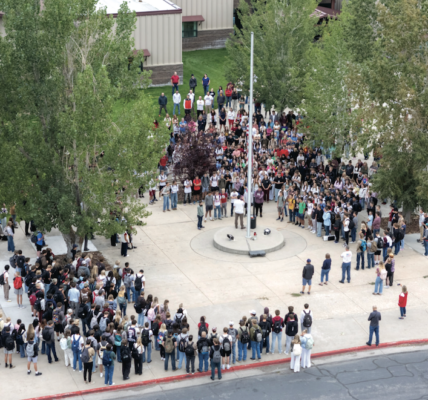
Dru & Kip Hanich stepped into the SVI Radio studio on Thursday, January 29 to report on a recent Martin Luther King Jr. Day event held in Star Valley and share plans for future upcoming events in conjunction with Star Valley Common Ground.
(0:00) Joining me again live in studio right now (0:03) is Drew and Kip Hanick, (0:04) and they’re gonna be telling us about (0:06) the recent Martin Luther King Jr. event (0:09) that was held once again in the Starvati community (0:11) over the Martin Luther King Jr. weekend. (0:14) Both of you, Drew and Kip, good morning. (0:16) How are you guys doing today? (0:17) Good morning.
(0:18) Hi there. (0:19) We’re glad to be here. (0:20) I appreciate you swinging by (0:21) and stepping in soon to tell us about this.
(0:23) So we’ve heard about this event on the air, (0:25) and it seems like it’s been well attended (0:27) and everything like that, (0:28) so happy you guys reached out to us (0:29) and offered to come in and tell us, (0:31) for those who haven’t been yet, (0:33) just give us some background on this event (0:35) and why you both decided to start it up. (0:38) Well, the members of the Baha’i faith many years ago (0:41) felt that the Martin Luther King Day event, (0:46) or usually on the day, (0:49) was an important aspect of community life (0:53) that hadn’t been receiving much attention. (0:57) And so the Baha’is, (0:59) because we believe in the oneness of humanity, (1:01) started an observance.
(1:04) It was small, (1:06) and I think some of the first were held in the flower shop, (1:10) the old Afton flower shop, (1:12) and then things faded a little bit (1:16) because the flower shop was no longer available. (1:19) Another couple decided that they would have (1:22) a free spaghetti dinner at the fairgrounds. (1:25) So we had quite large attendance to those on Monday nights, (1:31) but sometimes there was a blizzard, (1:34) and then COVID happened, (1:37) so everything shut down.
(1:39) And a couple of years ago, (1:40) I decided that we needed some observance (1:43) and visited with the Baha’i community (1:45) in a process called consultation, (1:48) where people share ideas (1:50) and we pick the best and go forward. (1:53) So we decided maybe Saturdays would be better. (1:56) And so we started about three or four years ago, (2:00) since COVID, (2:02) and we’ve had different iterations of the program.
(2:07) But three years ago, (2:09) we did a little bit about Barbara Rose Johns, (2:12) and Kip will be able to tell a little bit more about her. (2:16) So this year, (2:16) we joined with Star Valley Common Ground (2:20) as additional resources and support and manpower. (2:26) And this group is an amazing group.
(2:29) I have told so many people that figuring out what we needed, (2:34) and if we were going to do a free meal and all, (2:38) it just flowed. (2:39) People said, I can do this, I can do that. (2:42) One couple baked 16 loaves of sourdough bread.
(2:46) I mean, that goes above and beyond. (2:48) And no one asked, well, what should I do? (2:51) Everybody could see what needed to be done (2:54) and stepped up and did it. (2:55) Very cool.
(2:56) That’s very cool. (2:57) That’s when you know you got something good going on. (2:58) That’s right.
(3:00) So Kip, let’s talk about, (3:01) you had a great guest that Drew alluded to. (3:03) Tell us more about that. (3:04) Well, I told the story about Barbara Rose Johns.
(3:08) So the last chapter of her story (3:09) was just written last month, (3:12) when the state of Virginia unveiled a statue of her (3:17) in the visitors hall at our U.S. Capitol building, (3:23) because this seven foot tall statue of Barbara (3:26) is going to be one of the two statues (3:29) that state displays in the halls of Congress. (3:32) And it’ll actually be right under the rotunda (3:35) in the area called the Crypt. (3:38) And so Barbara will be joining George Washington (3:41) to represent the state of Virginia.
(3:44) Now, why? (3:45) Well, this story starts 75 years ago, (3:47) when Barbara was a 16 year old teenager, (3:51) a black teenager who was forced by segregation (3:54) to attend the Robert Roosa Moton High School, (3:59) a dilapidated building, overcrowded. (4:01) It was so crowded that when the school bus (4:03) got there with students, (4:05) they turned it into the classroom for the day. (4:07) And then the school board, the white school board thought, (4:10) well, we ought to do a little something (4:11) to help with the crowding.
(4:12) And they built these long tar paper shacks (4:16) for the students to have extra classes in, (4:18) heated by potbelly stoves. (4:21) The roofs leaked on the days that it rained (4:24) so bad that the students would hold an umbrella in one hand (4:28) and write their assignments with the other. (4:30) Well, Barbara was a very observant student, (4:33) and she didn’t think this was right, (4:35) because her school didn’t have a gymnasium, (4:37) a cafeteria, a science lab, (4:39) but the high school in Farmville, Virginia (4:41) for the white students had all those things.
(4:44) And she decided something had to be done about this. (4:47) So with the help of trusted friends, (4:50) she planned that there would be (4:53) a student-led assembly in the springtime, (4:56) and she rallied her classmates to go on strike, (5:00) to have a walkout. (5:01) And she encouraged all 400 students to follow her, (5:04) and out they went, out the door, outside, (5:07) and they decided to walk downtown (5:10) to the superintendent’s office (5:11) and demand that they had a high school (5:13) just as good as Farmville High School.
(5:15) He said no, and then he suspended the students. (5:18) They stayed out of school for two weeks, (5:21) trying to press their demands. (5:23) And in that time, the National Association (5:25) for the Advancement of Color People (5:27) took notice of what students were standing up for, (5:30) and they came to offer their legal help.
(5:33) And so, with the agreement of the students (5:35) and their parents, a court case was formed (5:38) to challenge segregated schools. (5:41) And in the federal court in Virginia, (5:45) they pleaded their case and they lost. (5:48) But they didn’t stop, they didn’t give up.
(5:50) So their case advanced all the way to the U.S. Supreme Court, (5:53) and many people will know about the famous decision (5:57) the Supreme Court made in 1954, (6:00) called Brown versus the Board of Education. (6:04) The famous decision that said separate but equal (6:07) is inherently unequal. (6:11) And so segregation was banned (6:12) and the schools had to be integrated.
(6:14) So how did this go over in Farmville? (6:16) Well, for Barbara, her life was threatened. (6:20) The Ku Klux Klan came and burned a cross (6:22) in her family’s front yard, (6:24) and her parents decided to protect her (6:26) by sending her off to Montgomery, Alabama (6:29) to live with an uncle and finish her schooling. (6:31) But the school board resisted this idea (6:34) of integrating schools to the degree (6:37) that they cut all the funding (6:40) for all the public schools in Farmville.
(6:42) Not only the schools for the black children, (6:45) but for the white children too. (6:47) And for five years, (6:49) there was no public education in Farmville (6:51) until things finally, finally started to ease and improve. (6:56) So what happened to Barbara? (6:57) Well, she graduated from high school in Montgomery, Alabama.
(7:01) She went on to Spelman College, (7:04) the historical black college for women in Atlanta. (7:07) And she studied there, (7:09) but left early to get married to Mr. Powell, a pastor. (7:13) And the family moved to Philadelphia.
(7:16) She raised five children there. (7:18) She eventually finished her degree at Drexel University (7:25) and continued on. (7:27) But what happened to her story? (7:30) Historians didn’t forget her.
(7:31) So the state of Virginia kept looking at this. (7:34) And finally, they built a monument right there (7:36) in Richmond, Virginia, next to their Capitol building (7:39) that honors Barbara. (7:41) And when the decision was made (7:44) to challenge segregated schools, (7:46) she wrote in her journal, (7:47) it felt like reaching for the moon.
(7:50) And that quotation is behind this monument. (7:54) Now, in this week’s Independent, (7:56) people can read more about Barbara (7:58) and see a photograph of this incredible statue (8:02) that was just revealed in our Capitol building (8:07) in the reception center, Emancipation Hall. (8:10) And Barbara is one of only 15 women (8:14) that are represented by statues (8:16) in all the hallways of Congress.
(8:20) And there are only three teenagers or children (8:24) that are displayed in statues. (8:27) The other two, one is Sacagawea from North Dakota, (8:31) and the other is Helen Keller for Alabama. (8:34) So this just goes to show that youth can change the world.
(8:38) And she fulfilled that desire to create justice (8:43) and liberty for all and was of service (8:46) as Dr. Martin Luther King inspires all of us to be. (8:50) It really is an incredible story. (8:51) And I’m glad you were able to share it.
(8:53) Thank you. (8:54) Yeah, and I think it goes to highlight also (8:56) the goals and intentions of this event (8:58) that you hold each year, right, (8:59) to help bring those types of stories to light (9:02) and help us recognize those people. (9:04) And I assume that’s gonna be the goal going forward, (9:07) correct, Drew? (9:07) Yes, we’re anticipating a bigger group next year.
(9:12) There are also individuals who’ve said, (9:14) I wanna help that learned about it afterwards (9:16) and said, why didn’t I know? (9:19) And so one of the things that we are going to be looking for (9:22) with consultation with Common Ground (9:26) is what is the best day? (9:28) And how can we promote this idea of being of service more so (9:34) the Common Ground really feels that democracy flourishes (9:38) when people participate in their communities. (9:41) So that’s one of the foci of the group, (9:46) Star Valley Common Ground. (9:47) And we’re a loose group, we don’t have a 501c3 (9:50) and we don’t even have officers.
(9:54) That’s all right though, you have spaghetti, right? (9:56) So we’ll take it, absolutely. (9:58) So if someone wants to get involved for next year’s event, (10:02) how do they do that? (10:03) Well, they could contact me, drewhannock at gmail.com (10:08) or Star Valley Common Ground has just launched a webpage (10:13) and it’s svcommonground. (10:19) I don’t remember the rest, but it’s svcommonground.
(10:23) And I did call it up, but let’s see. (10:27) I’m sure we can find it and we’ll make sure we link it (10:29) to our website when we post this interview online (10:33) for Star Valley Common Ground (10:34) and we can learn more about them as well along the way. (10:37) So it’s excellent.
(10:38) And so one of the reasons, as I mentioned earlier, (10:43) that the Baha’i faith has been promoting this (10:45) for so many years is because we really believe (10:48) that in the oneness of humanity and peace (10:53) can only come about by the elimination (10:55) of all forms of prejudice and the promotion of justice. (11:00) Absolutely, well, I appreciate both of you (11:01) stepping in studio. (11:02) That’s Drew and Kip Hannock in studio today (11:04) recapping the event in honor of Martin Luther King Jr. Day (11:08) and more to come.
(11:10) Anything we missed that you would like to mention today? (11:12) Turn out next year, hear another story, (11:15) and have a great meal with friends, (11:17) friends you just meet. (11:20) And sharing a meal together helps build community. (11:25) And that was one of the ideas (11:27) that Star Valley Common Ground promoted (11:30) was when you eat together, when you break bread together, (11:34) you build community.
(11:36) Yeah, absolutely, very well said. (11:38) In studio again this morning, that’s Drew and Kip Hannock, (11:40) and it’s all part of the weekday wakeup (11:42) this morning on SVI Radio.