
SVI Radio Interview: CEO Dan Ordyna and COO Mike Hunsaker – Star Valley Health Report

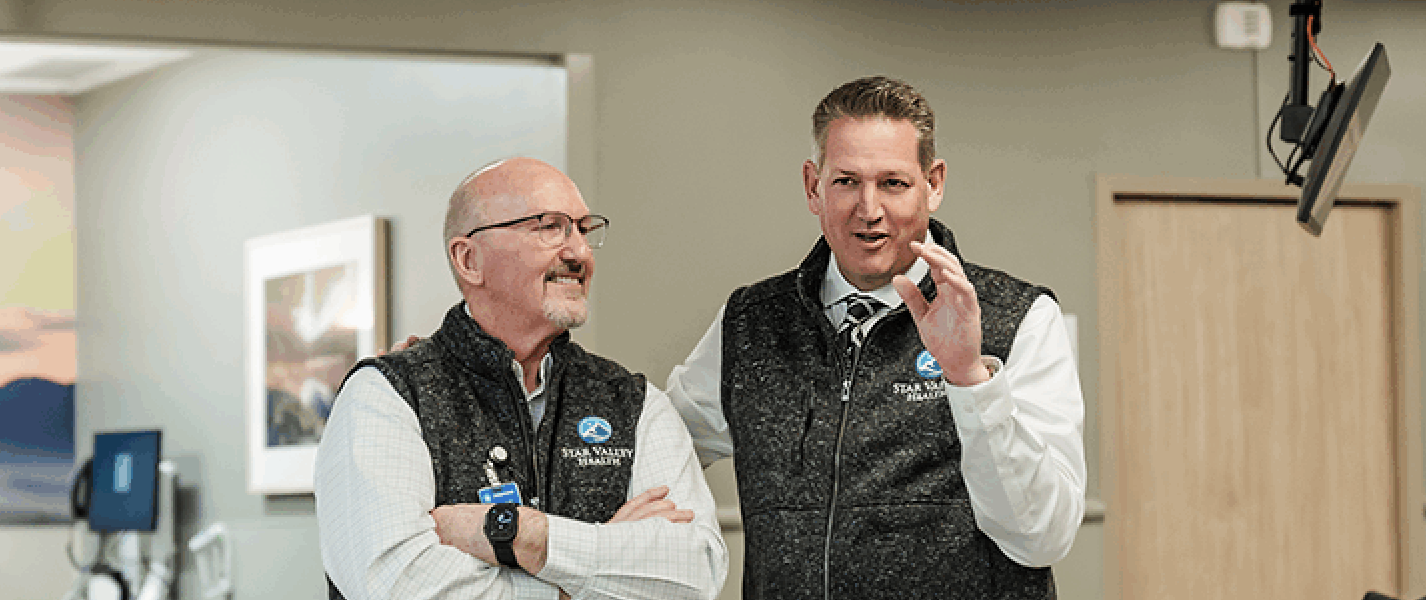
Dan Ordyna, CEO, and Mike Hunsaker, COO, from Star Valley Health both stepped into the SVI Radio studio on Monday, February 2. An update was provided regarding the financial status of Star Valley Health along with a discussion regarding the cost of healthcare, health insurance and the future growth of the organization.
(0:00) Joining me live in studio right now is Star Valley Health CEO Dan Ordena and COO Mike Hunsaker, (0:07) both with me live today. Dan, Mike, good morning. How are you guys doing? (0:11) Good morning.
Happy Groundhog Day. (0:13) Yeah, here it is, right? I guess he saw the shadow, so take it for what it’s worth, (0:18) which doesn’t mean anything, I guess, right? Especially for us out here. But no, I appreciate (0:22) you guys stepping in studio.
It’s been a while since we’ve chatted and got an update from Star (0:26) Valley Health. And so, Dan, maybe we’ll start with you and just recap for our listeners (0:32) what happened last year and the course corrections that Star Valley Health went through. (0:37) Yeah, we discovered an accounting adjustment that we needed to make, and it caused us to (0:45) pump the brakes on our growth initiatives.
And I’m happy to report that we’re in a much, much (0:53) better position now than we were almost 12 months ago. Through the first six months of this fiscal (1:02) year, we’re right at our budget. That’s not to say that we still don’t have significant challenges in (1:11) the healthcare industry that we have to address, but we’re very pleased with especially the level (1:21) of service that we’re providing, the services that we are providing to the community, and the (1:27) quality of care, and how people feel when they visit Star Valley Health, and some amazing providers (1:37) and nurses and support staff.
It really is an organization that’s come together to make sure (1:45) that we’ve got a sustainable pathway forward. And as you talked about where you were 12 months (1:51) ago and where you are now, what made the difference, I guess, and what did Star Valley Health do since (1:56) we last talked? Well, what we did is we just made sure that we were disciplined very operationally. (2:05) You know, the other issue that we struggled with was collecting from self-pay accounts.
(2:19) And so, you know, the concerns were just, hey, what does our cash flow situation look like? (2:27) And so, we’ve done a much better job of getting bills out faster, letting people know of what (2:33) they owe if they do owe something, working with them to put them, you know, to give them, you know, (2:39) zero interest payment plans. I think it’s just a matter of being very focused on making sure that (2:49) people understood what their financial commitment was because, you know, one of the big challenges (2:59) that we have as an independent hospital is, like every other hospital out there, is having to (3:06) collect these gigantic deductibles and coinsurance. And unfortunately, healthcare is becoming (3:15) unaffordable for people.
And it’s very clear that affordability is the biggest crisis right now in (3:22) America. And that’s why there’s so much national and state discussion about, you know, how are (3:29) we going to manage healthcare going forward with insurance companies getting out of the exchanges (3:36) and the prices of, you know, premiums going through the roof? All of this is impacting Star (3:42) Valley Health, and we’re just having to manage it. Again, in the studio this morning, that’s Dan (3:47) Ordina, CEO of Star Valley Health, Mike Hunsaker, CEO also with us.
So, Mike, let’s loop you in on (3:53) this. And so, what does this mean now moving forward for Star Valley Health now that it’s (3:58) in a much better position fiscally? Duke, thanks. I guess, really, from our perspective (4:06) as a healthcare organization, you know, as Dan mentioned, we took some steps.
One of the steps (4:11) was we were able to pay down some short-term debt that we had. And now that that’s paid off, (4:19) we’re able to really take those what was payments to that short-term debt. And we’re building cash (4:25) reserves now, which is going to help us from a sustainability standpoint.
So, I think that’s (4:32) a very positive thing. So, you know, if you can get rid of your debt and keep your cash (4:38) and build your reserves, that’s really important. And that’s what we’ve been focusing on.
(4:42) One of the things that Dan touched on a little bit was the affordability of healthcare and (4:48) the exchange thing that has been going on nationally, the healthcare exchange thing, (4:53) and the questions about that and the funding for that. We have found that 17% of people that (5:01) live in Lincoln County do not have health insurance. And so, we’re really working hard (5:10) to try and find a way to help those people, give them some comfort that they can get healthcare (5:19) services, and we want to work with them to be able to pay for those services.
And I think that’s (5:24) really an important thing for our community. Again, I want to touch on our small business (5:31) program that we have, which is our member care program, which provides some basic healthcare (5:39) services for small businesses that they can offer to their employees where they may not be able to (5:46) buy a major medical plan, but they can buy this member care from Star Valley Health and really (5:52) help them with primary care visits and x-rays and labs and things like that, urgent care visits at a (5:59) very nominal cost versus having to pay so much out of pocket for a major medical plan. So, (6:05) we’d be happy to talk to anybody that has a small business, even if it’s a two-person small (6:10) business that needs some healthcare services, we’d be happy to talk to them about that as (6:16) one way that we can help mitigate healthcare costs.
Yeah, and you know, it’ll be interesting (6:21) to see if that uninsured number rises over the next couple years with, as you guys mentioned, (6:26) the healthcare increasing. So, a couple more questions, Mike, as we’re talking healthcare. (6:32) It does sound like Cigna is now back with Star Valley Health.
Is that correct? (6:37) Yes, that is correct. And we’ve been working with all of the insurance companies (6:44) and adjusting our contracts with them. Cigna was a little more difficult.
(6:49) We were patient and things worked out with them in a way that I think is going to be very (6:54) beneficial for those Cigna covered individuals, whether they work for the state or whether they (7:02) work for a school district somewhere or just individually have Cigna plans. We have worked (7:07) that out with them and we are welcoming those Cigna patients back to Star Valley Health with (7:13) open arms. I’ll add that we, before the end of the year, we signed a Medicare Advantage plan (7:20) with Blue Cross Blue Shield of Wyoming.
And that’s huge because UnitedHealthcare (7:26) exited the market, or at least this county. I think they’re only in like five or six counties (7:32) now in the state of Wyoming. And so, you know, those that choose not to go with traditional (7:39) Medicare but want to sign up for a Medicare Advantage plan, we’ve now contracted with (7:45) Blue Cross Blue Shield of Wyoming.
Again, that’s Dan Ordina, CEO of Star (7:49) Valley Health. Mike Hunsaker, COO of Star Valley Health. Dan, one thing you mentioned earlier is (7:52) that last year, Star Valley Health had to pump the brakes on its, I don’t know if the word was (7:58) expansion or growth.
Where do you currently stand as Star Valley Health with that? Of course, (8:05) for our listeners in Kemmery, you have the orthopedics clinic that’s now open. And in (8:10) operational Kemmery, you have locations in Bridger Valley serving our listeners there as well. So (8:14) where does Star Valley Health now look down five years from now, 10 years from now? (8:18) Well, I think it’s going to be really, you know, all the multi-million dollar investments (8:26) we’ve made in Alpine, and in Bridger Valley, and in Diamondville, and we even have services (8:36) in Evanston.
I think all of these investments are meant to allow us to bring in more services. (8:44) And so, you know, we’ve recently added telerheumatology. We’re looking at neurology.
(8:52) We’re looking at interventional radiology. Having these services locally make a huge difference (9:00) on how far people have to travel, and being able to see a doctor quickly. I mean, (9:06) if you were to try to get into some of these specialists in some of these urban settings, (9:09) it takes months.
But the challenge with rural medicine is not having enough population to (9:18) support these specialists, and so we’re trying to find creative ways to bring those services (9:24) to Wyoming and keep those healthcare dollars locally and reinvest them into jobs and services (9:32) here in Wyoming. You know, the biggest concern I’ve got is if you look at healthcare in Wyoming, (9:38) it’s exported to Colorado, it’s exported to Montana, and to Idaho, and to Utah, (9:44) and so what is Wyoming left with? And so the name of the game is how do you build up that (9:51) healthcare delivery system here locally, and that’s really what the organization, the board, (9:57) the medical staff, administration, and everybody at Star Valley Health is trying to do is say, (10:01) look, you know what, we can have some very, very good services here locally, (10:08) but that growth presents challenges, right? We opened up a 25,000 square foot (10:16) facility in Alpine. We now have two emergency rooms in Star Valley.
I mean, that’s amazing, (10:23) but the cost to support that 24-7, 365 is significant, and so balancing all of these (10:29) growth initiatives and trying to make sure that there’s a sustainable pathway, that’s (10:36) the challenge, especially as people have to deal with, you know, high, you know, when they see (10:44) the bills for healthcare, it’s significant, and so we’re very sensitive to family budgets. We’re (10:52) very sensitive to what people are having to pay out of their pockets in order to get good healthcare (10:59) services, and it’s always a discussion that we’re having internally. (11:05) Dr. John Greene That’s Star Valley Health CEO, (11:06) Dan Ordina, Mike Hunsaker, COO of Star Valley Health.
Again, appreciate your time. Anything (11:11) else for Mike or Dan from either of you you’d like to mention? (11:14) Dr. Mike Hunsaker Duke, I might want to suggest that, (11:17) you know, we have 625 employees at Star Valley Health, and they’re really an important part of (11:25) our organization. We wouldn’t exist without all our great employees and just want the community to (11:31) know how much we appreciate their support.
I mean, we have a lot of great people that provide a lot (11:38) of great services. Speaking of the growth, Duke, I just wanted to let you know that we don’t want (11:45) to forget about our Afton campus either, you know, as an organization. We went recently through a (11:52) kind of a strategic growth planning process for our facilities here in Afton, and there are some (12:03) growth initiatives there.
We’ve actually had to, you know, we want to sustain all of the growth (12:09) we’ve had recently from a facility standpoint. We’ve got to stabilize that and begin to generate (12:17) the revenues we need to to sustain the organization. But in the near future, we’re (12:22) hoping to augment some of our services here in Afton, our main campus.
As you know, we’ve added (12:30) another orthopedic surgeon, a foot and ankle doctor, and we’ve got to have office space for (12:36) this physician. And so there are opportunities for us to grow more, but we’ve got to do it on the (12:43) right timing and make sure that we can sustain it financially, not just from the construction (12:48) standpoint, but also from the long-term stability standpoint so that we don’t find ourselves in a (12:55) situation like we were a year ago, where we have to put the brakes on and then recalibrate. We only (13:03) want to do that once.
We don’t want to do it again. So we’re really happy of the position we’re in (13:10) right now, heading the right direction, making lots of great progress. So I just want the community (13:16) to know that we’re here to serve them and provide them with the services they need here for their (13:21) health care.
So it sounds like with the Afton campus, still a lot of discussion to be had, (13:28) but do you dare estimate right now a timeline of when maybe an expansion may take place in Afton? (13:33) Well, I think it would be not prudent to give a timeline right now. I think (13:43) it’s a matter of us, like Mike said, just building our cash reserves back up, getting to a point (13:49) where we say, okay, now it’s the time to pull the trigger, to add another (13:56) building on the campus. We have obviously land that we can expand on, but the future’s (14:04) bright for Star Valley Health.
Notwithstanding the challenges that are out there, you look at (14:10) the local market, there’s facilities just in our region that are really (14:18) having to lay off people and to cut back services and close down locations. And it really is (14:29) challenging for health care right now, but Mike said it best, our strength is in our people. (14:36) And that’s where we’re going to end up being successful.
(14:40) All right. (14:40) Duke, I wonder if I could mention too the Rural Health Transformation Program, (14:45) which is part of the Big Beautiful Bill, as you know. (14:49) Wyoming is going to receive $200 million a year for the next five years, (14:55) and they want to make rural health care more sustainable through this program.
And I’d like (15:02) to mention our OB program in particular. There are several hospitals across the state of Wyoming (15:09) who have stopped doing OB. They’ve cut those programs.
And we’re really fortunate that, (15:18) you know, we delivered 120 babies at Star Valley Health last year. (15:21) And we’re excited to continue to offer that service to western Wyoming. (15:30) Our OBGYN is seeing patients in Bridger Valley, seeing patients in Evanston, (15:34) seeing patients from Kemmer, because there are no OB services in southwest Wyoming other than (15:41) in Star Valley.
And so we’re excited to continue that program. One of the initiatives is to (15:49) continue to stabilize OB programs that have existing OB services so that they don’t (15:57) cancel their OB programs. So that’s part of the Rural Health Transformation Funds.
(16:01) We’ll get more involved in that as the legislature figures out how they want to (16:08) distribute that money. The Wyoming Department of Health is involved in that. We get to have some (16:13) input as we develop ideas on how those funds could be best utilized across the state of Wyoming.
(16:21) We’re excited to participate in that. We think it’ll help us stabilize our (16:26) facilities even more than they are now. So that’s Mike Hunsaker, COO of Star Valley Health, (16:32) Dan Ordina, CEO as well.
Gentlemen, thank you so much. Dan, anything else? (16:37) No, just thank you, Duke, and thank you to the community and go Braves. (16:43) Yeah, there you go.
Absolutely. It’s all part of the weekday wake up this morning. (16:47) Yeah, you bet.
The report from Star Valley Health on SVI Radio.




2 COMMENTS
Comments are closed.