Jackson wolf hunting meeting sees high turnout, police presence, but stays tame

By Christina MacIntosh
Jackson Hole News&Guide
Via- Wyoming News Exchange
JACKSON — An outbreak of canine distemper virus that left the wolf population at its lowest point in 20 years has brought increased interest in and scrutiny of wolf hunting in Wyoming.
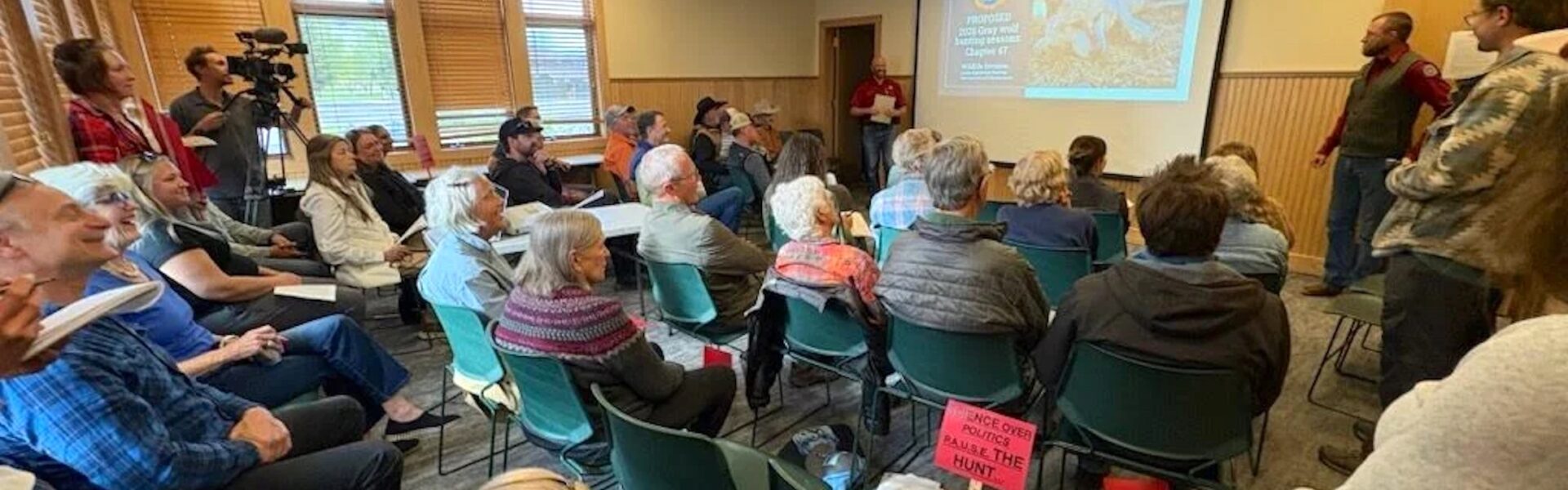
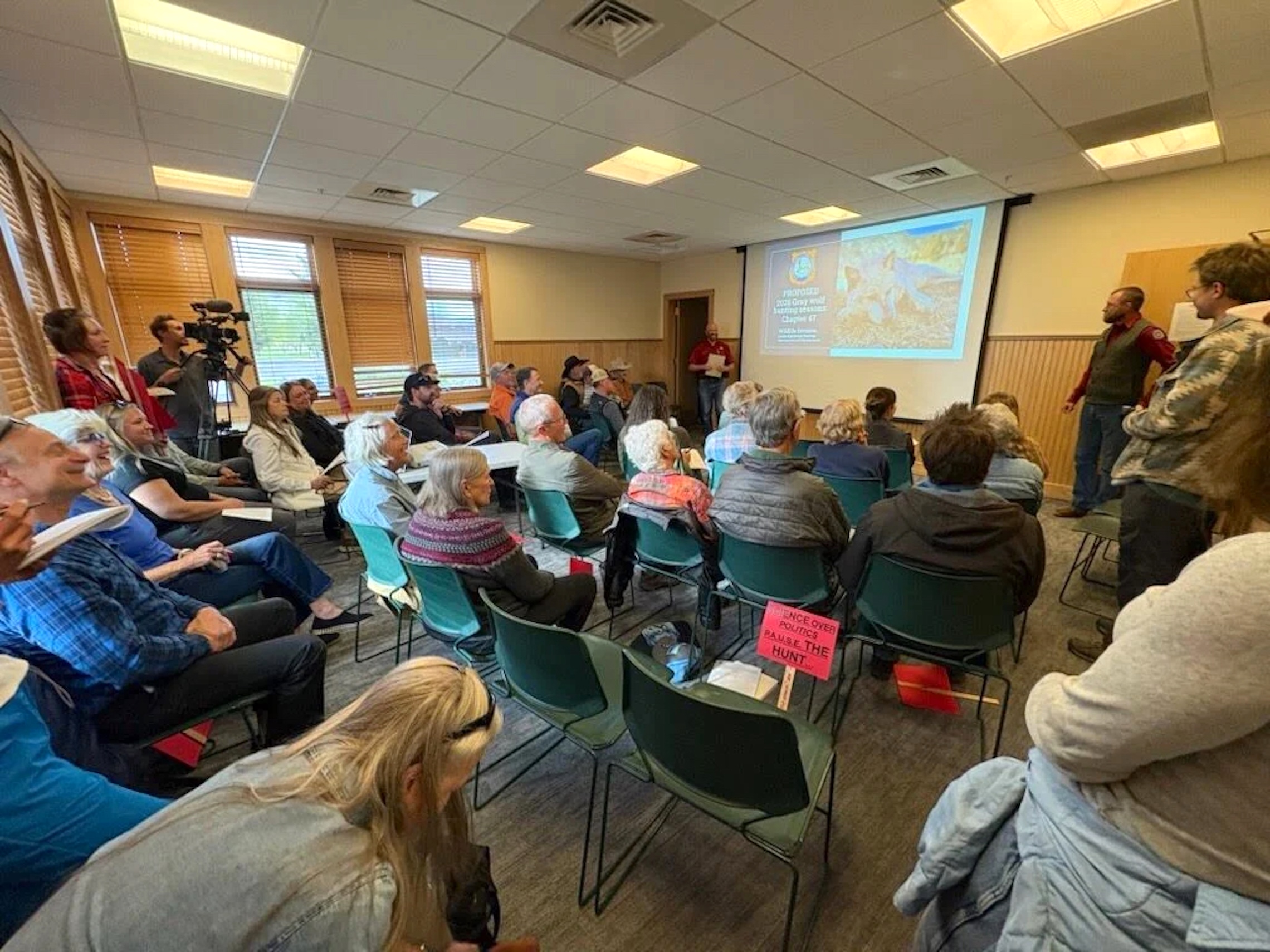
That much was evident last week at a May 26 public meeting in Jackson to discuss the proposed season.
Wildlife advocates arrived with picket signs calling on the Wyoming Game and Fish Department to pause the hunt. A handful of outfitters, some of whom feel strongly that wolves are pushing elk out of the Gros Ventre, also attended the meeting.
“This topic can be extremely emotional for all impacted,” said Jon Stephens, Game and Fish’s north Jackson game warden, adding that the meeting had people “representing both extremes.”
Department staff called the Jackson Police Department in case the meeting got out of control. As Ken Mills, the department’s wolf biologist, walked members of the public through how he calculates mortality limits to keep the population at its objective, a cop paced in the building’s vestibule.
Though the department has already proposed halving the season, the population dip ignited increased interest in wolf hunting. About 40 people attended last Tuesday’s meeting — up from nine at the same meeting the year earlier. More than half of those people appeared to be wolf advocates. The meeting was standing room only.
“It was reminiscent of the delisting meetings we had back in 2011 and 2012 when we went through the public process,” Mills said.
Despite the ongoing culture war over wolves, tensions never came to a head during the meeting, which Mills felt was “constructive.”
“It was a civil meeting with good candor amongst people that have very different views,” Mills said.
Wildlife managers regulate wolf hunting in what Game and Fish refers to as the “trophy game management area,” which includes most of northwest Wyoming outside of Yellowstone and Grand Teton national parks. In May, the department proposed cutting the mortality limit for the area from 44 wolves to 22 wolves, aiming to bring the population back up to its 160 animal objective.
Biologists counted 132 wolves in the management area at the end of last year, down from 163 the year prior, mostly due to low pup survival. Canine distemper virus is usually lethal to pups, but not to adults, Mills said. About 37% of pups survived, or between 31 and 34 of the 87 pups that were born in 2025.
In 2017, when the U.S. Fish and Wildlife Service removed wolves’ Endangered Species Act protections in Wyoming, the state agreed to maintain at least 100 wolves and 10 breeding pairs in the trophy game management area. The department manages for 160 animals and 13 to 14 breeding pairs, a buffer that ensures that the state will fulfill its commitment in the face of unforeseen events, like last year’s disease outbreak.
Wolf populations grow more when they’re below carrying capacity, Mills said, adding that, without wolf hunting this year, the population would end the year 20 animals above objective.
Outfitters were mostly quiet in the meeting except for BJ Hill, owner of Swift Creek Outfitter. He asked wildlife managers to redraw lines between some of the hunt areas in the Jackson region.
Wolf advocates asked Mills questions, including about poaching and whether hunting — and the stress it potentially causes — could inhibit wolves’ ability to recover from canine distemper. Signs carried by advocates asked for “science over politics” and for a pause to the hunt as the wolf population rebounds.
Advocates appreciate the proposed reductions, but would like to see a pause to hunting for at least two years, said Lisa Robertson, president and founder of Wyoming Untrapped.
“This is a matter of science, ethics and humane wildlife management,” Robertson told the Jackson Hole Daily. “Wolves need time to recover before additional recreational mortality is allowed.”
Mills is used to hearing feedback from the public about whether the decisions the department is making are scientific or political. Science doesn’t tell wildlife managers what to do; it tells them what’s likely to happen if they make certain choices, Mills said.
Wildlife managers use science to inform decision-making to ensure that the state stays within its commitments when it comes to wolves, Mills said. Politics were involved in crafting those commitments but are less relevant when it comes to following through on them.
“There was a political process. There also was a legal process, which isn’t science-based, to get to delisting,” Mills said. “And after delisting, ideally, science is what sits in the driver’s seat. That’s my job.”
At public meetings, like last week’s, Mills walks interested members of the public through the math that the department uses to calculate mortality limits to keep the population at objective.
Wolf advocates followed the logic but questioned the premise of the management strategy.
“We don’t have to stick to a formula,” Robertson said. “These are individual wolves that have their own stories, experiences and knowledge. No one wants to hear that in the department, but that’s the way we’re looking at it.”
Brian Taylor, owner of Gros Ventre Wilderness Outfitters, did not think that wolf advocates made headway at the meeting.
“They didn’t have enough fodder to progress their movement,” he said.
Public comments can be submitted at TinyURL.com/WolfComments through 5 p.m. on June 10.
The Wyoming Game and Fish Commission must approve the proposed hunting seasons. Commissioners plan to consider the seasons at their July 14 and 15 meeting in Sheridan.
The above story may be used ONLY by members of the Wyoming News Exchange or with the express consent of the newspaper of its origin.