SVI Radio Interview: Jillian Balow, candidate of U.S. House

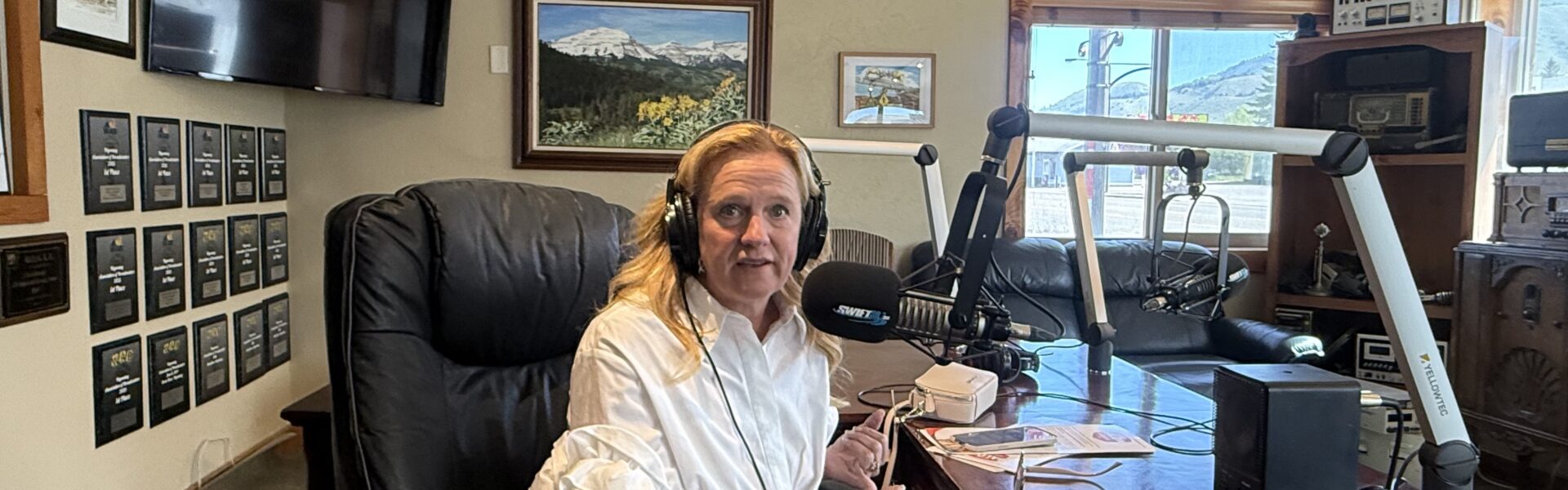
Jillian Balow, candidate for the U.S. House of Representatives from Wyoming, stepped into the SVI Radio studio to discuss why she is running for congress and how she would represent Wyoming.
(0:00) Weekday wake up this morning on the SBI radio network and a chance to touch base with Jillian (0:05) Balow, a former state superintendent of public instruction in Wyoming, and now candidate for (0:10) Congress in Wyoming’s lone House of Representatives seat in the United States Congress. Jillian, (0:17) welcome to Lincoln County in Star Valley. How are you today? (0:20) Oh my gosh, thank you so much for having me on.
And it is wonderful to be in Star Valley, (0:25) always. (0:26) Great, great place and appreciate your time and stopping in studio while you were here. (0:31) Now, let’s kind of recap what you did in Wyoming and where you’ve been up until this point.
So, (0:37) a former state superintendent of public instruction for a handful of years, (0:40) 2015 to 2022, I believe. What were some of your takeaways during those seven years in (0:45) that state superintendent spot? (0:47) Gosh, well, maybe one of the main thrusts to run for US Congress is that as soon as I became state (0:53) superintendent, I started going to a couple of national meetings and people would say, (0:58) Wyoming, it’s good to have you here. You haven’t been here in a while.
And I knew immediately that (1:03) I needed to lead nationally. I needed to represent Wyoming and rural America. You know, I went on to (1:09) be very successful and lead nationally in education on a number of issues, including (1:14) accountability and high expectations for students and schools, also critical race theory and DEI, (1:21) making sure that those radical ideologies didn’t find their way into our classroom, (1:26) school choice, career and technical education.
And it was really an honor to not only make changes in (1:32) Wyoming, but also to lead nationally on those issues. (1:35) After that time in Wyoming as state superintendent, (1:38) you went to North Carolina. Tell us what you did there.
(1:40) I actually was in Virginia. (1:42) Oh, Virginia, I’m sorry. (1:43) Yes.
So, because we were leading nationally as a state and in the work that I was doing as state (1:49) superintendent, I got almost a cold call from then Governor-elect Yunkin in Virginia. And he (1:56) said, this is the frontline of the soul of education. Can you please come and do in Virginia (2:03) what you did in Wyoming? Our kids are still in masks.
Our schools are still closed. It’s 2022. (2:10) We’ve got parents who are worried that they don’t have any control over what their children are (2:15) learning.
And so I went and I fought that battle alongside Governor Yunkin, (2:20) impacted lots more families and children. Really proud of the work. Never intended to stay in (2:25) Virginia.
Moved back here the week after my son graduated from high school. And we’ve been back (2:30) for two years. (2:31) Okay.
So tell us what made you decide to go from those positions in education (2:35) to now as a candidate for Congress. (2:37) Yeah, you know, I’m so fortunate. I’m fifth generation Wyomingite.
I grew up in Gillette (2:41) and my family’s livelihood depended on the boom and bust of our energy industry. And Wyoming is (2:49) on the cusp of really moving from boom and bust to abundance. And as a kid who grew up in Gillette, (2:55) seeing boom and bust, now seeing all of this innovation and all of this opportunity with new (3:00) energy, new revenue streams with energy and even more production.
I want to take that to Congress. (3:09) Of course, as a statewide elected, I also sat on the State Loan and Investment Board, SLIB, (3:14) and the Board of Land Commissioners. Our public lands are super important to me.
(3:19) Our communities and economic development across our state is also really important to me. So (3:25) while I’m an educator at heart and I think like a teacher and I make decisions like a teacher, (3:31) I really, really understand all of Wyoming. I’ve lived all over Wyoming.
And one thing that I’ve (3:36) appreciated about our delegation is that they understand that a decision in Star Valley feels (3:44) really different than it does in Casper. And I’ll continue to take that service mind to the people (3:50) of Wyoming. I’m in communities now and I’m listening.
And once I’m elected, I’ll continue (3:55) listening. I in no way, shape or form think that this job is about me or soundbites or getting on (4:02) the news. This is about the people of Wyoming and the challenges that we face.
And I’ll lead (4:07) alongside Wyoming. Jillian Bailo in studio this morning. Jillian, with your background in (4:13) education, of course, the Trump administration has pushed to end the Department of Education (4:18) on the federal level.
Tell us what your stance is on that. And as that continues in Congress, (4:24) what you would do to be part of that process? Yeah, absolutely. So I hope to serve on three (4:29) committees, natural resources, energy and commerce and education.
As a member of the (4:34) Education Committee, or even if I’m not on that committee, I am fully supportive of the US (4:39) Department of Education closing down. In fact, in my real job right now, that’s exactly what I’m (4:44) working on. I’m working with states across the nation to take back not only the funding for (4:50) education, but also the programming.
Since 1979, states red and blue have become accustomed to (4:57) waiting for the federal government tell them what to do and how to do it in education. That’s not (5:02) the Wyoming way. And states don’t want to operate like that, whether they’re red or blue.
So I’m (5:08) in my real job helping states figure out how do you take the reins in education and really make (5:13) that work. As Congresswoman, I’ll continue to do that. It is the right move.
And it will be well (5:19) supported no matter what administration comes next as states learn that they can control their fate (5:25) and their dollars federally. Now, you mentioned the mineral industry and energy production, (5:30) and of course, being from from the Gillette area, you’re well familiar with that. (5:34) On this side of the state, as you know, in Lincoln County, of course, we have a coal mine.
And (5:38) there’s been some recent news from the Trump administration with with the kind of their (5:41) investment in coal. There’s still some question marks, though, on on in Lincoln County and coal (5:46) production and the future of the industry here. So what do you see from a federal level (5:50) that you could do to help maybe some of the smaller energy production operations? (5:54) Yeah, it’s always, you know, again, growing up in Gillette, where it wasn’t small, it was big.
(6:00) But, but also being very cognizant of the rest of the state and that we rely on smallness to to (6:08) thrive in Wyoming, whether that’s a small business, a small coal mine, small communities, whatever, (6:13) that’s what we’re about. And so always being able to represent that as important. So at the federal (6:17) level, continuing to roll back and repeal some of those rules that make it really difficult to (6:22) produce energy are going to be important for us to continue working on.
We also have a pretty (6:29) finite amount of time to make sure that the executive orders that President Trump is, (6:34) is putting out become law, and that we can codify some of these, some of these things that really (6:41) open up the floodgates for energy production, even at our small mines. I’m super excited about (6:47) nuclear energy in Wyoming. You know, we’ve been mining uranium for decades in Wyoming.
But to have (6:54) some of the newer aspects of the process is very exciting. We see that right here in Lincoln County. (7:01) Perfect.
Jillian Bailow in studio this morning, here on the weekday wake up candidate for US (7:05) Congress to represent Wyoming. Let’s talk more about the public lands aspect of what you do in (7:11) Congress. And that’s been a big part of what Representative Hageman has done in this current (7:15) seat during her time.
And so what do you see you bring to the table when it comes to multi use and (7:20) access to public lands and those types of things? Yeah, so multiple uses is easy to say, and a (7:26) little more nuanced to, to talk about, but multiple uses is basically our public lands, (7:31) and even our private lands, when the landowner chooses, can be open to recreation, timber, (7:39) grazing, energy industry, you know, and so much more. It’s really important that our public lands (7:46) stay public. And that includes our federal lands, I do not agree with any wholesale sales of our (7:53) public lands or transfer of our federal lands to state hands.
But as a member of the land board for (7:59) seven years in Wyoming, I also understand that when leaders and community members and landowners and (8:06) business and industry come to the table with stewardship of our lands in mind, that we can (8:11) usually get a win win with some different land exchanges, and making sure that we open up public (8:18) access to our public lands. And also, sometimes the win win is making sure that our landowners (8:25) have better chunks of land that aren’t so checkerboarded. So looking forward to taking (8:30) that knowledge and that insight to the federal level.
And also the understanding that Wyoming (8:35) voices weighing in, even on our federal lands, are the most important voices that we have. (8:41) And we need to continue that. (8:43) Jillian Bailow, candidate for Congress in the United States House of Representatives.
(8:48) Jillian, this is a crowded field. This election 10 Republicans have filed for this seat. So tell us (8:55) what sets you apart and why you feel like people should vote for you in the upcoming August (9:00) election? (9:00) Yeah, you know, this is a really interesting race.
10 of us are in it. And as a voter, (9:07) that probably feels really overwhelming. Here’s what sets me apart.
I’m a fifth generation (9:12) Wyomingite. And it’s really important that we send someone to Congress right now who understands (9:18) all of Wyoming. It’s not the fact that I have a history in Wyoming.
It’s the fact that I know (9:26) Wyoming, and that I bring that broad depth and perspective to the job. Second of all, (9:32) I have a history of being someone who works with leaders, who works with communities to get (9:41) problem solved and get wins across the finish line. That’s what I’ll take to Washington, DC.
(9:48) You know, I’ve always done that. I’ve hit challenges or I’ve faced challenges head on (9:53) and, and really worked on behalf of Wyoming to get that done. I’ve led nationally in a number (9:58) of areas.
And I understand, after having spent two years in Virginia, what bipartisan and, (10:05) and partisan political battles look like and we won. (10:09) Jillian, of course, you’ve been meeting with the public here in Lincoln County during your (10:13) stops here. As you travel around the state and meet with the residents of Wyoming, what are (10:17) some of the common occurring questions and concerns that people express to you? And how (10:22) do you feel that you can help people with that as the residents of the state? (10:25) Yeah, you know, this has been a really interesting race, because most of the forums and debates that (10:29) we have have centered around what I’ll call kind of the red meat issues that we mostly agree on, (10:35) even in a big field of 10.
So, so again, kind of going back to your other question, what sets us (10:41) apart is, it’s, you know, you probably won’t find much difference. But the difference between (10:47) me and other candidates is that I am out and I am listening. And so I will always be the reliable (10:53) red vote and the strong voice for Wyoming on the Republican ticket.
But in addition to that, (10:58) I want to solve the problems that I hear about. People are super concerned about high prices of (11:03) everything, especially energy, health care and housing. They want to make sure that there are (11:09) opportunities in Wyoming for the next generation and affordable housing.
They are concerned about (11:16) our water issues and our public lands. They are concerned, or they’re they’re excited, but also (11:21) nervous about the energy production and innovation that we have. Those are the problems that I’ll (11:27) solve.
So when I’m in Washington, DC, I’ll make sure that we cut wasteful spending, I’ll make (11:32) sure that I am always a no vote on new spending new taxes or higher taxes. I want to make sure (11:37) that the most important relationship in health care is between a patient and their doctor, (11:42) not the government. And I’ll always protect children in schools and online.
(11:48) We always need to keep our military well funded, and protect our Wyoming assets, especially and (11:55) take great care of our veterans. And so those are a few of the issues that I want to work on day one. (12:00) You know, we have several pieces of legislation, including the Save America Act, which is election (12:06) integrity, the Permit Act and the Speed Act, which deal with our energy industry.
Those are (12:12) through the House of Representatives, but not to the President’s desk yet. And I’m super excited (12:17) to be a strong voice, not only in Congress, but also on the Senate side, advocating for those, (12:24) even though I’m not a senator, I can still advocate for the passage of those and make (12:28) sure that they get to the President’s desk. That’s Jillian Bailo, Republican candidate (12:32) for the United States House of Representatives in Congress in Wyoming.
Jillian, thanks so much (12:36) for your time. I appreciate you stopping by while you’re in town today. Thanks so much for having me (12:40) and Star Valley.
Just always a treat to be here. Thank you. Perfect.
Jillian Bailo this morning. (12:45) It’s all part of the weekday wake up on SVI radio.