Food freedom supporters rally at Capitol over enforcement against Wyoming producers

By Alyssa Tolman
Wyoming Tribune Eagle
Via- Wyoming News Exchange
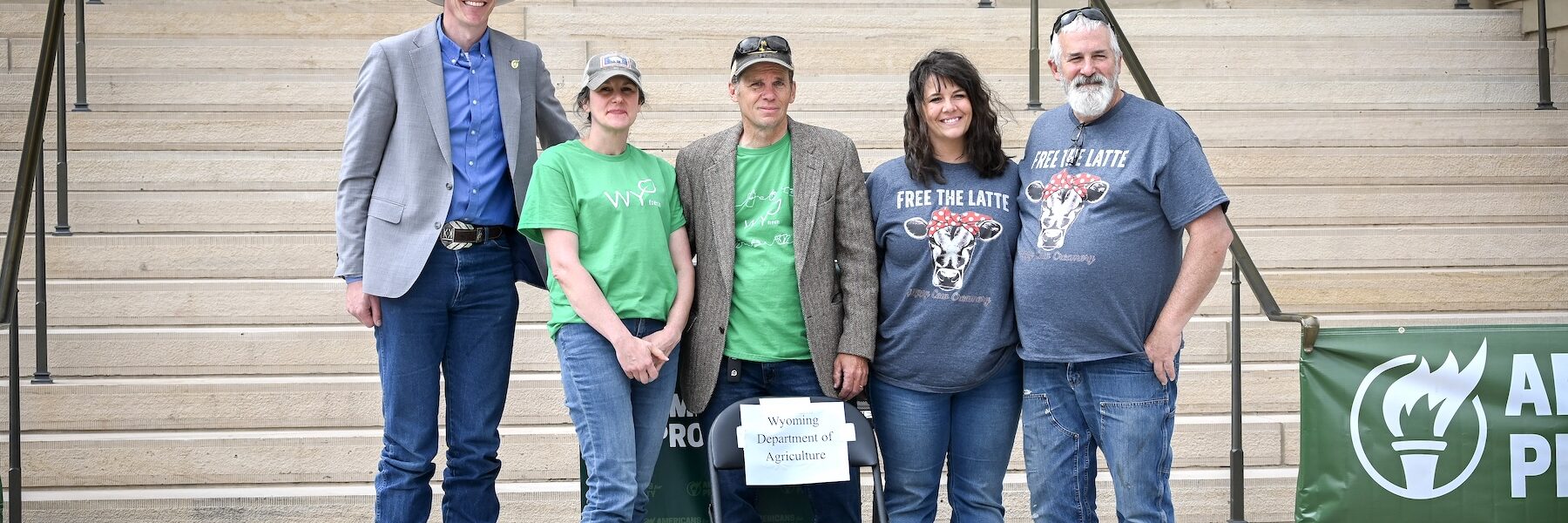
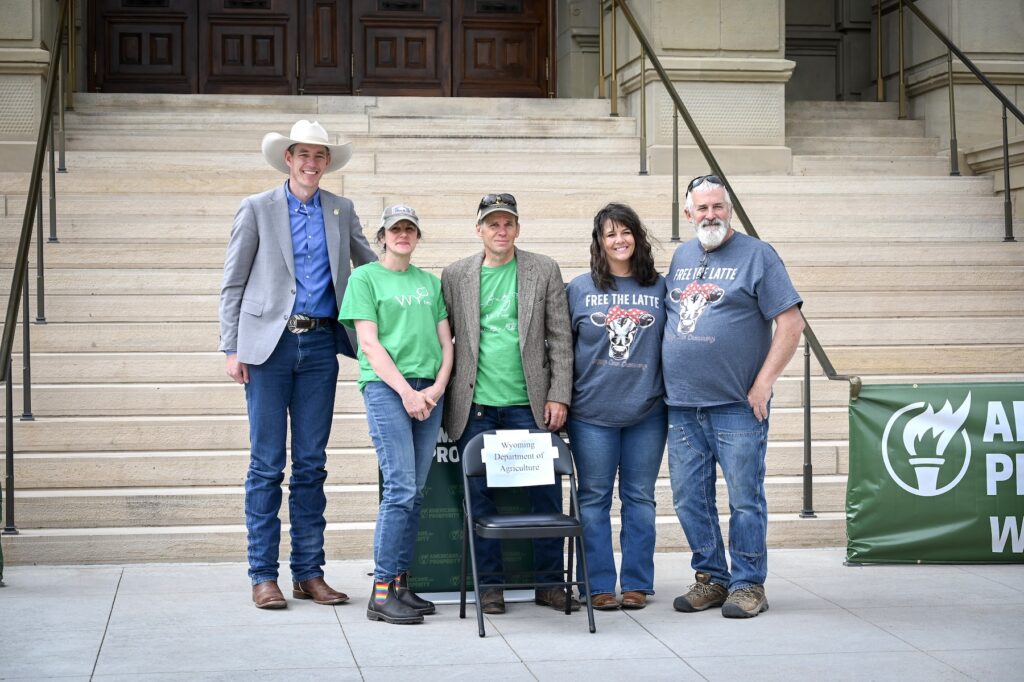
CHEYENNE — Farm owners and supporters of Wyoming’s Food Freedom Act gathered at the Wyoming State Capitol on Saturday, arguing recent state and local enforcement actions against small food producers contradict both the spirit and the intent of the law originally designed to protect direct farm-to-consumer sales.
Former state representative Tyler Lindholm, who is also the director of Americans for Prosperity Wyoming, opened the rally by calling the event a “good news story” focused on defending small producers and preparing for future legislative fixes.
“We’re going to depend on the Wyoming Legislature to step up and right a wrong,” Lindholm said. “… This is about being happy.”
Lindholm, who sponsored and passed the Wyoming Food Freedom Act in 2015 after taking over the effort from the late representative Sue Wallis, said the act allows producers to sell homemade and home-produced foods directly to consumers with limited regulation. He said the law has helped create successful farm stands and food businesses throughout the state.
But he argued state agencies and local governments have increasingly imposed restrictions that he and other lawmakers never intended.
“Over time, what we’ve seen happen is a lot of folks in department spaces, a lot of bureaucrats, as they would be called, have decided to make hay,” Lindholm said. “And especially this year, of all years to do this, it’s pretty wild. We’ve had folks hurt all the way up in the northwest corner (of the state). We’ve had folks hurt down here in the southeast corner, all over the state of Wyoming.”
Much of Saturday’s rally centered on disputes involving local farm and farmstand WY Fresh and Cody-based Hippy Cow Creamery.
Tommie Kniseley, co-owner of WY Fresh, said the business began in 2017 through selling at farmers markets. But in 2020, due to the COVID-19 pandemic, those markets were shut down. So the Kniseleys started a local online farmers market.
“I started thinking, ‘Could it be possible? Could we dream and have a farm stand that was located in Cheyenne that could service the community and be convenient for them but also give our producers and our farmers access to this community?’ It was definitely an answer to the broken food system that we saw in 2020,” Kniseley said.
Kniseley said she consulted local officials, the health department and Lindholm before opening the farm stand in 2022, and that government scrutiny began almost immediately afterward.
“Within a month, once again, the government came to help,” Kniseley said sarcastically.
She said WY Fresh was accused of trying to “find loopholes” in the Wyoming Food Freedom Act.
“I don’t think freedoms are loopholes,” Kniseley said. “We should never consider freedom as anything other than just a given right. We fought back and we thought we had solved the problem, and then the city came for us in 2026.”
Earlier this year, the Kniseley family engaged in a weeks-long battle with members of the Cheyenne City Council regarding the potential forced annexation of its farm and farm stand.
That decision was ultimately delayed until November, but then the Kniseleys got an unexpected visit from Wyoming Department of Agriculture officials who zip-tied their meat lockers shut, stating they’d need a license to continue selling the meat.
The dispute now centers on whether businesses operating under the Food Freedom Act can serve as designated agents for local meat sales.
Lindholm said the WDA’s interpretation of the act excludes beef sales, which he argues directly conflicts with legislative intent.
“Legislative intent is damn sure a thing, and I wrote that law,” Lindholm said. “And I intended that designated agents could be utilized across any (food). It didn’t mean it was just for rhubarb, for Christ’s sake.”
Lindholm also alleged the scrutiny surrounding WY Fresh is connected to local political disputes over the annexation efforts involving the business’s property.
“It’s a local government striking out at one of their businesses for daring to oppose them,” he told the Wyoming Tribune Eagle. “It’s a bully government. This is them standing up, and the people of Wyoming, the people of Cheyenne standing up and saying, ‘Whoa. You’ve gone too far.’”
Representatives from Hippy Cow Creamery traveled to the capital from Cody to describe similar conflicts involving the sale of their raw milk lattes and food preparation regulations.
Hippy Cow co-owner Mark Nelson said the creamery started as a small family dairy operation before expanding into a local food store featuring multiple vendors.
After a complaint prompted an inspection from the WDA, the business later learned local officials required additional infrastructure upgrades if the owners wanted to continue serving lattes made with raw milk.
Nelson said estimates for required renovations, including an ADA-compliant bathroom and additional sinks, totaled approximately $20,000.
“We were selling enough lattes per month that paid the rent on the building that we were in,” Nelson said. “So it’s not an insignificant thing for a small business. That’s fairly significant.”
He said state officials determined the business could legally prepare a latte in a private home kitchen located “300 yards” away and carry it back to customers, but it could not prepare the drink inside the store itself.
Nelson also criticized what he described as inconsistent enforcement practices and alleged the initial complaint originated from a competitor.
During the rally, Nelson read a statement from Rep. Tomi Strock, R-Douglas, supporting changes to the law and defending consumer choice.
“For Wyoming families, ranchers and small business owners, freedom has always meant more than a slogan,” Nelson quoted Strock. “Our nation was built on the idea that individuals have the right to make informed choices for themselves and their families. And that government exists to protect liberty, not unnecessarily stand in its way.”
Lindholm said lawmakers are already working on amendments to clarify the Food Freedom Act, and encouraged supporters to attend the legislature’s Joint Agriculture Committee meeting on June 12, where proposed changes are expected to be discussed.
“When it’s people that are actually affected by your law, it’s a big deal,” Lindholm said, “and legislators pay attention to it. … The other part is getting everybody on the same page, understanding where the law currently sits. We’re moving forward. We’re talking with state legislators. … The good news is this will be fixed. Hold fast.”
The above story may be used ONLY by members of the Wyoming News Exchange or with the express consent of the newspaper of its origin.