
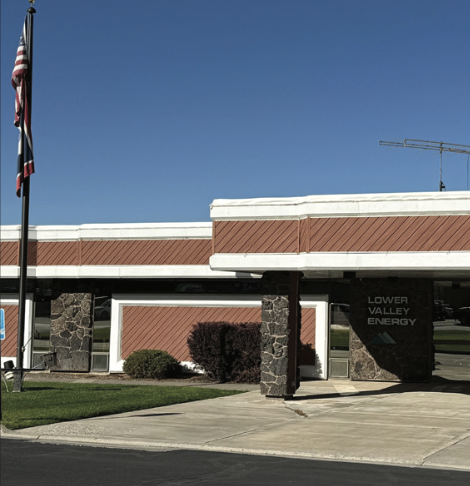
SVI Radio Interview: Bear Prairie – Lower Valley Energy CEO

Bear Prairie, President and CEO of Lower Valley Energy, stepped into the SVI Radio Studio on Wednesday, May 13 to discuss the future or a proposed solar farm in Star Valley. LVE recently withdrew a permit application from Lincoln County.
(0:00) This is the weekday wake up on the SVI Radio Network. (0:04) It is 8.45 this morning on Swift 98 and the Spur heading into our next guest interview (0:08) and live in studio now is the president and CEO of Lower Valley Energy. (0:12) That’s Bear Prairie.
(0:13) Bear, good morning. (0:13) How are you doing today? (0:15) Doing great, dude. (0:15) Happy to be here.
(0:16) Appreciate your time. (0:17) Thanks for stopping in studio. (0:18) Of course, we’re talking about this solar farm and right out of the gate.
(0:22) I just want to make sure we clarified something with your permit application. (0:26) Whether you’re opposed or in favor or don’t care, there’s a big difference (0:30) between withdrawing and having the application denied, right? (0:34) And this was with the withdrawn situation. (0:37) Correct.
(0:37) Yep. (0:37) Yep. (0:38) Yeah.
(0:38) We wanted to withdraw that because it got tabled earlier when we moved from (0:43) private land to focusing on state land, because that’s what we had for feedback (0:48) from people was they weren’t in favor of the local residents with the original (0:53) private land location, but there was broad support and people said, Hey, what (0:57) about this state land piece and as you know, near already industrial area and (1:01) so on and so forth, and the, you know, that was a more favorable location. (1:05) So when we went to there you know, we started exploring what that is and we (1:09) need to get a lease from the state on that. (1:11) So it didn’t do any good to continue to pursue the conditional use permit (1:16) without having, you know, a site land location locked up with the state.
(1:20) So that’s really where we’ve been focused. (1:21) And the county reached out, said, Hey, where are we at on this permit? (1:25) And we said, you know, give us a minute. (1:27) We’re working through some stuff here.
(1:29) So let’s pull that off. (1:31) So it’s not just sitting there. (1:32) So yeah, that, that was our action, our choice.
(1:34) Okay. (1:35) And, and so the, the permit is through state lands and investment. (1:39) Is that, is that right? (1:40) Yep.
(1:41) Yep. (1:41) The board, correct. (1:42) And so you’re still just waiting for that final approval from SLIB then? (1:45) Yeah.
(1:45) So we’ve been working off the SLIB is working through the terms of the lease. (1:49) And we’re, we’re near the end of that. (1:52) And then the next step would be to go to the state land board and ask for, you (1:57) know, that lease in those terms to be approved at the same time, though, we (2:01) don’t want to run ahead of the community on all this.
(2:04) I think there’s, you know, and rightfully so some, some concerns that we’ve been (2:08) moving a little faster than we should, as far as getting in front of the local (2:12) residents and people around this and really educating them on the benefits (2:16) and the impacts that this project might have on them. (2:20) So when I came in as CEO, I saw that, I heard it. (2:23) So the advice I gave to the team was let’s slow this down a little bit so we can (2:29) engage and listen and explain, you know, what we’re trying to do, address concerns.
(2:34) A lot of misinformation out there around this project. (2:36) And we want people to, whether you’re in favorite or not, at least be making (2:41) decisions from a fact-based standpoint, not, you know, what they saw on YouTube (2:46) or some hearsay, you know, that isn’t factual. (2:50) One of the well, let’s talk about that timeline then and what you, what you (2:54) expect to have moving forward.
(2:56) So what, what happens between now and during this permitting process? (3:02) And when do you, when do you expect to have some more public conversations? (3:06) Sure. (3:06) So what we’re also doing is, you know, we’ve, you know, as we pivoted to the (3:11) state land, which we thought would be, you know, a success where everybody’s (3:15) like, great, that’s a preferred location. (3:18) Continue to have a lot of, you know, local community, you know, outcry that (3:22) they don’t support that location either.
(3:25) So what we want to do is listen to them and also look for other alternative (3:30) locations, if we can find a place for this project that meets everybody’s (3:35) needs or most everybody, cause I’m not Pollyanna sheer thinking that (3:38) we’re going to get to a hundred percent. (3:40) But we would like to have, you know, as broad a support as we can for this. (3:44) If we can find another location, great.
(3:46) We’ll look at that. (3:47) So please bring, bring all options and ideas. (3:50) We’re trying to find that win-win location, but we’re, I want to be clear.
(3:54) We’re not backing away from the state land either. (3:58) We’re assessing all options, going to try and find and listen to the community. (4:02) And at the end of the day, as we take that next step here, whatever direction (4:06) that is in next two to three months, my commitment to, you know, the community (4:10) and all of our members of the co-op, is we work together and collaborate (4:14) to try and find that success.
(4:16) Cause there are a lot of people that support solar and want to participate (4:19) in this community solar project. (4:21) So it’s not all one-sided. (4:24) We want to make sure that we communicate when we get ready for that next step, (4:29) whether that’s moving to the state land lease and getting (4:32) in front of the state land board.
(4:34) We want to make sure that nobody’s getting, you know, surprised by finding (4:38) out that we’re in front of the state land board, you know, that day. (4:41) You know, we want to be open and transparent with everybody. (4:44) So before we make that, that next step, whatever that next step might be, (4:48) people have ample time to, and we will hold open houses and bring people in (4:52) and listen to them and listen to their concerns and those that are for it.
(4:57) Like we want to hear from people that are for this project too. (4:59) A lot of times the supporters stay silent and we need to hear from, you (5:03) know, the supporters of, of these projects throughout our membership also. (5:07) So as you, as you are open to considering other options are you looking at any (5:12) places in Teton County for a potential solution? (5:14) Cause we hear this all the time and I’ll let you confirm or, or not.
(5:19) Uh, why are we putting a Jackson project in star Valley? (5:23) And, and so when you look at solutions, are, are there locations (5:27) potentially being considered in Teton? (5:29) Yes, we’re looking hard in Teton County, but I also want to be clear (5:32) because there is a lot of people that have said that of why is this a, you (5:36) know, a, a, a Teton County, you know, project in Lincoln County, and I want (5:41) to be clear, it’s a lower Valley energy project and there are supporters and (5:45) people that want this also in Lincoln County and we don’t cite and locate (5:49) projects based upon, you know, County specific, this is, you know, for lower (5:54) Valley energy and we’re going to cite projects where it makes the most (5:57) economic and operational sense across our service territory. (6:02) Um, but we are looking at all options, you know, it’s end up there also, but (6:07) you know, end of the day, the electrons flow where the electrons flow. (6:10) And, you know, currently we have very little power generation (6:14) anywhere on our system.
(6:15) So we’re going to be building all kinds of, you know, generation from, you (6:20) know, energy storage, battery systems to, you know, peaking off of, you know, (6:25) even natural gas, because we need capacity resources. (6:28) This is, you know, run a power system. (6:30) It’s all the above.
(6:32) And you can’t run a power system on 100% of any single type of resource. (6:37) So, you know, it becomes concerning for me as being a power supply guy. (6:41) And that’s what my core background is.
(6:43) When we have members saying, no, just do this. (6:47) You know, I watched a YouTube video. (6:48) I’m an expert.
(6:49) We just need all of this, or we just need all of that. (6:52) And the right answer is everybody’s right. (6:54) And everybody’s wrong.
(6:54) We need it all. (6:56) And we need to do it economically and operationally prudent, but (7:00) it’s not going to be, you know, power lines. (7:03) You know, I think they’re beautiful, but some people don’t like them.
(7:05) Right. (7:06) But at the end of the day, we all want electricity and same thing. (7:09) You know, we’ll just underground those.
(7:10) Well, the economic impact. (7:12) So we always, you know, work to make decisions that minimize impact as much (7:16) as we can, knowing that we’re not going to make everybody happy, but we need (7:20) to make, um, you know, decisions that benefit the co-op as a whole. (7:26) And, you know, my stress to the membership is, and the people in the (7:29) community is let’s get back to those cooperative principles and values of, (7:33) you know, you might not like everything, but we need to cooperate because our (7:37) next project might be the one that you’re in favor of, but the, you know, (7:42) the person across the street isn’t.
(7:44) So we need to, you know, get back to those, you know, community and cooperative (7:48) values. (7:49) Talk to us more about the kind of subscription model of this solar, uh, (7:54) proposed solar farm and how that would work and what, what you see as benefits (7:58) for that. (7:59) Yeah.
(7:59) That’s what makes this project great with the funding support that, um, ECW (8:05) is bringing, uh, you know, $1.9 million. (8:07) It’s a tremendous amount of money to put towards this project. (8:11) And then we will offer subscription.
(8:14) So people will subscribe because they want to have solar serve, solar energy (8:18) serve their home and maybe their, their roof line, uh, doesn’t support it. (8:23) And we can build it at a scale, you know, one megawatt set of doing (8:27) individual small panels at a price point. (8:28) That’s great.
(8:29) So they will subscribe and pay money up their money upfront. (8:33) And then that solar energy will deliver to their home. (8:36) The reality is the electrons just go on the grid.
(8:38) Um, so there’ll be served from that, from that project. (8:41) So they’re going to pay between, you know, the ECW funding and those (8:45) who subscribe will pay for a hundred percent of this project, including all (8:49) that ongoing operations maintenance. (8:50) So they’re buying into a solar project for them.
(8:54) What we get is lower Valley energy also as a whole, and all of our (8:57) members benefit from this is. (8:59) It reduces our total load because we are building generation (9:03) to serve our members here. (9:05) It reduces our purchasing of energy from the wholesale market, which is (9:10) higher than our current retail rates, right? (9:13) So anytime we can have people, you know, buy their own generation, help us (9:18) support them getting their own generation here that is lowers our total overall (9:23) costs to the point of, you know, the numbers are 30 to $40,000 a year.
(9:28) This will lower our costs for all lower Valley energy members. (9:33) Now it’s not a huge number, but it’s also not a huge project. (9:37) And 30 to $40,000 is real money to the co-op, right? (9:42) So we, you know, that’s a win, win, win.
(9:44) So president and CEO of lower Valley energy bear Prairie in studio this morning. (9:49) Uh, so bear, there’s been some concerns on the effectiveness of solar in star (9:53) Valley, uh, amount of sunshine, mountain coverage, uh, all that kind of stuff. (9:57) What kind of research has done as, as gone into this, as far as are these, (10:01) would the solar farm even be effective to have here? (10:03) Yeah.
(10:04) And that’s the first thing we did is we did a, you know, assessment in Teton (10:07) County, uh, did it in Lincoln County, trying to find a site in a location with (10:12) the right view angles, make sure it doesn’t have the shading to find those optimal (10:17) sites. (10:17) Uh, the argument that, you know, solar doesn’t work here. (10:20) That’s not an accurate argument.
(10:22) Actually, the higher elevation you are, the better the solar is because you have (10:25) less atmosphere to penetrate through. (10:27) Um, we have a lot of daylight hours. (10:30) Um, solar is a, is a effective resource here.
(10:33) And the nice thing about solar that I like from a power supply, you know, guy (10:36) compared, compared to wind, wind has its place too in a portfolio and we own a (10:40) chunk of a wind farm. (10:41) I’m all about diversity. (10:42) Um, I can count on the sun coming up tomorrow, the wind blowing wellness is (10:47) spring in this region, then you can kind of count on it, but you, you know, you, (10:50) you can’t schedule that and guarantee it.
(10:52) So as a component of a system at the right price, this makes good (10:55) economic and operational sense. (10:58) Bear Prairie, president and CEO of lower Valley energy and studio. (11:02) All right.
(11:02) So as you continue this progress, stay tuned for more details on more public (11:05) information meetings. (11:05) And it sounds like on, on that front, correct? (11:08) Yeah. (11:08) And I definitely want to draw people to our website.
(11:10) I’ve focused really hard and the team at lower L energy and our communications (11:13) team, putting good fact information on our website, on this project. (11:17) So as people are sending us questions, instead of me answering those individually (11:21) of, well, I heard that, you know, solar panels leak fluid when they crack into (11:26) the, you know, water system, I’m not answering those individually. (11:30) I’m putting those answers and facts on our website as, as Q and a. (11:33) So we’re really trying to build a comprehensive information list and also (11:38) informing everybody what our next steps are when we start taking those.
(11:42) So please go to our website to get facts and information. (11:45) If you see something there that doesn’t make sense to you, reach out to us so we (11:49) can get that updated and, or, you know, get information out there or come in and (11:53) talk to us like, like we, you know, we want to, you know, work hard for our (11:57) members, (11:58) Bear Prairie, lower Valley energy, the website, LV energy.com. (12:01) Uh, while I have you, uh, it is an election year and, uh, a couple of seats (12:05) on the board of directors for lower Valley energy up for election this year. (12:09) Correct.
(12:09) Yeah. (12:09) And this year’s a little unique. (12:11) We actually have three seats up for reelection because, uh, Devin Simpson (12:15) was appointed to fill the seat of, of Fred, um, late Fred.
(12:19) So, uh, his seat under the bylaws will stand for, uh, election at the nearest (12:24) election, which is now, and then we also have, uh, Senator Doxer’s seat up for (12:28) election and then, uh, Ray Elster up in, um, seat up for election. (12:33) So yeah, we have, we have three up for election and voting’s really easy. (12:37) You’re going to get information.
(12:38) You can vote online, you can vote through our IVU portal. (12:41) So we try to make it really easy for people to go vote and get information. (12:45) So the, you know, the candidates, uh, that are running for these seats (12:48) will be out there.
(12:50) Um, all the incumbents are also running. (12:51) Then we also have three challengers for each of those. (12:54) I’m so excited that there’s interest in running for, for our board and people, (12:58) um, stepping up to serve the members.
(13:00) It’s always nice to see, you know, participation from our members (13:03) and voting will take place in June. (13:05) Is that correct? (13:05) Yes. (13:06) So you can vote in person at the annual meeting in June, or you can vote ahead (13:10) of time, um, for, you know, voting will open up here in, in a week or so where (13:15) you can go vote online and through your IVU, um, portal that you use to pay your (13:21) bill.
(13:21) So we try to make it really easy to vote. (13:23) I want to say every member has one vote. (13:25) So even if you own multiple properties, all members get one vote, make sure (13:29) you’re the member listed and you have to vote in your district.
(13:32) Any questions on that though, please reach out to anybody at our customer (13:36) service staff and we’ll get you squared away. (13:38) That’s Bear Prairie, president and CEO of Lower Valley Energy. (13:40) Anything else we missed you want to mention? (13:42) No, Hey, appreciate it.
(13:43) And, uh, you know, want to continue to engage with our members and, you know, (13:47) continue to move this, uh, you know, project community solar project forward (13:50) and continue to listen to everybody. (13:52) And, and I am working hard to try and find, uh, that win-win solution and (13:56) to, to work together with everybody. (13:58) I know I’m, you know, I’m never going to make a hundred percent of the people (14:02) happy 100% of the time, but we’re going to do our best to try and, you know, (14:06) stay on those cooperative values and work together.
(14:09) All right, Bear, appreciate your time. (14:10) It’s all part of the weekday wake up this morning on the SBI radio network.
1 COMMENTS
Comments are closed.