
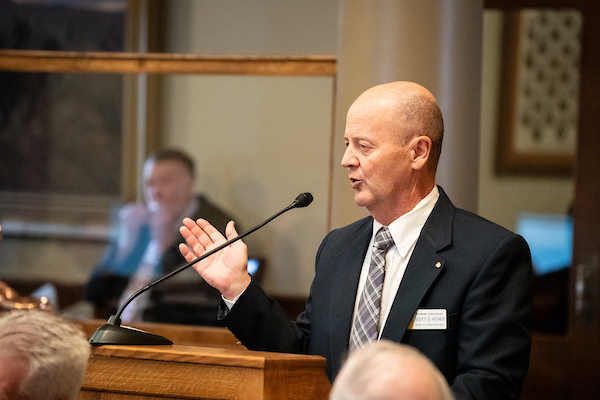
SVI Radio Interview: Rep. Scott Heiner (R-HD18) – School Recalibration

Representative Scott Heiner (R-HD18), the current House Majority Floor Leader in the Wyoming Legislature, stepped into the SVI Radio studio to share his thoughts on the school recalibration bill passed this year by the legislature.
Heiner, who serves as Chairman of the Select Committee on School Finance Recalibration, provided the following links to view the bill directly from the legislature’s website.
K-12 Education Resource Block Grant Model Comparisons – click here.
Detailed spreadsheet outlining the Wyoming Funding Model – click here.
(0:00) Weekday wake up on SVI radio swift 98 and the spurn a chance to catch up with representative scott heiner house district 18 (0:07) Representative heiner, of course is the chairman of the house minerals business and economic development committee (0:12) He’s also chairman of the select committee on school finance recalibration (0:16) which of course is (0:16) The reason we wanted to have representative heiner on the air today to talk about the the recal bill and the school’s representative (0:22) Good morning. Appreciate your time in studio today top of the morning duke appreciate for the opportunity of being here. Absolutely (0:28) Now I know that uh that you and senator pearson and others have been spending a lot of time in the communities (0:33) Inside your district over the last few months, uh, and including in lincoln county talking about this with with (0:39) Constituents and schools and what’s been the overall? (0:43) Um kind of consensus or questions and and what have you gotten from those meetings? (0:47) Duke, I appreciate this opportunity to come on the radio program to clear up some misconceptions about the educational recalibration bill (0:54) So that’s that’s what i’d like to do this morning (0:57) Let’s talk a little bit about that and and i’m going to take some of the information that i’m presenting right off the web page (1:03) so people and and hopefully when you publish this on your one on your web page you can (1:09) Provide the links for people to actually go and see the numbers for themselves (1:14) So that these they see that these numbers are actually coming from the state web page (1:18) And that web page being the the legislature’s web page (1:22) Yes, okay.
All right, and i’ll show you how to drill down and and provide a link for that. Perfect (1:27) Okay, so let’s talk about uh where things stand with this recal bill and what would you like to touch on so this recal? (1:35) Provided the biggest infusion of public money into public education in the history of wyoming (1:40) this increased the uh amount of money going to public education by (1:45) 248 million dollars per biennium biggest increase ever and most of that went to salaries and wages (1:52) So there’s been some conversation out there that we increased the the salaries for teachers by 12 percent, but we did not (2:01) Do anything for the support staff and I I want to share a page with you duke right from the web page (2:08) That shows that all staff received increases in salary and wages (2:13) And we’ll start at the top the superintendent received a 22 percent rage wage increase (2:19) the uh (2:21) computer technicians network supervisors got a seven percent raise (2:26) Principals got 12 13 percent raise assistant principals got a 22 percent raise (2:33) uh secretaries got a 24 percent raise (2:36) Library aides 25 percent raise all staff received wage increases because (2:41) the recalibration part of that was to look at the market for each one of these positions (2:47) and (2:48) Bring those people up to market condition (2:52) Now the state is going to increase funding to the districts by that amount (2:57) But of course, it’s it’s local control the local school board and school administration (3:04) Will then decide whether to use that money for salary increases or for something else that’s local control (3:09) And that’s not within the purview of the legislature (3:13) but (3:14) of that (3:16) dramatic increase in funding (3:18) Here in lincoln county number two (3:20) Lincoln county number two will receive six and a half million more than they did (3:25) last year (3:27) It’s 11 increase in overall money for funding here in in this school district. Okay (3:33) Now (3:34) Explain to us this the silo because that’s something that a lot of the uh, the local school leaders have talked about (3:40) And they they brought up this silo concept and that’s from what they’ve shared with us previously (3:46) Has been one of the concerns with the local control that you’ve talked about and and the ability to use these funds (3:52) So so give us your thoughts on the silo (3:54) so duke (3:55) the (3:56) This funding model creates an amount of money that’s given to each school district based on their demographics (4:02) And that comes in a bucket and we call it a bucket of cash that local control decides how to spend it (4:08) So let’s say it’s a five gallon bucket (4:11) We took a court of that and put it into a silo to protect the teachers (4:16) We have heard for years as a legislature that our teachers are not fairly compensated (4:21) And that we are not able to hire and retain teachers and we’ve tried to (4:26) Improve that by raising the salary (4:29) Uh, the amount of money we give to teachers (4:31) We we increased that by eight and a half percent last year two years previous to that.
We did a three and a half percent raise (4:38) but (4:39) For most of the state those raises are not actually getting to the teachers and we’re continuing to hear that story (4:45) So as a legislature, we thought we not only need to take care of our teachers today (4:49) But for another 10 years down the road (4:52) How do we do that? (4:53) Well, let’s put a silo around the classroom so that teachers (4:57) tutors (4:59) paraprofessionals (5:00) The the money allocated for the classroom for salaries has to stay in the classroom (5:05) So when the in the future when the legislature (5:08) Gives a raise to the teachers. It has to go to the teachers. So that silo means that money that’s that’s (5:15) Designed to go to to those teachers stays there (5:19) But it doesn’t mean that the school district can’t put more money in there (5:23) And it also (5:24) Allows flexibility in the classroom.
They can hire more teachers and less tutors or they can hire more paraprofessionals (5:31) They can do that that (5:33) That court that I talked about of money (5:36) They still have the flexibility within the classroom (5:39) To employ more teachers or less teachers (5:42) That’s up to the school district, but they just can’t take that money out of that silo and use it for some other purpose (5:48) Now, okay, and so within that silo (5:51) They can use it for more than just teachers (5:53) It’s I mean the silo includes the other staff that you were mentioning earlier on so it includes teachers tutors instructional aides (5:59) paraprofessionals (6:01) Yes, everything within the classroom protects that and and within the this recalibration bill. We are increasing the number of tutors (6:09) In the past when I went to school the the mode was to have one teacher in front of 25 students (6:15) one adult in the classroom (6:17) That’s 1950 1960 mode of education (6:21) And all the data shows that that doesn’t work anymore. You need multiple adults in a classroom (6:27) So this new funding model provides for two to three adults in each classroom (6:34) It to provide effective learning atmosphere, but also to protect the teacher now now you lower the risk (6:40) And liability of a teacher an adult all by themselves (6:44) In front of a group of students that they may be accused of something that really didn’t happen (6:49) But now by having too deep leadership or multiple adults you protect them (6:54) so there’s additional things there, but but now if with a (6:58) Tutor right in the classroom if you have one one or two students that are not grasping the concept (7:04) That tutor is right there to work with that individual one-on-one and the definition of a tutor is a certified teacher (7:13) Paid at the same salary as a teacher (7:15) So now you have a teacher and a tutor they’re they’re both certified teachers (7:19) But one is to work as a tutor with individuals and the the teacher leads the class (7:26) Representative scott heiner on in studio today for the weekday wake up talking about this recalibration bill (7:31) Anything else with the silo concept that you’d like to touch on representative? No, let’s let’s go on to some other things (7:38) duke (7:39) We expanded the the career and technical education (7:42) We increased the number of teachers in that by a factor of 33 (7:47) We’re hearing (7:49) our industry (7:50) Our parents saying they want more emphasis on career and technical education for our kids.
So we not only increase the amount of (7:59) teachers (8:00) We increased we doubled the amount of money for supplies and (8:05) Equipment and we also put eight million dollars into the university of wyoming to update their cte their their career and technical (8:13) uh college (8:14) So that they can attract more more people that want to go into that (8:19) profession (8:20) So we also increased uh middle school specialists and elective teachers by by a factor of 50 (8:27) 50 so we’re trying to provide more options there and (8:33) We also (8:35) increased dual enrollment a dual enrollment duke is when (8:37) A high school student wants to take a college course while they’re still in high school (8:43) So through the outreach here, they could take a college course and get college credit (8:47) And we provided 10 million dollars per year in grants to pay for that (8:52) So a high school student can take college courses at no cost to them (8:56) so that gives them a jump start jump start on their higher education and makes it so that they can pursue a (9:03) Career faster and get their college degree degree faster. Okay, and (9:08) Are you just that’s something that’s going out statewide then because because a lot of schools I know specifically star valley high schools (9:15) working on a great program in place now through (9:19) Their education foundation and some things like that. So this would be (9:22) Obviously then in addition to that in that situation then right? Yes, this is a grant through the whole state (9:28) So the schools if a if a high school student wants to take a college course (9:33) Then the high school administration will receive a reimbursement for that grant (9:38) Okay representative scott heiner in studio, uh representative.
What else would you like to touch on? (9:44) So there’s been a lot of discussion about activities duke (9:47) Activities we changed the formula for that instead of a school-based enrollment the way it used to be (9:53) It was based on the number of of students within a school. It was changed to a district enrollment (10:00) And and we added a little bit of money to activities. We didn’t cut any funding for activities (10:06) you see out there that (10:08) It’s being advertised that activity funding was was cut by three million dollars (10:13) That was actually because of declining enrollment not because we cut funding (10:17) the state has (10:19) We’re going through a transition where we’re we have declining enrollment and activities are funded on a per (10:25) Student basis.
So you have less students you have less funding (10:29) We actually increased the funding for activities with this recalibration bill (10:34) Now the only problem the problem we have is that by going from a school base to a district base (10:41) It hurts some five small schools cokeville (10:45) Being one of them farce and eden being another (10:48) k through 12 schools like like cokeville (10:52) That are attached to a larger school district like lincoln county number two their funding got (10:58) Got hit hard with this new calculation (11:01) That is an oversight. That was an unintended consequence (11:05) And we are going to fix that (11:07) but we need to be able to do that and so what i’m encouraging school districts and and (11:13) School (11:15) Council to do is don’t cut any programs. Let us fix the problem (11:20) Don’t cut some of these athletic programs that are out there.
They’re good programs the legislature never intended to cut funding for activities (11:29) so (11:30) We will are we will go into our next recalibration committee meeting (11:35) In june and this is on the agenda. I put it on the agenda for june 25th, and it’s over in lander (11:40) We will talk about activities the funding for activities and what we can do to rectify this situation (11:47) duke, whenever we pass (11:48) Legislation that is big and is all encompassing as the school education recalibration bill (11:54) There’s some unintended (11:57) Unintended consequences that sometimes you have to come back and fix (12:00) This is the one one of those areas that we made a mistake and we’re going to fix it. Okay (12:05) Uh, and so we’ll (12:06) See you mentioned that’s in june is when the committee meets in june 24th and 25th (12:11) And we’ll see what comes out of that on the 25th.
We’ve got the afternoon slated for activities discussion (12:16) Okay representative scott heider in studio. So, uh, the activities piece of that was was a big. Um, (12:23) Obviously you mentioned a lot of discussion going on that.
So it’s one of my big questions (12:27) Um, and in regards to that, I know cokeville, for example, you mentioned them (12:32) They’re thinking that the district is going to for the next school year dip into savings to help (12:37) uh (12:39) Fund through the next school year while that portion of the bill is fixed (12:42) Do you see a reimbursement to school districts on that when they have to dip into savings to for that correction? (12:48) That’s part of the discussion. We will have duke (12:50) Okay, I can’t speak for 93 legislators, but we can we can sure talk about doing a retroactive reimbursement (12:57) We can make it effective immediately when the governor signs it (13:00) But to go backwards that we can try but i’ve got to get 93 legislators to agree to that. Gotcha (13:06) Representative heiner another discussion that’s come up over the last few weeks (13:10) Alternative schools and and funding and it sounds like there may in this bill (13:14) Included a little a few changes for alternative school funding such as swift creek high school.
And yeah frontier high school in kemmer (13:21) Would you like to touch on that? (13:23) So those alternative high schools are doing great and I hear a lot of good things coming out of the swift creek high school here (13:29) We’ve got others frontier and kemmer and they’re throughout the state and they do a great service for our students (13:37) So the silo that we created actually benefits them because there’s still that flexibility (13:43) Within the silo to move teachers around and increase adults in the classroom (13:49) But that money has to stay in the classroom. So now the school board can decide. Okay (13:55) Here’s swift creek we want to put more more adults there (13:59) Than somewhere else and so they can move it there and and and with the actual funding and the increases in funding (14:06) They will be able to hire more people than what they have today (14:10) And have more adults in there now, will they be teachers? That’s up to the school board to decide (14:15) Will they be tutors that’s up to the school board to decide but the money is there for more adults (14:21) Representative scott heiner this morning on the weekday wake up.
Uh, appreciate you touching on these items representative anything else on this recalibration bill (14:28) You’d like to mention today. I would just like to (14:30) To end duke that we’re trying to do what is best for the for the whole state (14:36) We’re trying the recalibration hasn’t happened for 15 years. I’m not going to make excuses for that but because (14:43) wyoming statute and the wyoming supreme court (14:47) Mandates that this happened every five years and it has not happened for 15 years.
We’re trying to pay play catch up (14:54) We’re trying to do what should have been doing before I was in the legislature (14:59) Now we have infused (15:01) a lot of money into school (15:04) public schools the biggest (15:06) The biggest amount ever in the history of wyoming (15:09) And we’re bringing those wages up to where they should be we fell behind (15:14) With our wages we recognize that because this recalibration wasn’t done (15:19) We’re trying to rectify that we’re trying to keep our schools strong and our education strong so that our our students can (15:26) Can have a good career and have the education they need to be able to compete in a world environment right now (15:32) and uh, you know, we (15:34) We’re trying to do what’s right. Sometimes we make a mistake. I will own up to those mistakes and we’ll try to fix them (15:40) It’s representative scott heiner this morning house district 18 talking recalibration bill.
It’s all part of the weekday wake up on sbi radio


2 COMMENTS
Comments are closed.