
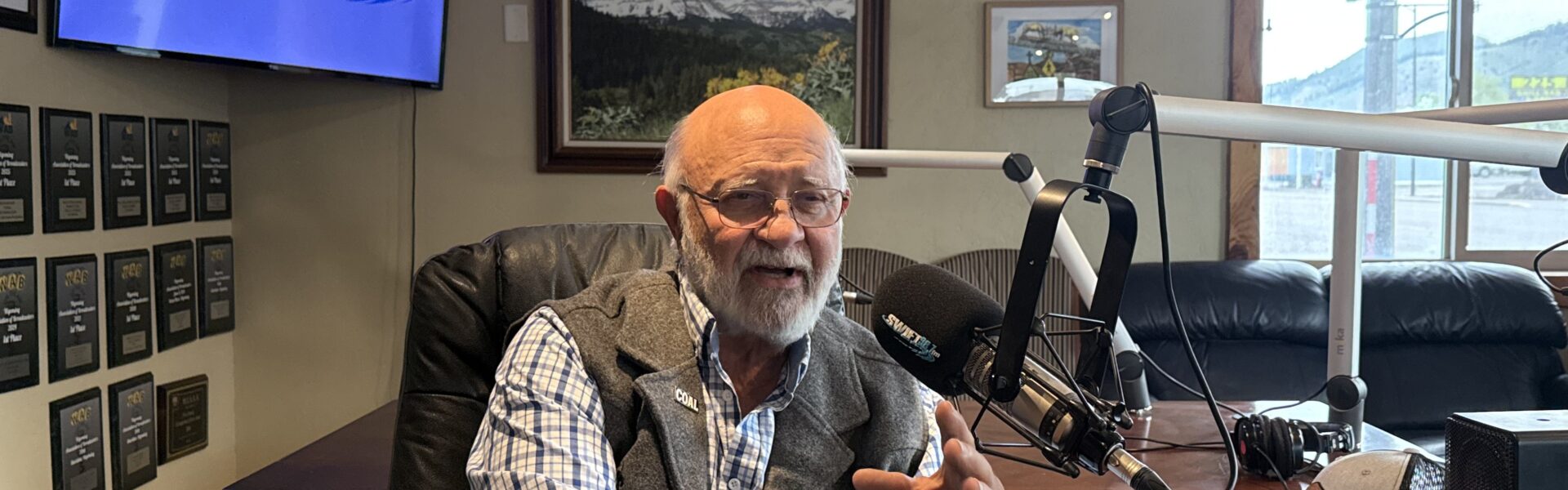
SVI Radio Interview: Lincoln County Commissioner Kent Connelly

Lincoln County Commissioner Kent Connelly stepped into the SVI Radio studio on Monday, June 1 for the monthly report from the commission. Chairman Connelly discussed the recent 2-1 vote to deny the creation of an EMS tax district in Star Valley and a revised proposal for the Lincoln Star Improvement Service District.
(0:00) Heading into this hour’s guest interview segment and chairman of the Lincoln County Commission, (0:05) that’s Commissioner Kent Conley in studio today. Commissioner, good morning. Usually we get you (0:10) over the phone, but just worked out you happen to be in Star Valley today, so thanks for stopping by.
(0:15) Morning, Duke. It’s one of those days when I plan meeting, got five meetings up here today (0:19) trying to chase some stuff, other things coming up on the agenda. So nice day to drive up.
Looks (0:23) like you finally got some rain like we did. A little bit. Yes, we did.
Much needed, of course. (0:28) Well, of course, there’s always plenty we can talk about what’s happening in Lincoln County. (0:32) Most recently, the two to one vote to not approve the proposed tax district, the EMS tax district (0:39) in Star Valley.
Walk us through. You were one of the two no votes along with Commissioner Shumway. (0:43) Walk us through your decision there.
Exactly. The EMS district was brought to us by (0:49) the Star Valley Health. It was not something the commissioners come up with.
(0:54) And so when they brought it to us, there was four or five people who gave presentations and said (0:57) they were utilizing the new law, which was put in, I think, three, four, maybe even five years (1:02) ago for ambulance districts, which was pretty much geared for smaller counties with smaller (1:09) mill levies and stuff like that. Doesn’t matter. It applies to the whole state.
(1:13) And the request to us was that we vote two types of requests that we voted in. We could have put (1:19) a two mill one on by three votes by the county commissioners. And then we appoint the board.
(1:23) We chose not to do that option. And then on top of the two mills of commissioners could (1:28) have the authority to put on, you can add a two mills that the voters vote on. (1:35) We had before us in the final decision making process, the hospital said the ambulance was (1:41) costing two point five million dollars.
And for a transparency thing, we got a lot of input from (1:46) people saying you need to do an audit on them. You need to do this and that. The hospital was (1:50) totally transparent with us.
We saw their books. We saw the numbers, saw what they are. And I’m (1:55) very well versed in this going back into fire districts and stuff and ambulances for a long (1:59) time.
This is a long time issue, not just here, not just in southern Lincoln County, in different (2:05) parts of the state. And that mill levy that they were wanting was basically in order to cover the (2:10) two point five, what you would need to go to four mills, which you would have under the authority (2:15) of that law to do. But we would appoint the board then that would decide what to bring to the deal, (2:21) appointing a board in this commissioner’s opinion.
And it was reflective in our discussions. (2:27) I shouldn’t be appointing your boards have that authority to do in some cases in this one, (2:32) that board would have been put in place for ever in the district. And we would be appointing them, (2:38) not the local people that that board would answer to.
And so the local people should have that right (2:43) to vote in that board. One of the key things in my discussions and going back and forth and why I (2:48) voted no. And four mills is one more mill than what the hospital gets.
And so in total money, (2:56) and there’s a basic question to ask here, do we need to create another district for what districts (3:02) that exist could already handle? In most places, ambulances are either with the fire district or (3:07) with hospitals. So creating another district, possibility of them asking for four mills, (3:13) or whatever mills, it was going to create another district with a new tax, which would raise your (3:17) taxes. I have not, we had very little input on this.
We had the people brought it to us. And then (3:23) in the, what do you call it? The period when I lost the comment period, yeah, comment period, (3:30) thanks, sir. And the comment period that took place, we received 22 comments.
13 of them were (3:37) against and nine were yes. That’s, and then you take the eight other people in there, that’s 30 (3:42) people or less that are talking to us about an issue that affects 15,000 people. That was very (3:49) disappointing to all three commissioners.
And so based on that input, and the best example I can (3:56) give you even this morning, as I come to Star Valley, I talked to four or five people this (3:59) morning, and I talked about this and many other subjects in there on it. They, at the end of the (4:05) day, when I asked them, if we put this in place and it comes before you as a vote, how will you (4:09) vote? I probably talked to a hundred people that said, no, I will not vote for it. So I had more (4:15) people on the side tell me, no, they wouldn’t vote for it.
Even if we created, if we created (4:20) it and the voters voted, no, that would be a district that existed with a board with no money. (4:25) And there’s also a part of this discussion that’s very important. The current contract, (4:30) I believe with Star Valley Health expires November 1st.
You’re not going to vote until the November (4:34) election on the subject. Plus then if you voted yes, you don’t start collecting money until next (4:39) year. So you’re going to try to start a district in the middle of being almost discussing what (4:45) should have been discussed to begin with, is how do you form this thing? And as a commissioner, (4:52) I was part of the systems when we created Lower Valley Fire District and Thane, I mean, excuse me, (4:59) Alpine.
I was very vocal about it then, and this stands to be the same way. That belongs to (5:05) come from the people in a regular petition so that when you take it to you, the voters, you get to (5:10) decide, plus you get to decide on who your board that represents you. Because this district would (5:16) have been just for Star Valley.
Kemmerer down there, the hospital down there did not wish to (5:20) participate this way. And so when I voted no, and of course Mel voted no too, not an easy decision. (5:27) Absolute respect for the people that run the ambulances.
Do we need a system? Yes, we need (5:32) a system. We were in the midst of a time when raising taxes and creating more districts is (5:38) what’s becoming a byline in this state, given what the state legislature is doing. I’ve got four or (5:44) five other requests for different types of districts, and I’ve got districts, the people (5:48) of Lincoln County as a whole were very conservative on their districts.
They control them in the (5:54) boards. We had nine districts that were not taking the full mill. My estimation is this year when we (6:00) get all the input from them on it, all of them are going to raise their mills based on the 25% (6:05) loss.
And so you’re in a time when people are trying to figure out how to create districts (6:10) to do different things. And we’ll talk even in five county commissioners in the discussions that (6:15) are going on. So at the end of the day, when I made my decision on it, I could not live with (6:21) that idea that I would be appointing a board that represented you up here in Star Valley, (6:26) when you should be putting that board into place.
So Commissioner, what’s next here? Because this (6:31) isn’t, this is going to continue to be a discussion. You mentioned Southern Lincoln County as well. (6:36) They also need funding for EMS services.
And so what do you think happens now? What’s the next (6:41) step here? I don’t know. But I’ve heard that they’re going to have a meeting with the hospital (6:45) in there. But like I said, that void period when if you voted it in, you’d have still had to have (6:49) that discussion.
How are you going to make it till the time you receive the money? Because the money (6:53) just doesn’t flow in and you only get a monthly payment. So you’re really going to have to figure (6:57) out how to operate for six months, even if it did pass. And it’s not going to be easy.
There had to (7:03) be something. The hospital said they would take care of it and handle the whole setup. Way too (7:08) many questions unanswered how you make that transitions from basically three full-time EMT (7:12) systems up here into where you are presently now.
Kemmerer’s just the same way. It is no different (7:19) down through there. This is not an issue that’s going to go away.
Emergency services aren’t going (7:25) to go away. Search and rescues fall into the same thing. How do you keep them funded? We do not get (7:31) money from the state legislature for EMS.
We do not get it for search and rescue. We do not get (7:36) it for hospitals. We don’t get it for fire districts.
We don’t get it for cemetery districts. (7:41) We don’t get it. We have a set amount of money we were given for specific things in the 12 mills.
(7:46) We have 27 districts in Lincoln County, one of the higher numbers. And that’s a burden for us in how (7:52) we handle things. Plus inside of them, we had 39 other requests outside of districts in this latest (7:58) budget in through there.
And from all different things, your social services in the cutbacks get (8:03) hit the hardest. And we have high demands. I’ve got senior centers that are struggling to maintain (8:08) themselves right now.
We’ve got a lot of struggles going on. And so in the future, I’ve said this (8:15) before, that voters need to decide the direction how you’re going to go. I’ve been told no growth (8:20) in government.
If you go to five county commissioners, that’s going to be growth in (8:23) government. If you go to more districts, that’s going to be growth in government. You already (8:27) have districts in place that I believe can handle what’s going on right now.
Do they have to have (8:32) serious hardcore discussions sitting down with one another? Yes, they do. And it’s just not here. (8:37) This is a statewide issue.
There’s a lot of money comes into Wyoming. This state has $158 billion (8:43) reserve with $1.8 billion in interest they made last year. But it’s the taxation districts in (8:51) between here that are taking all the hits in there as we pay for everything locally.
(8:55) Something’s got to change in that scenario. We need infrastructure in Wyoming. We need it (8:59) desperately.
And we need this emergency services. In the legislature this last year, when they did (9:04) the cuts, they had discussions on backfilling some of these things. All of those things never (9:09) passed.
Nothing got backfilled. Where are they going to head? Because this is going to be an (9:14) interesting legislative session when they sit down and say, okay, what happens now? What happens (9:21) with the referendum? Will that affect this district? You could have had a district if you (9:26) voted for it and the people passed the 50% where you would only get 50% of your four mills. So you (9:33) don’t only in reality only get two mills.
That wouldn’t run it. So the issue is still would still (9:38) be there. Or at 25% you’re not going to get it.
At four mills you’re only going to get three. (9:43) So it wouldn’t have covered the 2.5. With that even factoring into this EMS district, (9:49) which it does, we’re standing back trying to prepare. We prepared for this thing by putting (9:54) away before the legislature did the 25%.
We had $800,000 the year before they did the legislation (10:01) that we set aside and we gave a tax break to the homeowners. That wasn’t enough. The (10:06) legislator’s estimation of the taxes that we would lose at 25% was 1.3 million.
It wound up (10:13) being 1.8. And so all of those factors figure in on how we’re trying to survive through this. (10:19) TerraPower won’t pack it. We’ve already lost $4 million from the coal industry down there.
We’re (10:24) actually in a recession right now. We’ve lost 400 jobs in the coal industry down in Southern Lincoln (10:30) County. But the biggest taxpayer in this county is gone.
It is now Exxon Corporation. It is not (10:35) that mine anymore. And that effect on our whole economy, I’ll say it again, we’re in a recession.
(10:41) We hate to talk about it. We don’t like to talk about it. But it’s the truth.
We are in a recession. (10:46) TerraPower, once we get it built down there and a couple other businesses, (10:49) some of the taxes will come back. We have a bright future that way.
But we don’t get to (10:54) tax these new businesses till they get the… It’s just like building a house. You build a house in (10:58) Star Valley, we can’t collect the property taxes off until you move in. It’s the same thing.
(11:03) Commissioner, from tax districts to service districts, on the same day that the EMS vote (11:09) took place, there was a public hearing for the Lincoln Star Improvement Service District, (11:14) which is a revised proposal from a previous proposal. So take us back. What is this (11:19) Lincoln Star ISD and what would the purpose be? Another type of district, like I was just (11:24) referring to.
Service districts have existed for quite a while in Wyoming. There’s a strong belief (11:30) that the legislation around them doesn’t give enough leeway to bring businesses in. And so, (11:35) most people, when you say a service district, you think of an industrial park where everything (11:40) has borders.
That’s not the way they’re all set up. In fact, the Idyllwy, for example, (11:48) for the garbage dumps in Lincoln County, is a service district. It actually spans two states (11:53) and it actually doesn’t have property that borders one another.
One of the controversies (11:57) in this one was that the properties didn’t border, which they don’t. They don’t have to. (12:01) And they actually had investors from other counties want to be in it.
And of course, (12:06) the bigger part of the ISDs is, is it another district that taxes? Can be, if it was brought (12:12) to us that way. Was not. And if you tax in it, it just taxes the people in the entity.
(12:17) So what I’m explaining here is not an easy explanation. But like I say, you already have, (12:22) well, the first one I was ever around, and that’s how I cut my teeth on this and the experiences I (12:27) had, was a swimming pool in Kemmer. I worked for FMC Corporation then, and my bosses wanted a (12:34) swimming pool in a rec center.
And so they formed an ISD down there and then put a bond issue on (12:40) the election ballot for the voters to vote. That’s how we build a swimming pool. And so that was an (12:45) ISD to do that.
And that was businesses stepping up and saying, we want in on this. And in the (12:51) same fashion of this ISD now, no ISD is created equal. No ISD is the same.
Are they hard to (12:57) figure out? And are they hard to go through? Yes, they are. But that’s what we will see when (13:01) they, we give them an extension. When we voted the other day, we were kind of split on it in (13:06) there.
We want to get this moved along. But we had a request from one of the main property owners in (13:12) it to extend it. And so that’s when Commissioner Bowers made the motion to extend it.
And so we’ve (13:17) extended it to our next meeting to make the decision. We’ll make a decision in our next (13:21) meeting on the ISD. But we need, we need incentives to bring mid-range jobs into not (13:28) just Lincoln County.
It’s desperate for Lincoln County right now. We have some big paying jobs, (13:32) and you have a lot of good private businesses like up here. But we have trouble with what you call, (13:38) you know, in between jobs.
We need, we need some businesses in Wyoming. We’ll get the tax base (13:44) back in a few years. But the big tax base, service districts, we have a lot of other companies (13:50) looking at southwestern Wyoming.
We have a lot of energy in Wyoming. But we need to make products (13:56) out of Wyoming that keep taxes at home, instead of shipping them all over the world. So this (14:01) Lincoln Star ISD, this is one that had previously been withdrawn, announced back on the table.
So (14:06) what’s what’s different between this current version and the previous? The first edition had (14:12) owners in another county. And we just sat back and let the other county decide if you wanted (14:17) to play in the sandbox. And they said no.
And so then they had to bring it back in a different (14:22) fashion, which was the property owners in there. This is a private property rights issue at the (14:27) end of the day. Do they get to develop under the rules that exist? How do they, and how they play (14:32) in there? Most of the decisions we get into, we got gravel pits right now on the table for us.
(14:38) Private property rights, they play in highly into what we do in the decision making process. (14:44) We’ll average sometimes as many as high as 20 applications coming through a month. That’s the (14:49) many, many meetings you have to go to, because that’s what I’ll be doing today is going up and (14:53) looking at these new things.
But the ISD before, like I say, when Sweetwater County said no, (14:59) they didn’t want to have it because I explained to you already, you can you could jump state (15:03) boundaries like in the Idaho. And so people’s idea, like I say, when I talk to people about it (15:09) and hear from many people on these things, was a improvement district like this is like a business (15:16) park is how they view it. Business park, everybody’s together in this business park.
(15:21) Well, in the bigger areas where they have development Cheyenne, Cheyenne uses this, (15:25) that’s how they get it. They have the better infrastructure money for the power and all the (15:28) other stuff. But Sweetwater County said no, and which took it off the table in its present form.
(15:34) And so that’s when they had to come back with a different form, which they did come back this time. (15:38) And so that’s that was the major difference. There has been concern over some of the landowners (15:43) involved.
Is that a concern for you? You mentioned one of the landowners asking for an extension. (15:48) That was Brad Barnum with TriSite. He’s one of the owners.
Is there concern for you? (15:53) You always take a look at, you know, where the applications come in. So yes, we try to (15:57) do the best vetting we want. But at the end of the day, I don’t get to judge developers, (16:02) whether they’re going to succeed or fail.
I have to look at the application face value. (16:08) And quite frankly, it’s just like businesses anywhere in this state or in this in this valley (16:13) or Kemmer. Some businesses are going to make it some quicker than the others.
And there’s one (16:18) thing about businesses of these types that are going in there. Terra Power is going to take 10 (16:22) years. The Barnum group and other groups, we got four or five other groups down there that are (16:27) looking at development.
It takes four or five years. The Idawai, for example, that was eight (16:33) years in the making. So nothing happens quick.
Do you keep track of what those businesses are (16:37) doing in between? We do the best, but we absolutely demand that they come in and speak to us, (16:42) which that group has done more than once in going back and forth. And so do we have concerns? (16:51) We always have concerns. We try to follow it to the best of our ability.
But we also would (16:57) like to see somebody else. We’ve got to go back to big business. When they paid the bulk of the (17:02) taxes in here, we went 14 years.
And during my tenure, where we did not charge the 12 mills, (17:07) you want to give us the ability to try to cut the mills and have the flexibility of that in there. (17:12) You’ve got to bring some businesses back in different places. And they’ve got to have (17:16) a business model that basically makes work for all in what I would call the food chain, (17:22) the high paying jobs right down to the people.
We have a trouble building affordable housing, (17:27) but we don’t have affordable jobs to be able to pay for the housing we have. (17:31) That’s Chairman of the Lincoln County Commission Kent Conley this morning (17:35) on the Weekday Wake-Up. Commissioner, appreciate your time.
Thank you very much. Anything else (17:38) you’d like to mention here at the end while we got you? (17:40) Just thank you to the people. The people of Lincoln County are very resilient.
We talk about a lot of (17:46) hard subjects in between here. And we talk about a lot of money. You had an article in the paper (17:51) the other day about a sheet that said we had 50 million in there.
That was a state document, (17:57) not a, that was a, what do you call it? Anyway, that was not a county ledger. That is the money (18:05) we send to the state. We send a lot of money to the state.
Ad valorem taxes and those type of taxes (18:10) is what the state lives off of. They’re making money and putting money away and gaining interest (18:14) down there left and right because of what we send. So when you see a document that is, (18:18) read on the bottom of the document.
Is it a county document? I was told that that was a (18:22) county document. It says right on the bottom, it’s a state document. We send out, and state (18:26) document means this.
Well, for example, on property taxes, everybody thinks we get all the property (18:32) tax. No cities get a piece. But all the property taxes come in and then we split off what the (18:37) cities get off out of that.
But the total number looks like we have more. Same thing with any other (18:42) sales tax. We collect all the sales tax and then we distribute it to the cities by population, (18:48) not by our vote.
And so those numbers are going to look big is what they’re going to look because (18:53) we are all the king’s men. Some people hate me to call it that, but that’s what we do. (18:57) We collect all the tax.
Every district flows through us. Every sales tax flows through us. (19:03) Your ad valorem, the checks we send to Cheyenne are huge.
We’ve had as much as sometimes to Cheyenne (19:10) is $73 million. The present one that was in the paper had $50 million on it. That is very (19:15) reflective of what took place in that coal mine drop right there.
That’s what that number shows (19:19) you. And I have it right from the treasurer all the time when somebody asked me about this. (19:24) You’re more than welcome to come into his office because Jerry Greenfield said this to me the last (19:28) time.
There was an article in the paper said we had $53 million. He said, please send them to my (19:33) office so you can show me the $53 million because I’ll show you where it went to Cheyenne. (19:38) That’s the Lincoln County Commissioner Kent Conley this morning.
(19:41) It’s all part of the weekday wake up on the SVI Radio Network.

3 COMMENTS
Comments are closed.