SVI Radio Interview: U.S. Representative Harriet Hageman

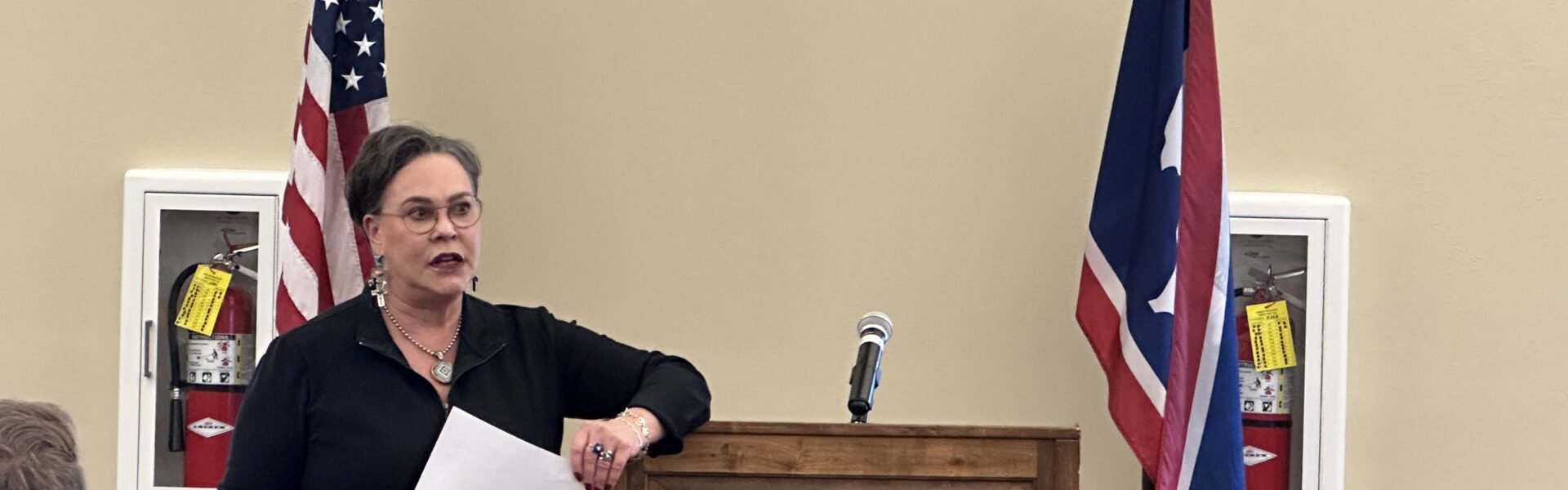
U.S. Representative Harriet Hageman called into the Weekday Wake-Up on Thursday, August 20 for her monthly report from D.C.
Congresswoman Hageman discussed results from the recent Wyoming Primary Election and her decision to move from the House to the Senate, an update on the Roadless Rule, water resources across the Rocky Mountains and a bill she has proposed that would tax private colleges and universities who allow men to compete in women’s sports.
(0:00) Heading into my guest interview today and the monthly report from (0:04) Representative U.S. (0:05) Representative Harriet Hageman joining me live over the phone this morning. (0:08) Representative, good morning. (0:09) How are you today? (0:11) I’m wonderful.
It’s good to be back with you. (0:13) Hey, thank you for your time as always. (0:15) And of course, I think we have to start with the the primary election (0:19) taking place in Wyoming and quite the convincing win for you (0:23) for the U.S. Senate seat in the Republican primary.
(0:26) So congratulations. (0:27) It’s not something we’ve talked about because it was pre-election. (0:30) But now that it’s over, let’s chat about your decision to to go from the House (0:35) to the Senate with in Congress and run for that seat left open by Lummis.
(0:42) Well, of course, yes, I had opportunities to visit with Cynthia (0:47) Lummis over a period of time. (0:48) And when she made the decision (0:50) that she was not going to run for reelection, it made sense for me (0:53) to step into that position. (0:54) As you know, I was a trial attorney for 34 years prior to going to Congress.
(1:01) Most of my work, in fact, was done in federal district court. (1:04) And I’m hoping that I would be appointed to the Judiciary Committee (1:07) on the Senate side. (1:09) I am on the Judiciary Committee on the House side right now.
(1:12) One of the obvious responsibilities of the of the Senate Judiciary (1:18) Committee is vetting judges. (1:20) And as I’ve indicated, I definitely having practiced (1:23) before many different federal courts around the United States, (1:27) I have a pretty good handle on what makes a good judge. (1:29) But I also have a good handle on what makes a bad judge.
(1:32) So that would be one of my responsibilities (1:34) if I’m fortunate enough to be elected and to be appointed to that committee. (1:38) The other thing is with the kind of work that I did, (1:40) the administrative law work that I did dealing with a variety of federal agencies. (1:45) Again, I have a pretty good understanding of what we should be (1:48) looking for in terms of qualified agency heads.
(1:52) And that is another responsibility on the Senate side (1:55) is vetting the the appointees from the presidents, (2:00) whether Democrat or Republican. (2:01) So those are just two of the many reasons as to why it made sense (2:05) for me to seek this seat. (2:06) Now, of course, going into the Senate, that leaves your House seat open.
(2:11) And the likely person now to replace you in the House would be Chuck Gray (2:15) with his Republican Party win. (2:17) And of course, still that general election coming up. (2:19) But talk to us about what what that transition would look like (2:23) now with someone taking your place in the House and how the House (2:26) and Senate work together within the Wyoming congressional delegation.
(2:30) Well, the Wyoming delegation has always gotten along very, very well. (2:33) And I work closely with John and Cynthia. (2:35) We often do companion bills on the House and Senate side (2:38) to make sure that we can perhaps push them forward a little bit more quickly.
(2:42) So that’s one of the things that we do. (2:44) We also work on behalf of the citizens of Wyoming. (2:48) There will be oftentimes where a particular municipality or county (2:52) or a company may contact both all three offices (2:56) and we will do joint delegation letters to a particular agency (2:59) asking for relief or assistance or consideration.
(3:03) So those are just some of the things that we do together. (3:06) The House and Senate are definitely different. (3:08) I think different feelings and different in the way that they operate, especially.
(3:14) I think that one of the things that I’ve learned, (3:16) because there is only one representative for the state of Wyoming, (3:20) that you that you have to be able to get along with people. (3:24) When you go back there, you’re going to there. (3:26) You’re going to be one of four hundred and thirty five people.
(3:29) And you have to if you’re going to get a bill through a committee, (3:32) especially if it’s a committee that you maybe don’t sit on, (3:34) you’re going to have to work with someone to have to help them help you (3:38) in terms of doing markups or submitting amendments to particular legislation. (3:44) So one of the things that I think is absolutely critical and would apply (3:48) to both sides, and I think it’s all something that we learn as children, (3:52) and that is that if you want somebody to work well with you and to help you, (3:56) you’re going to have to get along well with people (3:58) and you’re going to have to engage with people. (4:00) So, you know, I know that that’s a lesson that I need to take with me (4:03) to the Senate side.
(4:03) And I think that it’s just an important fact that that has been (4:08) reinforced and reinforced and reinforced as I’ve been back in Washington, D.C.. (4:12) Congresswoman Harriet Hageman with us on the weekday wake up. (4:15) Let’s get down into some of the discussions and legislation (4:18) that are taking place right now. (4:19) You and I have talked about the roadless rule.
(4:21) I know you’ve been working with Lemus and Barrasso on this as well, (4:25) along with some others around the Rocky Mountain. (4:26) Give us an update on where the roadless rule stands now (4:30) and maybe as a solution coming soon. (4:34) Yes, well, just it was just announced this week.
(4:36) Brooke Rollins has said they are going forward with a rulemaking (4:39) to undo the 2001 roadless rule. (4:42) And the roadless rule was one of the very last things (4:44) Bill Clinton did on his way out of office. (4:47) It was a fundamental rewriting of, well, not rewriting (4:51) because it was a regulation, not a statute.
(4:54) So it kind of a fundamentally fundamental violation of FLIPMA, (4:59) the Federal Land Policy Management Act, the Wilderness Act, NEPA (5:03) and the National Forest Management Act, etc. (5:05) The way that we have historically managed our national forest. (5:08) And keep in mind, there’s one hundred ninety two million acres (5:11) of National Forest Service lands in the United States.
(5:13) The way that we have historically managed them under FLIPMA is that (5:18) they are done on individual forest management plans basis. (5:21) So the Shoshone National Forest, the Bighorn National Forest, (5:25) Ralph, Medicine Bow, etc., they all have management plans in place. (5:29) And those management plans lay out everything from how many cattle (5:32) they’re going to graze, what areas are going to be logged (5:35) and what areas should remain roadless.
(5:37) But with the Clinton administration, they came in, (5:40) they threw that all out the window and they identified fifty (5:43) eight point five million acres of National Forest Service lands (5:46) that they were going to actually treat in a more restrictive manner (5:49) than even then than is wilderness areas. (5:53) And wilderness areas are supposed to be the most restrictive. (5:55) But that was done by Congress and this was done by rulemaking.
(5:59) So eventually I sued on behalf of the state of Wyoming (6:02) and we were successful in getting a nationwide injunction. (6:05) But then the subsequent administration didn’t defend that decision on appeal. (6:09) And so ultimately we did not preserve that that win.
(6:13) But what we’re trying to do, what I’ve tried to do legislatively (6:16) and what Brooke Rollins, the secretary, is doing is repealing (6:19) what is an unlawful rule. (6:21) And the thing is that nine of the ten most catastrophic forest fires (6:25) that have occurred on our national forest have occurred (6:27) since the roadless rule went into effect, which was something (6:30) that we predicted was going to happen way back when. (6:33) That was one of the reasons that the state of Wyoming was so adamantly opposed (6:36) to this, because we knew what it was going to do to our national forest.
(6:40) And in fact, those catastrophes have been borne out. (6:43) So the purpose of this is to go back to what Congress actually intended (6:48) when they adopted FLPA, the National Forest Management Act, (6:51) and allow these lands to be managed on an individual by individual basis, (6:56) which is what they should be by the experts on the ground (7:00) who understand each of these individual national forests. (7:03) Congresswoman, what’s your response to those who say (7:05) are saying that the roadless rule helps protect the hunting (7:09) and fishing and tourism destinations in Wyoming? (7:12) Well, in fact, that’s exactly the opposite of what it does.
(7:15) It’s denied access to 58.5 million acres of National Forest Service lands. (7:21) So it really has done exactly the opposite. (7:24) The forest there, the roadless rule has been devastating (7:27) in terms of providing access for hunting and recreation (7:30) and those sorts of things.
(7:32) And it’s also substantially hindered our ability to do (7:35) what we want to actually manage the national forest the way we need to (7:40) in the way that they were intended by the 1897 Organic Act. (7:43) So it comes down to that the forests were set up for timber production. (7:48) And yet we are not allowed to do that because of the roadless rule (7:53) in a full one third of our national forest.
(7:56) So, in fact, it doesn’t provide better access. (7:59) It restricts access and limits people’s ability to use these resources (8:04) and access these resources. (8:05) United States Representative Harriet Hageman with us on the weekday (8:08) wake up this morning.
(8:09) Representative, let’s switch gears, but kind of still stick (8:11) with some of these natural resources. (8:13) Water becomes more and more of a hot topic with the drought (8:17) ongoing across the West and the Colorado River (8:20) and what to do with with reservoirs like Lake Mead and Lake Powell (8:24) and how much water should be drained from other reservoirs, (8:27) including from in Wyoming. (8:29) Give us an update on what’s happening in D.C. (8:31) to kind of control this and make sure everybody gets what they need.
(8:34) So the various basin states, Wyoming, Colorado, Utah, (8:38) New Mexico are the upper basin states. (8:41) Arizona, Nevada and California are the lower basin states. (8:44) This is based upon a compact that was agreed upon and approved by Congress in 1922.
(8:50) Yes, we’ve been having a severe drought, especially this year, (8:53) and it has affected the the amount of water that is stored in those (8:57) in the reservoirs, Lake Powell, Lake Mead, Flaming Gorge. (9:01) You know, drought in the West is cyclical. (9:04) You can go back to the 1930s, the 1950s, the 1990s, (9:08) and you can see that drought in this part of the world is very cyclical (9:11) and it’s something that’s expected.
(9:13) It’s why we construct things such as these reservoirs. (9:16) And that’s why our forefathers did it. (9:18) But one of the things that California has really failed to do (9:22) is they failed to build the infrastructure (9:23) that they need to meet the water demand of their citizens.
(9:26) And what I mean by that is that today, (9:30) California has essentially the same water infrastructure in place (9:33) with 40 million people as they had in the 1960s with 16 million people. (9:38) They have failed to build the infrastructure that they need. (9:41) They won’t build reservoirs and dams.
(9:42) They won’t go the desal rate way. (9:46) They just simply continue to dry up irrigated agriculture, (9:50) get rid of their dairies, misappropriate their assets. (9:55) And California and Arizona are really part of the of the problem (9:58) of not building the infrastructure that they need.
(10:02) And we’re all suffering the consequences of that. (10:04) So over the last several years, the various states and states (10:07) have been attempting to reach an agreement as to how to operate (10:10) the entire river system. (10:13) Those talks have to this point failed.
(10:16) I think that many of the states are willing to work together to get this done. (10:21) I think Arizona seems to be somewhat of a sticking point right now. (10:25) So we’ll see what what can happen there.
(10:27) But it seems to be appears to be that the Department of Interior (10:30) may very well step in and basically impose (10:34) an operational scheme on the states. (10:37) It has been released. (10:38) It’s I have not read it, but it is my understanding (10:40) that Wyoming does pretty well in it, that Wyoming is is is going to be OK with it.
(10:46) I know Arizona is claiming is complaining. (10:49) But again, those lower basin states are going to have to build infrastructure. (10:52) But the radical environmentalists won’t let them do it.
(10:55) But that’s not our problem. (10:56) They’re it is their problem and they need to fix it. (10:59) They need to address this.
(11:01) Congresswoman, let’s touch on a bill that you proposed (11:04) that would tax colleges who allow men to compete in women’s sports. (11:08) Tell us about the details in this in this bill. (11:11) Well, you know, I’ve said this, and if anybody has watched (11:14) any of our Judiciary Committee hearings where we have debated some of these bills, (11:18) I think that they will understand that I am adamantly opposed (11:21) to allowing men and boys to compete in women’s sports and to invade (11:25) their private areas.
(11:26) I don’t know why we’re having this discussion in twenty twenty six. (11:29) I think everybody understands that there are physiological differences (11:33) between men and women and that it is unfair to compromise women’s sports (11:37) so that someone who is a mentally ill man or someone who just wants to cheat (11:42) is able to participate in sports. (11:44) And it’s just that simple.
(11:45) But we continue to have universities that despite all of the evidence, (11:49) despite the public outcry, despite the fact that they are treating women (11:52) absolutely horrifically, they insist upon allowing men and boys (11:57) to compete in girls sports and to invade their private spaces, (12:00) such as as locker rooms. (12:01) So I’ve introduced a bill and it is directed at private colleges (12:05) because of some federal federalism issues. (12:08) But what it would do is for these universities and colleges (12:11) that allow boys and men to compete against women or invade their spaces, (12:16) there is going to be an excise tax imposed against them.
(12:19) We’ve got to find a way to get back to common sense (12:22) and to protect our girls and women. (12:24) Congresswoman Harriet Hageman on the weekday wake up, (12:26) as always, appreciate your time. (12:27) Anything else you’d like to mention while we have you on the air today? (12:30) No, but it’s always wonderful to be on your program.
(12:32) Thank you for all your good work. (12:34) Absolutely. (12:34) That’s Congresswoman Harriet Hageman this morning.
(12:36) It is the weekday wake up on SVI Radio.