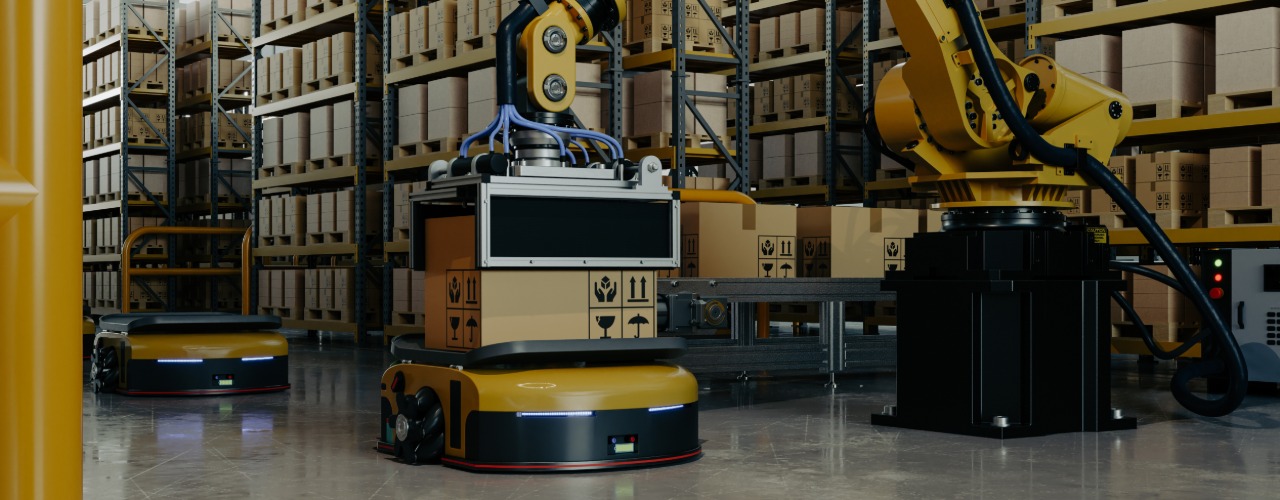

Warehouse floors move inventory through a sequence of connected tasks. Products enter receiving areas before they travel into storage, and orders move through picking and shipping as teams prepare goods before departure.
While manual labor is essential, repetitive transport and positioning tasks place steady demands on workers throughout a shift. Modern warehouse automation equipment takes over selected movements, so employees focus on work that involves their close attention. Find out which machines streamline repetitive tasks.
Conveyor Systems
Conveyor systems move cartons and pallets along a fixed path throughout a facility, and they create a continuous flow that connects different work areas. Belt conveyors use a continuous surface to carry products from one point to another. Additionally, roller conveyors move items across rotating cylinders positioned beneath each load. These designs work together to support steady and predictable movement across longer distances.
Powered conveyors rely on motors to regulate product flow through receiving and fulfillment zones. Control systems coordinate this movement by starting and stopping the line based on activity at downstream stations, which keeps operations aligned across each stage of handling. Some conveyor setups use pneumatic stops or pushers to hold and release products during movement. In these compact assemblies, round body cylinders improve automation systems by supporting repeatable linear motion in tight equipment spaces.
Reduced lifting and carrying between workstations maintain a consistent flow of products. This coordination supports the next stage of automation and limits unnecessary handling throughout the facility.
Sortation Systems
Sortation systems separate products according to their assigned destination, and they rely on order data to guide each item through the correct path. As products move along the conveyor, the system reads this information and determines where each item must go next.
Once the system identifies the destination, it activates a sorter at the precise point along the route. Mechanical diverters then push items away from the main conveyor and guide them into the correct lane. In other designs, angled rollers or shifting surfaces redirect packages smoothly toward their assigned exit.
This coordinated process keeps high-volume operations moving efficiently. Instead of requiring workers to make routing decisions at every junction, the system handles those choices automatically. As a result, packages flow more consistently toward packing or shipping areas, and employees complete tasks that require ample oversight.
Automated Guided Vehicles
Warehouses rely on automated guided vehicles (AGVs) to transport pallets or containers between pickup and drop-off points. These predictable travel patterns work especially well in facilities with stable layouts where material flow rarely changes.
An AGV travels along a physical or virtual path that guides its movement through the facility. The system directs the vehicle from one destination to the next, and it follows that route with precision. When an obstacle appears in its path, the vehicle stops and waits until the route is clear.
AGVs reduce the need for employees to drive or carry items around the facility, streamlining routine transport tasks. The vehicles perform best in operations where materials follow the same route each shift.
Autonomous Mobile Robots
Autonomous mobile robots (AMRs) transport goods by calculating their routes during operation. Unlike AGVs that follow fixed paths, AMRs rely on onboard computing to determine the most efficient way to reach each destination. They’re suitable for environments with shifting traffic patterns because of their adaptability.
An AMR receives pickup and drop-off instructions through its software, then immediately begins evaluating possible paths as it moves. When an obstacle appears, the robot quickly adjusts its route. Real-time adjustments support fast-paced warehouse operations.
Automated Storage and Retrieval Systems
Automated storage and retrieval systems manage inventory by placing items into designated storage locations and retrieving them when warehouse software issues a request. This coordinated process allows facilities to automate movement within high-density storage environments while maintaining accurate inventory control.
The combination of storage racks and automated machinery operates together to move goods efficiently. Cranes or shuttles transport loads to specific positions based on software instructions, ensuring each item reaches the correct location without manual handling. In some configurations, conveyors connect storage areas with nearby workstations to streamline the flow of materials. By automating both storage and retrieval, these systems reduce the need for employees to travel through storage aisles.
Warehouse Sensors
The ability to detect objects and conditions throughout automated processes is extremely valuable to warehouse operations. The sensors translate the collected information into real-time signals for equipment control. As a result, the systems are able to decide when to continue, pause, or adjust a programmed action. There are numerous types of sensors used across warehouse environments.
- Photoelectric sensors use light beams to identify when an object enters a defined area.
- Proximity devices detect nearby items through specialized sensing technology suited to various applications, such as detecting metal components in automated machinery and verifying bin positioning.
- Distance sensors track position changes during machine movement and send that data directly to automated controls.
Together, these sensing technologies create a continuous feedback loop that improves timing across equipment. Conveyors rely on sensor input to release cartons at the right moment, and robotic systems use confirmation signals to verify that products reach the correct position before they move to the next step. Coordinated efforts allow separate machines to work as a unified system and maintain a smooth, efficient flow of materials.
Robotic Picking Systems
Warehouses apply robotic picking systems to complete repeatable handling tasks within order fulfillment or palletizing operations. The machinery uses programmed machines to grasp and move individual products. The robotic arms perform the physical movement between defined positions.
A picking robot uses an end effector to contact the product. Vision systems or sensors identify the item and guide positioning in suitable applications. Software directs the arm through each motion before the robot places the product at its destination.
Robotic picking transfers repetitive handling away from employees during suitable tasks. The equipment delivers consistent motion across repeated cycles and works alongside other automated systems. Warehouses use robotic arms at selected stages where product shape or packaging supports reliable gripping.
Streamline Warehouse Operations With Automated Technology
From conveyor belts to storage systems, there are several types of warehouse automation equipment that streamline workflows. Warehouse automation works best when each machine serves a defined operational purpose. When these systems work together, they create a coordinated operation that improves speed and accuracy.